

A Warm Home Built on a Cold Peace: Three Blueprints for
Peaceful Coexistence

Jeeman Han, Ph.D.
Research Professor, Ewha Institute of Unification Studies (EIUS), Ewha Womans University
The Korean Peninsula is entering a period of increasingly hostile confrontation, marked by an intensifying arms race. What began as a buildup of military capabilities at sea has now extended to the land border, further heightening the risk of confrontation. North Korea completed tests of submarine-launched ballistic missiles (SLBMs) as early as 2016. On September 6, 2023, it launched the Hero Kim Gunok-ho, which Pyongyang described as a tactical nuclear attack submarine.
North Korea has also pursued underwater nuclear strike capabilities. In March and April 2023, it publicly conducted a series of tests of the Haeil nuclear torpedo, which it characterized as an underwater strategic nuclear weapons system. These tests appeared to signal a strategy aimed at threatening South Korea’s coastal industrial centers and rear-area infrastructure. The unveiling of an 8,700-metric-ton nuclear-powered strategic guided-missile submarine, reported in Rodong Sinmun on December 25, 2025, further suggests that North Korea is accelerating efforts to establish a strategic strike capability through its submarine fleet, regardless of the platform’s actual operational performance.
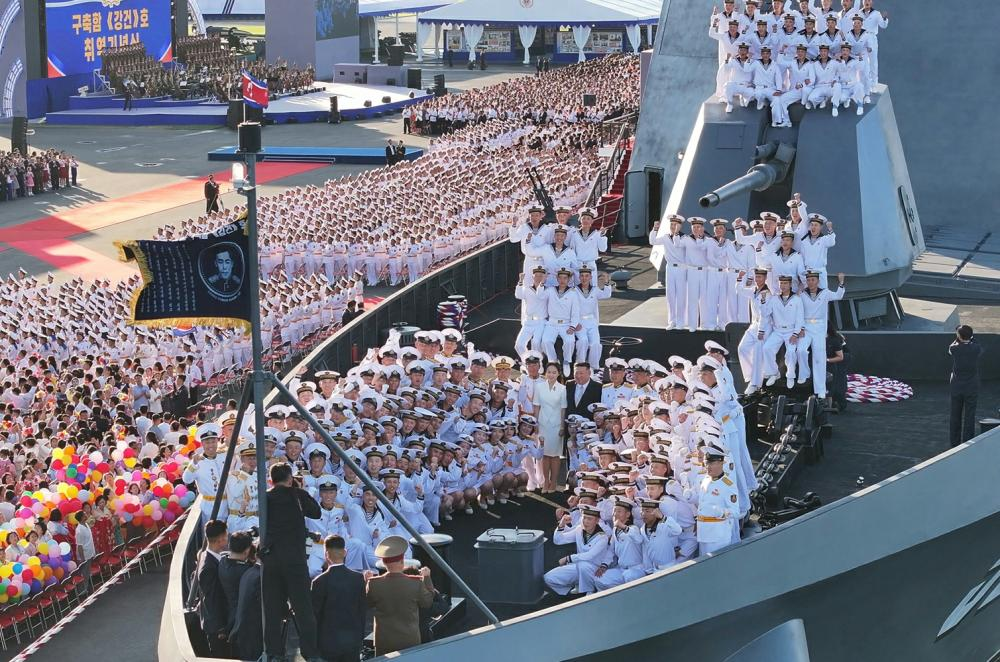
The expansion of North Korea’s surface fleet presents an additional security challenge. The 5,000-metric-ton-class destroyers under construction at the Nampo and Chongjin shipyards could significantly enhance the country’s naval capabilities. Chairman Kim Jong-un has directed that at least two surface combatants of this class or larger be built annually during the new five-year plan period. Notably, the second vessel, the Gang Gun-ho, was relaunched at the Rajin Shipyard in June 2025, reportedly after approximately 20 days of repairs following its capsizing during the initial launching ceremony. On July 3, the Korean Central News Agency released footage showing the vessel test-launching a strategic cruise missile.
Taken together, these developments appear intended to demonstrate to neighboring countries and the international community Pyongyang’s determination to develop two principal maritime strike capabilities: submarine-based and surface-based offensive systems.
On land, military tensions have intensified as North Korea undertakes extensive fortification along its southern border. This development follows Pyongyang’s formal adoption of the doctrine that the two Koreas are hostile states at the December 2023 plenary meeting of the Workers’ Party of Korea. Although the Korean Armistice Agreement imposes restrictions on the introduction of weapons and explosives into the Demilitarized Zone (DMZ) and establishes procedures governing military activities and personnel deployments, North Korea has continued large-scale construction and blasting operations involving substantial troop deployments. These activities have further heightened tensions along the Military Demarcation Line (MDL).
The injuries sustained by South Korean military personnel in a landmine explosion in the DMZ on September 21 may have resulted from a North Korean field commander’s misinterpretation of the established MDL amid the accelerated fortification campaign. Such a miscalculation could have led North Korean troops to mistakenly regard territory south of the MDL as their own and plant landmines accordingly.
South Korea’s response to these developments is equally consequential. As its defense industry has expanded its presence in global markets, particularly since the outbreak of the Russia–Ukraine war, the South Korean military has accelerated the development of advanced weapons systems with strategic capabilities. In response to North Korea’s SLBM program, South Korea successfully conducted its own submarine-launched ballistic missile test on September 15, 2021. More recently, on October 8, 2026, South Korea successfully tested a domestically developed hypersonic missile, reflecting its efforts to counter North Korea’s advances in hypersonic weapons technology.
In effect, North Korea is seeking to impose its self-declared two-hostile-states framework on inter-Korean relations, while South Korea is responding by strengthening and demonstrating its own military capabilities. This dynamic resembles the tit-for-tat strategies examined in game theory, in which each side responds to the other’s actions with reciprocal measures.
The result is a dangerous cycle of military escalation that has significantly heightened the risk of confrontation and miscalculation on the Korean Peninsula. The current situation evokes the August 18, 1976, Axe Murder Incident at Panmunjom, when a confrontation between North Korean forces and United Nations Command personnel brought the two Koreas to the brink of armed conflict.
The crisis was eventually defused after North Korean leader Kim Il-sung expressed regret over the incident. Despite the enduring structural rivalry between their competing political systems, the two Koreas subsequently engaged in various behind-the-scenes efforts to manage military tensions and prevent escalation.
The present circumstances, however, are fundamentally different. Chairman Kim Jong-un’s efforts to secure sanctions relief through two rounds of negotiations with the United States ultimately failed. As Victor Cha has observed, the summit diplomacy pursued during President Donald Trump’s first term also foundered amid North Korea’s continued commitment to expanding its nuclear arsenal and advancing its nuclear weapons capabilities.
The failure of the Hanoi summit appears to have contributed to North Korea’s subsequent adoption of the hostile two-state doctrine. This doctrinal shift is closely intertwined with Pyongyang’s ongoing military buildup. North Korea increasingly appears to view sustained confrontation, rather than de-escalation, as better serving its strategic interests.
Against this backdrop, a fundamental question arises: Is there a viable way to break—or at least slow—the seemingly self-reinforcing cycle of military escalation between the two Koreas?
One possible starting point is the policy framework proposed by Victor Cha, a senior fellow at the Center for Strategic and International Studies (CSIS). In his article “North Korea as It Is: The Case for a Cold Peace,” published in the May–June 2026 issue of Foreign Affairs (Vol. 105, No. 3), Cha calls for a fundamental reassessment of the U.S. approach to North Korea that has guided Washington’s policy for more than three decades.
According to Cha, North Korea already possesses approximately 50 nuclear warheads and has accumulated sufficient plutonium and highly enriched uranium to produce an additional 40–50 weapons. It has also developed nearly 20 types of delivery systems, including intercontinental ballistic missiles capable of reaching the continental United States.
Across seven U.S. administrations, Washington has pursued a combination of phased incentives and economic sanctions under the broader objective of complete, verifiable, and irreversible denuclearization (CVID). Cha argues, however, that the scale and sophistication of North Korea’s nuclear arsenal expose the limitations of this approach. In particular, he contends that heavy reliance on economic sanctions has failed to halt Pyongyang’s nuclear advances and may instead have reinforced its determination to expand its capabilities.
Cha therefore does not advocate abandoning denuclearization as a policy objective. Rather, he argues that Washington must acknowledge that achieving it has become a distant prospect.
In the meantime, U.S. policy should prioritize more immediate security imperatives: protecting the American homeland, reducing the number of adversarial relationships Washington must manage, minimizing the risk of a North Korean nuclear first strike, and weakening strategic cooperation among China, Russia, and North Korea.
Rather than making denuclearization a prerequisite for all diplomatic engagement, Cha proposes opening negotiations with Pyongyang around a more practical agenda. Potential areas of agreement include arms control arrangements, restrictions on nuclear testing and missile production, crisis-management mechanisms, and prohibitions on transferring nuclear weapons and related technologies to third parties. In parallel, the United States would strengthen deterrence and defense cooperation with its regional allies to build support for this revised strategy.
Cha characterizes this approach as a cold peace: a relationship that falls short of full diplomatic normalization but sustains sufficient communication to reduce the risk of miscalculation and escalation. In his assessment, maintaining a cold peace with a nuclear-armed North Korea may offer the most realistic means of preventing a hot war.
Cha places particular emphasis on the lack of reliable crisis-management channels between Washington and Pyongyang. He notes that the United States has extremely limited means of communicating directly with North Korea. These include a telephone line in the DMZ, which Pyongyang rarely answers, and written messages delivered to North Korea’s mission to the United Nations in New York, many of which reportedly go unanswered or are returned unopened. Such channels are plainly inadequate for managing a crisis that could escalate into nuclear confrontation.
Cha also anticipates criticism that his proposal would amount to tacit acceptance of North Korea’s status as a nuclear-armed state. He counters that a preventive military strike against a state that already possesses nuclear weapons would have uncertain prospects of success and could trigger catastrophic escalation. Moreover, the effectiveness of international sanctions has diminished as China and Russia have increasingly undermined enforcement of the UN sanctions regime.
For these reasons, Cha presents cold peace not as an ideal or permanent settlement, but as an interim framework for protecting the U.S. homeland and reducing the risk of nuclear escalation in the Indo-Pacific.
Although developed independently and articulated at different points in time, the South Korean government’s Three Blueprints for Peaceful Coexistence share several important elements with Cha’s cold peace proposal. President Lee Jae-myung presented this vision to the international community in his address to the United Nations General Assembly.
Three areas of convergence are particularly noteworthy.
First, both approaches recognize the limitations of a denuclearization-first strategy.
In an interview with The New York Times published shortly before his address to the UN General Assembly, President Lee suggested that insisting on denuclearization under current circumstances was unlikely to yield meaningful results. In his subsequent address, he outlined a phased approach: first halting further advances in North Korea’s nuclear and missile capabilities, then pursuing reductions over the medium term, and ultimately working toward a nuclear-free Korean Peninsula.
This approach closely parallels Cha’s recommendation that denuclearization remain a long-term objective rather than a precondition for initiating negotiations.
Second, both frameworks place considerable emphasis on crisis management.
Under the second blueprint, which calls for stable peaceful coexistence without conflict, President Lee advocated establishing institutional mechanisms to prevent crises and manage disputes. He also identified the restoration of basic communication channels and the rebuilding of trust as essential first steps toward a more stable inter-Korean relationship.
This emphasis aligns with Cha’s assessment that the absence of reliable communication channels between Washington and Pyongyang constitutes a major source of strategic risk.
Third, both approaches reflect a reassessment of the effectiveness of sanctions.
In his interview with The New York Times, President Lee suggested that exchanging sanctions relief for a halt to further nuclear weapons development and advances in intercontinental ballistic missile technology could yield meaningful benefits, particularly given the limited effectiveness of existing sanctions.
Cha similarly argues that the UN sanctions regime has been weakened by the actions of China and Russia. Russia vetoed the renewal of the Security Council mechanism responsible for monitoring the implementation of sanctions, while trade between China and North Korea reportedly increased by 25 percent from 2024 to 2025, reaching a record level.
Despite these important similarities, however, the two approaches differ in three significant respects.
The first concerns whose security interests serve as the primary reference point.
Cha identifies protecting the U.S. homeland as Washington’s most urgent priority. President Lee, by contrast, emphasizes South Korea’s role as a principal stakeholder and pacesetter in advancing peace on the Korean Peninsula.
This distinction is far from trivial.
Cha himself acknowledges that an American strategy focused primarily on reducing threats posed by North Korea’s long-range missiles could raise concerns among U.S. allies. South Korea and Japan might view such an approach as insufficiently attentive to the short-range missile, artillery, and other conventional threats they face, or interpret it as a potential weakening of U.S. security commitments.
At a forum in Seoul in September 2026, Cha advised President Lee to maintain close communication with President Trump to ensure that South Korea would not be sidelined if Washington and Pyongyang resumed direct negotiations.
Cha has also suggested that North Korea may seek reductions in the U.S. military presence in South Korea and that anticipated changes in the ROK–U.S. alliance could become intertwined with negotiations over phased arms reductions.
The second difference concerns the scope of the ultimate political objective.
Cha’s concept of cold peace is deliberately limited in scope. It seeks to establish a manageable relationship that reduces security threats and prevents armed conflict without necessarily achieving full diplomatic normalization.
President Lee’s vision is more expansive. He has argued that dialogue aimed at establishing a peace regime could provide a framework not only for normalizing relations among the parties concerned but also for promoting shared prosperity through multilateral cooperation and advancing peace, stability, and cooperation throughout Northeast Asia.
The third difference concerns the relative emphasis placed on deterrence.
Cha maintains that any sustainable strategy toward North Korea must rest on credible deterrence among the United States and its allies. He argues that Washington should make clear that any North Korean use of nuclear weapons would result in the destruction of the regime. South Korea, the United States, and Japan, he contends, should reinforce this commitment through advanced missile defense capabilities and stronger collective defense arrangements.
At the same time, Cha recommends placing less emphasis on offensive measures, including elements of South Korea’s Kill Chain strategy that involve preemptive strikes against North Korean nuclear facilities or efforts to eliminate the North Korean leadership. Instead, he advocates greater reliance on deterrence by denial—the ability to convince an adversary that an attack is unlikely to achieve its intended objectives.
President Lee’s address to the UN General Assembly, by contrast, did not separately elaborate on deterrence or specific military defense postures.
In this sense, Cha’s cold peace can be understood as the floor of South Korea’s broader vision, while peaceful coexistence represents its ceiling. The two approaches need not be mutually exclusive. Rather, they can be integrated into a sequential framework in which immediate security risks are managed through cold peace, thereby creating the conditions for a more durable and cooperative relationship over time.
For this framework to succeed, however, South Korea must move beyond the role of a diplomatic pacesetter and become an active architect of the negotiating agenda. In particular, Seoul should press for threats posed by North Korea’s short-range weapons systems and the need for inter-Korean military confidence-building measures to be incorporated into any renewed U.S.–North Korea dialogue.
The current cycle of military escalation imposes mounting costs on both Koreas and offers no sustainable foundation for long-term security. From this perspective, the South Korean government’s Three Blueprints for Peaceful Coexistence represent an effort to develop a practical alternative to indefinite confrontation.
Historical experience offers a useful perspective on why such an approach is necessary.
Israel and Egypt were once bitter adversaries, having fought four major wars: the 1948 Arab–Israeli War, the 1956 Suez Crisis, the 1967 Six-Day War, and the 1973 Yom Kippur War. During the 1967 conflict, Israel occupied Egypt’s Sinai Peninsula, further deepening the hostility between the two countries.
William B. Quandt, who served on the U.S. National Security Council staff and participated in the Camp David negotiations, later observed that peace between Egypt and Israel after the October 1973 War was possible but not inevitable. In his assessment, both governments eventually recognized the potential benefits of a negotiated settlement under American mediation, yet neither was likely to achieve an agreement on its own.
The United States also had compelling reasons to pursue a diplomatic resolution. The 1973 War raised the possibility of Soviet intervention and contributed to a major international oil crisis. These developments prompted unusually intensive engagement by the U.S. president and secretary of state in efforts to resolve the conflict.
A decisive breakthrough emerged from an extraordinary political initiative.
On November 9, 1977, Egyptian President Anwar Sadat announced his willingness to address the Israeli parliament, the Knesset, if doing so could advance the cause of peace. From November 19 to 21, he became the first Arab head of state to visit Israel, meeting Prime Minister Menachem Begin and delivering a historic address before the Knesset.
In September 1978, U.S. President Jimmy Carter invited Sadat and Begin to Camp David, the presidential retreat in Maryland. The negotiations lasted 13 days, from September 5 to 17.
According to William B. Quandt’s account, Carter assumed several distinct roles throughout the negotiations. At times, he acted almost as a psychotherapist, helping each leader understand the other’s fears and mistrust. At other moments, he served as an intermediary, conveying positions and impressions between the two sides. When necessary, he became a more active mediator, pressing both leaders toward compromises he considered fair and politically achievable.
These efforts culminated in the Camp David Accords, signed on September 17, 1978. On March 26, 1979, Egypt and Israel signed a peace treaty in Washington, D.C., formally ending three decades of hostilities. Under the treaty, Israel agreed to return the Sinai Peninsula to Egypt, while Egypt formally recognized Israel. Sadat and Begin were jointly awarded the 1978 Nobel Peace Prize.
The political costs of peace, however, were considerable.
Sadat had hoped that peace would help Egypt address its severe domestic challenges. Yet on October 6, 1981, he was assassinated by Islamist extremists during a military parade commemorating the 1973 War.
Moreover, the relationship that emerged from the peace treaty was far from warm.
Quandt observed that cold peace best described Egyptian–Israeli relations in the mid-1980s. Nevertheless, he emphasized that both sides continued to respect the essential provisions of the peace agreement.
A cold peace, however imperfect, was preferable to an endless cycle of war.
Contemporary inter-Korean relations cannot be equated directly with the historical relationship between Israel and Egypt. Nevertheless, the experience offers an important lesson. After four major wars, two deeply hostile states ultimately concluded that perpetual military confrontation and an escalating arms race were unsustainable. Their initial achievement was neither reconciliation nor mutual affection, but a cold peace that established a durable framework for preventing renewed war.
The central question for the Korean Peninsula, therefore, is not simply whether reconciliation is immediately possible, but who can help create the political conditions for a comparable transition from confrontation to a more stable peace.
In the Egyptian–Israeli case, President Carter’s sustained diplomatic engagement and credibility as a mediator were instrumental in bringing the two sides together.
The circumstances surrounding a possible U.S.–North Korea summit today are considerably more complicated.
The renewed summit proposal has come not from either Korea, but from President Trump. Unlike Carter during the Camp David negotiations, Trump is directly involved in a major conflict with Iran and faces significant domestic political pressures. Under these circumstances, a summit with Chairman Kim Jong-un could also serve as a means of addressing the political challenges confronting his administration.
From Pyongyang’s perspective, these circumstances may diminish the appeal of renewed summit diplomacy.
Having seen his previous negotiations with Washington end without a durable agreement, Kim has reason to approach another summit with caution. He may be concerned that Trump, facing domestic and international challenges ahead of the midterm elections, would seek a diplomatic breakthrough primarily to secure short-term political gains.
Kim may also be assessing the consequences of the conflict with Iran, including its implications for U.S. influence in the Middle East and the broader regional security environment. He is likely to be monitoring the domestic economic pressures facing the Trump administration, including reports that average U.S. diesel prices have exceeded $6 per gallon, growing dissatisfaction among Midwestern farmers and other consumers, and the resulting political challenges as winter approaches.
If Republicans suffer substantial losses in the upcoming midterm elections and lose control of both chambers of Congress, Trump could enter an early lame-duck period, with his ability to advance major policy initiatives significantly constrained. Under such circumstances, Kim may see little strategic incentive to accept another summit proposal, particularly if he doubts the continuity of U.S. policy toward North Korea or the prospects for implementing any agreement reached.
Nevertheless, the strategic rationale for renewed U.S.–North Korea summit diplomacy remains compelling. A meeting on the sidelines of the APEC Summit could offer an opportunity to break the diplomatic impasse, reduce military tensions on the Korean Peninsula, and create an opening for the resumption of a broader peace process.
What, then, should South Korea do to navigate these challenges?
A viable response requires a comprehensive strategy that combines immediate risk reduction with a long-term commitment to mutually beneficial cooperation. Such a strategy should draw on the common principles underlying Victor Cha’s cold peace framework and the South Korean government’s Three Blueprints for Peaceful Coexistence.
At its core, this approach would preserve denuclearization as the ultimate objective while recognizing that progress may require greater flexibility and an incremental process. Rather than making complete denuclearization a prerequisite for any sanctions relief, policymakers should consider linking carefully calibrated, partial relief to verifiable initial steps toward constraining North Korea’s nuclear capabilities.
At the same time, South Korea should pursue sustained initiatives to improve the living conditions of the North Korean people.
One promising area is long-term cooperation on rural housing and community infrastructure, an issue that has featured repeatedly in discussions of inter-Korean humanitarian cooperation.
North Korea itself has identified rural housing development as a central domestic policy priority.
At the Fourth Plenary Meeting of the Eighth Central Committee of the Workers’ Party of Korea in late 2021, Chairman Kim Jong-un introduced the Program for a Rural Revolution in the New Era. At the Ninth Party Congress, held from February 19 to 25, 2026, he claimed that approximately 110,000 rural homes had been constructed nationwide.
These official figures, however, warrant careful scrutiny.
According to annual construction figures reported by North Korean state media, the number of completed rural housing units declined from approximately 58,000 in 2023 to 41,000 in 2024 and 32,000 in 2025. Moreover, comparisons with the number of publicly reported housewarming ceremonies suggest that even these figures may overstate actual construction achievements.
Rural housing is significant for two reasons. It serves as a visible expression of the North Korean leadership’s commitment to improving living standards, while also providing a tangible measure of the extent to which those promises are being fulfilled.
This is precisely where South Korea should consider directing its long-term humanitarian and technical assistance efforts.
Technologies and infrastructure associated with rural housing—including disaster-resistant structural design, thermal insulation, heating systems, construction materials, and village-level water supply and sanitation facilities—could directly improve the safety, health, and well-being of ordinary North Koreans.
In his address to the United Nations, President Lee articulated a vision of inclusive peaceful coexistence grounded in mutual respect and expressed hope that international cooperation could expand in areas such as public health, disaster response, and climate change.
Supporting the development of flood-resilient rural housing in North Korea would directly advance these objectives. Such projects would bring together disaster risk reduction, climate adaptation, public health, and humanitarian development, making them particularly well suited to the cooperative agenda envisioned under the Three Blueprints for Peaceful Coexistence.
Admittedly, Pyongyang is unlikely to respond positively to such proposals in the near term.
Following severe flooding in the Yalu River basin in late July 2024, the South Korean government offered humanitarian assistance through the Korean Red Cross on August 1, marking its first such offer of flood relief in 12 years. North Korea did not respond. The following day, Chairman Kim rejected Seoul’s initiative and declared that the enemy would remain an enemy.
Yet the absence of an immediate response should not be mistaken for the failure of a humanitarian initiative.
As Doo-hyun Cha, a senior research fellow at the Asan Institute for Policy Studies, has argued, South Korea should continue offering assistance whenever humanitarian emergencies arise in North Korea, regardless of whether Pyongyang accepts or rejects those offers. Sustained humanitarian engagement can demonstrate Seoul’s sincerity and its commitment to the welfare of the North Korean people.
Cooperation through international organizations offers a practical means of overcoming some of the obstacles to direct inter-Korean engagement.
In 2016, severe flooding struck North Hamgyong Province following Typhoon Lionrock. North Korean authorities subsequently requested assistance from international humanitarian organizations. The International Federation of Red Cross and Red Crescent Societies (IFRC), working alongside the United Nations and other international partners, provided roofing materials for approximately 10,000 households as part of a reconstruction effort led by the North Korean government.
This experience demonstrates that multilateral humanitarian cooperation can remain feasible even when direct inter-Korean relations are severely constrained.
Under such an arrangement, the United Nations and relevant international organizations could take the lead in implementation, while South Korea provides financial resources, technical expertise, and appropriate material assistance.
The existing UN sanctions framework also provides a mechanism for humanitarian exemptions, subject to approval by the UN Security Council Committee established pursuant to Resolution 1718.
Support for rural housing development in North Korea should therefore be viewed as a long-term investment rather than an initiative expected to generate immediate political or diplomatic returns.
South Korea should work with international organizations to prepare detailed project proposals in advance. These proposals should identify potential beneficiary communities, establish standardized housing designs, specify required construction materials, and incorporate credible monitoring and evaluation mechanisms.
Seoul should then communicate its willingness to pursue such cooperation consistently, even if Pyongyang does not respond immediately.
Ultimately, the Three Blueprints for Peaceful Coexistence provide the political and conceptual foundation for such a long-term strategy.
Inclusive peaceful coexistence, grounded in mutual respect for each side’s political and social system, could help reassure Pyongyang that humanitarian assistance is not intended as an instrument of absorption or political coercion.
Stable peaceful coexistence, based on the prevention of armed conflict, can provide the security environment necessary to ensure that humanitarian and developmental cooperation is not repeatedly disrupted by military tensions.
Responsible peaceful coexistence, oriented toward contributing to international peace and stability, can provide the legitimacy and institutional framework needed to encourage meaningful participation by the United Nations and other international organizations.
The immediate objective may be no more than a cold peace: a stable but limited relationship in which both sides manage their differences and avoid military confrontation. Yet such an arrangement need not define the limits of what can ultimately be achieved. A cold peace can provide the foundation for a more humane and sustainable future—one in which the practical needs of ordinary people become an enduring basis for cooperation. Even if peace must begin in the cold, the home we build upon it must be warm.
-
PREV [Issue Analysis] ROK–U.S. Economic Cooperation
-
NEXT 다음 글이 없습니다.