

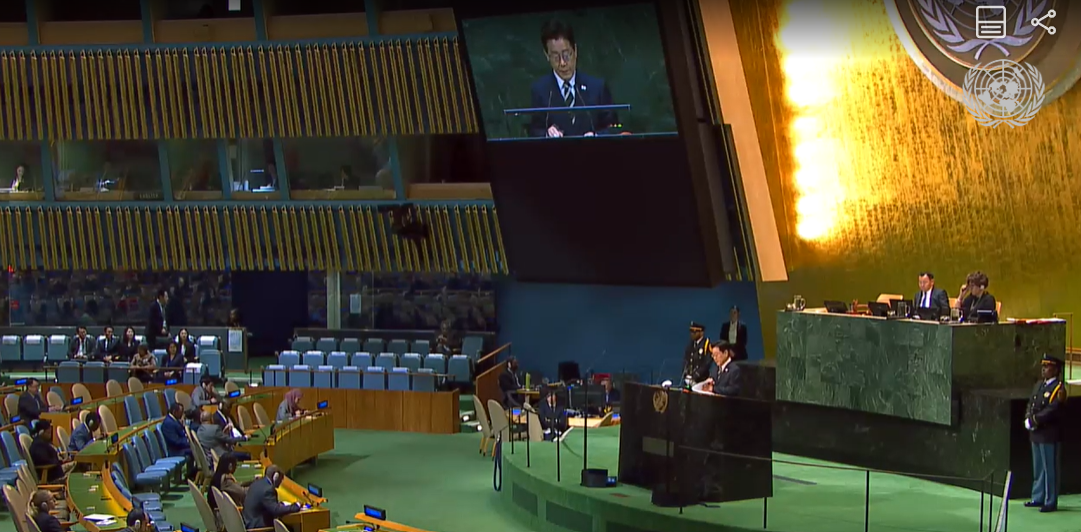
President Lee’s Keynote Address to the UN General Assembly and the Feasibility of Halting North Korea’s Nuclear Program

Ki-young Yoon
Adjunct Professor
Hankuk University of Foreign Studies
1. Introduction:
In his keynote address to the 81st United Nations General Assembly, held at UN Headquarters in New York on September 22 (local time), South Korean President Lee Jae-myung presented the international community with a phased approach to peace on the Korean Peninsula and the North Korean nuclear issue. At the core of this approach is the prompt resumption of the long-stalled U.S.–North Korea dialogue, with an immediate focus on halting further advances in North Korea’s nuclear and missile capabilities, followed by their reduction over the medium term and, ultimately, the pursuit of a “nuclear-free Korean Peninsula.”
President Lee stated, “The Republic of Korea will lay the groundwork for the prompt resumption of U.S.-North Korea dialogue—which has been stalled for a long time—and for its evolution into dialogue among the parties concerned aimed at ending the war on the Korean Peninsula and transitioning to a peace regime.” He noted that U.S. President Donald Trump’s recent decision has created an opportunity for renewed engagement with North Korea and emphasized South Korea’s determination, as a key stakeholder and “pace-setter” for peace on the Korean Peninsula, to open and sustain a path to dialogue.
A particularly noteworthy aspect of the speech is that it did not stop at reaffirming the ultimate goal of “denuclearization,” but instead outlined a phased pathway: “halting the advancement of nuclear and missile capabilities → medium-term reduction → a long-term nuclear-free Korean Peninsula.” Given the extent to which North Korea’s nuclear capabilities have already advanced, this approach can be understood as an effort to first prevent further expansion of those capabilities and then address the broader nuclear issue in stages, rather than seeking to achieve complete denuclearization in the short term.
This approach has practical value. Given the difficulty of resolving the North Korean nuclear issue in a single step, a phased approach can broaden the space for dialogue and help sustain momentum in negotiations. However, “suspension” must not become a substitute for the ultimate objective of denuclearization. It is therefore essential to make clear that preventing further advances in North Korea’s nuclear capabilities is not the endpoint of the denuclearization process, but rather the first step toward achieving that objective.
2. Assessment of the Three Blueprints for Peaceful Coexistence
In his address to the UN General Assembly, President Lee presented three blueprints for peaceful coexistence on the Korean Peninsula: △ “Inclusive Peaceful Coexistence,” which emphasizes mutual respect for each side’s political system and differences; △ “Stable Peaceful Coexistence,” which focuses on restoring communication channels and rebuilding trust; and △ “Responsible Peaceful Coexistence,” which seeks to contribute to peace and stability in Northeast Asia and beyond.
The first, “Inclusive Peaceful Coexistence,” is based on mutual respect for the political systems of the two Koreas and recognition of their differences. President Lee stated that, on this basis, the two Koreas could cooperate in areas such as public health, disaster response, and climate change. Given the prolonged disruption of inter-Korean relations, resuming dialogue and cooperation in areas that can remain relatively insulated from political and military disputes could provide an opportunity to rebuild trust.
The second concept, “Stable Peaceful Coexistence,” focuses on establishing institutional mechanisms to prevent crises and manage conflicts. President Lee emphasized that restoring basic channels of communication and rebuilding trust are the first steps toward achieving stable peaceful coexistence.
The third concept, “Responsible Peaceful Coexistence,” envisions promoting stability and cooperation beyond the Korean Peninsula and contributing to peace at the global level. This reflects the recognition that peace on the Korean Peninsula is not solely an inter-Korean issue, but also has broader implications for security in Northeast Asia and international peace and stability.
These three blueprints are significant in that they seek to address the breakdown of inter-Korean relations and establish a foundation for peaceful coexistence. However, political declarations alone are insufficient to transform peaceful coexistence into a sustainable framework. Concrete implementation measures are needed, including the restoration of inter-Korean communication channels, military confidence-building measures, and mechanisms to prevent accidental clashes.
In particular, it will be difficult to ensure the stability of peaceful coexistence as long as North Korea’s nuclear and missile capabilities continue to advance. Peaceful coexistence and the reduction of the North Korean nuclear threat should therefore not be treated as separate policy objectives, but pursued in a coordinated and mutually reinforcing manner.
3. Implementing the Three-Stage Approach: “Suspension → Reduction → A Nuclear-Free Korean Peninsula”
To operationalize the “Suspension → Reduction → A Nuclear-Free Korean Peninsula” vision presented by President Lee at the United Nations, the objectives, verification mechanisms, and corresponding measures for each stage must be clearly defined.
First, Stage 1 is “Suspension.” This stage would involve freezing the production of nuclear materials and halting nuclear tests and long-range missile tests to prevent further advances in North Korea’s nuclear and missile capabilities. However, a political declaration alone is unlikely to be sufficient. It must be accompanied by a verification system capable of confirming the suspension of nuclear material production and monitoring the status and operation of relevant nuclear facilities.
This stage should also be accompanied by measures to reduce military risks. A phased package could include △ a freeze on nuclear material production, △ advance notification of missile tests, △ the establishment of an inter-Korean military hotline, and △ the reopening of a liaison office, with corresponding measures provided in response to verified North Korean compliance.
For instance, a verifiable freeze on nuclear material production could be met with humanitarian assistance and the restoration of communication channels. The implementation of advance notification of missile tests and the restoration of the military hotline could, in turn, lead to additional measures to reduce military tensions. A phased framework that links specific North Korean actions to corresponding reciprocal measures is therefore necessary.
In particular, the initial agreement must establish a clear timetable and objectives for subsequent negotiations on nuclear reduction. To ensure that “suspension” does not become an indefinite nuclear freeze—which could effectively amount to de facto recognition of North Korea as a nuclear-weapon state—the parties should agree in advance on a timetable for declarations concerning nuclear materials and weapons, procedures for inspecting and verifying nuclear facilities, and a schedule for commencing negotiations on nuclear reductions.
Phase 2 is “Reduction.” This stage would involve the gradual reduction of North Korea’s stockpiles of nuclear materials and weapons, along with the dismantlement or elimination of related facilities. Key agenda items could include declarations of nuclear materials and weapons, a comprehensive inventory of nuclear facilities, international inspections and verification, and the removal and disposition of nuclear materials.
Stage 3 is “a nuclear-free Korean Peninsula.” This stage must encompass not only the complete dismantlement of North Korea’s nuclear weapons, but also the establishment of verification mechanisms and institutional safeguards to prevent their reemergence. It should also include the development of a peace regime capable of structurally reducing military tensions and establishing lasting peace on the Korean Peninsula.
Throughout this process, corresponding measures by the international community should also be structured and implemented in phases. The process could initially begin with limited measures, such as humanitarian assistance and the restoration of communication channels. As North Korea makes verifiable progress in declaring and verifying its nuclear facilities and reducing its nuclear materials, international measures could gradually be expanded to include economic cooperation, sanctions relief, the normalization of diplomatic relations, and the establishment of a peace regime.
4. Conclusion: The Necessity and Feasibility of Halting North Korea’s Nuclear Program
The North Korean nuclear issue is a complex challenge that cannot be resolved in the short term. North Korea’s nuclear and missile capabilities have advanced substantially, while trust between North Korea and the United States has deteriorated amid a prolonged suspension of dialogue. Under these circumstances, maintaining complete denuclearization as a precondition for negotiations may constrain the prospects for reopening diplomatic engagement.
At the same time, the international community should neither accept North Korea’s possession of nuclear weapons as a permanent reality nor allow further expansion of its nuclear capabilities. Accordingly, while clearly defining the ultimate objective as a “nuclear-free Korean Peninsula,” a strategy is needed to pursue realistically achievable measures in a phased manner.
The most significant challenge is verification. Mobile, solid-fuel intercontinental ballistic missiles (ICBMs) can be relocated and prepared for launch within a relatively short period, making it difficult for external actors to verify whether such systems are being developed, deployed, or maintained. Verifying a commitment not to develop such weapons would require extensive inspections and intelligence sharing, neither of which North Korea is likely to accept readily.
For this reason, negotiations would realistically need to begin with a “moratorium” on nuclear tests and missile launches. However, an agreement limited solely to halting ICBM development would have only a limited effect on the broader nuclear threat. The challenge extends beyond ICBMs capable of threatening the U.S. mainland to nuclear capabilities directed at South Korea, including the production of nuclear materials and the development and deployment of short-range delivery systems.
Accordingly, even an agreement to “halt ICBM development” could have substantially different implications depending on its scope and coverage. A meaningful moratorium would therefore need to address not only long-range missile development but also the production of nuclear materials and other activities that could expand North Korea’s nuclear capabilities.
If negotiations were to result in a limited commitment to halt ICBM development, the resulting agreement could amount to a “small deal” that constrains only one component of North Korea’s nuclear capabilities. By contrast, an agreement that includes a verifiable freeze on nuclear material production, comprehensive verification measures, and a defined timeline for subsequent negotiations on nuclear reductions could serve as an initial step toward phased nuclear disarmament.
The value of suspending North Korea’s nuclear program lies in reducing immediate nuclear risks while creating the time and diplomatic space necessary for sustained negotiations. If North Korea freezes nuclear material production, provides advance notification of missile tests, and restores the inter-Korean military hotline and liaison office, these measures could reduce the risk of accidental conflict while preventing further expansion of its nuclear and missile capabilities. They could also create conditions under which the international community can more effectively monitor and verify North Korea’s nuclear activities.
A suspension of North Korea’s nuclear program should therefore not be viewed as a substitute for denuclearization, but rather as a practical and verifiable starting point for advancing toward that goal. The critical issue is not to stop at suspension, but to establish a clear and verifiable pathway from suspension to reduction and, ultimately, to dismantlement.
Ultimately, peace on the Korean Peninsula cannot be achieved through political declarations alone. Dialogue must resume, military tensions must be managed, further advances in nuclear and missile capabilities must be halted, and verifiable reductions must be achieved. For the phased plan presented by President Lee Jae-myung at the United Nations to produce tangible results, its political vision must be translated into concrete implementation measures and integrated into a single, coherent roadmap.
The suspension of North Korea’s nuclear program is not the end goal. Rather, it is a first step toward reducing nuclear risks, rebuilding trust, and restarting the denuclearization process. What is needed now is to move beyond a general declaration of “suspension” and establish a concrete, verifiable implementation framework that leads from suspension to reduction and, ultimately, to a nuclear-free Korean Peninsula.