

The 60 Trillion-Won CPSP Program:
Advancing Economic Security Through Strategic Partnership

Dong-soon Park
Professor
Graduate School of Defense Studies
Hansung University
By 2026, the Defense Industry Is Entering the “K-Defense 3.0” Era
By 2026, South Korea’s defense industry is poised to emerge as one of the world’s four leading arms exporters, solidifying its position as a major global supplier and a leading defense industrial power. Building on a record order backlog exceeding 130 trillion won, Korea is moving beyond the traditional export of finished defense products toward the “K-Defense 3.0” paradigm, which emphasizes local production, industrial cooperation, and advanced technology transfer.
First, the most notable development is the record-breaking growth and scale of South Korea’s defense exports. Defense exports in 2026 are projected to reach approximately $37.7 billion (about 56 trillion won), setting a new all-time high. At the same time, both export destinations and product categories continue to diversify significantly.
In terms of global competitiveness, South Korea has rapidly capitalized on Europe’s rearmament efforts and growing demand in the Middle East for integrated air and missile defense systems. Its success has been driven by a combination of cost competitiveness, proven operational performance, and a strong reputation for reliable and timely delivery.
Examining South Korea’s defense export performance by region, Europe has emerged as a key market. Through large-scale exports and deliveries of K2 main battle tanks and K9 self-propelled howitzers to Poland, South Korea has demonstrated the reliability and competitiveness of K-defense products. Building on this success, its presence in the broader Eastern European defense market continues to expand.
In the Middle East, South Korea has secured a leading position in the regional air and missile defense market through exports of the Cheongung-II surface-to-air missile system to the United Arab Emirates (UAE). Amid heightened regional security tensions, including those associated with U.S.–Iran rivalry, demand for advanced air defense capabilities has continued to grow. At the same time, defense cooperation in the missile sector is evolving beyond conventional export arrangements toward localized production, technology transfer, and joint venture–based industrial partnerships.
In the Asia-Pacific region and North America, South Korea is likewise expanding its defense export footprint. Its market reach is broadening beyond traditional customers in Southeast Asia to include advanced defense markets such as Canada and Australia.

As the international security environment increasingly shifts toward a more self-help–oriented order, demand for K-defense products—whose competitiveness has already been demonstrated in global markets—is likely to continue growing regardless of whether the Russia–Ukraine war or U.S.–Iran tensions eventually subside.
Accordingly, 2026 is expected to mark a watershed moment in the evolution of K-defense, as the industry transitions from a phase of quantitative expansion to one of qualitative consolidation. In this context, South Korea’s defense industry is being redefined from a conventional arms manufacturer into a national strategic platform that simultaneously advances economic security, technological competitiveness, and diplomatic influence.
This paper examines South Korea’s capabilities to secure the Canadian Patrol Submarine Project (CPSP), a mega-project valued at up to 60 trillion won. It further assesses that South Korea is structurally well positioned to emerge as the most competitive bidder, given its accumulated industrial track record, demonstrated defense-industrial performance, and sustained strategic engagement with Canada.
The CPSP: The Korean Defense Industry’s Top Strategic Objective for 2026
The highest priority for South Korea’s defense industry in 2026 is securing the CPSP, a procurement program valued at approximately 60 trillion won. Under the CPSP, Canada plans to acquire up to 12 submarines in the 3,000-ton class to replace its current fleet of four Victoria-class submarines (approximately 2,400 tons each).
Canada has established a target delivery date of around 2035 for the lead vessel. The total value of the project is estimated at approximately 60 trillion won, including roughly 20 trillion won in submarine construction costs and an additional 40 trillion won in long-term maintenance, repair, and overhaul (MRO) expenditures.
Canada’s requirement for next-generation submarines is driven by several structural factors. First, as the country with the world’s longest coastline, Canada requires persistent surveillance, deterrence, and response capabilities across three major maritime theaters—the Atlantic, Pacific, and Arctic Oceans—creating a growing need for a modern and capable submarine fleet.
Second, Canada’s four Victoria-class submarines, acquired secondhand from the United Kingdom in 1998, have experienced declining operational readiness as a result of aging platforms.
Third, evolving maritime security challenges, including increased Russian and Chinese naval activity in the Arctic region, have heightened the need for advanced, stealth-capable submarines capable of safeguarding maritime sovereignty and strengthening deterrence. Accordingly, the CPSP is closely linked to several core Canadian national security priorities, including the modernization of the Royal Canadian Navy, the protection of Arctic sea lines of communication, and the enhancement of maritime domain awareness.
Four Key Advantages of K-Defense in the CPSP
South Korea’s submarine development program initially emerged through technology transfer and industrial cooperation with Germany. Over the past three decades, however, South Korea has developed an indigenous submarine design and construction capability and is now widely regarded as one of the most competitive players in the global conventional submarine market.
South Korean and German defense firms are currently competing for the CPSP. A Korean consortium consisting of Hanwha Ocean and HD Hyundai Heavy Industries is competing against Germany’s ThyssenKrupp Marine Systems (TKMS). The preferred bidder is expected to be selected in the coming months, making the CPSP one of the most strategically significant defense export competitions involving South Korea in recent years.
South Korea’s competitive advantages relative to the German proposal can be summarized under four key categories.
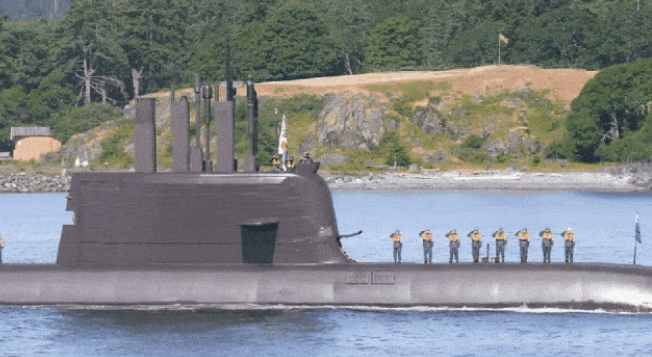
First, South Korea offers a combat-proven operational platform rather than a design-stage platform that remains in the development phase. South Korea’s Dosan Ahn Changho-class (KSS-III) Batch-II submarines are already in operational service with the Republic of Korea Navy. Their performance, reliability, and operational stability have been demonstrated through actual fleet operations, including extended deployments and long-range maritime missions.
By contrast, TKMS’s Type 212CD submarine remains in the development and production phase and has not yet accumulated comparable operational service experience. From Canada’s perspective, where timely fleet recapitalization and risk reduction are critical procurement considerations, the Korean proposal offers a lower-risk acquisition pathway based on a platform that has already entered operational service.
Second, delivery schedule credibility. K-shipbuilding offers a highly competitive and executable delivery timeline based on its established production capacity. South Korea has proposed delivering the lead vessel within six years of contract signing, with the first submarine scheduled for delivery by 2032 and all 12 units to be delivered by 2044. In contrast, Germany faces structural constraints arising from existing order backlogs for both its own navy and other European partners, including Norway. Although Berlin has indicated a willingness to adjust production priorities, its capacity to match South Korea’s accelerated delivery schedule remains limited.
Third, strike capability and weapons scalability. The KSS-III is the world's first diesel-electric submarine to be equipped with both Air-Independent Propulsion(AIP) and a Vertical Launch System(VLS), enabling the deployment of Submarine-Launched Ballistic Missiles(SLBMs). The Batch-II variant, with a displacement exceeding 3,000 tons, offers significant growth potential for the integration of additional payloads and capabilities.
German submarines, by contrast, are optimized primarily for littoral defense and stealth operations and are generally assessed as possessing more limited strike scalability. Given Canada's requirement to operate across the Atlantic, Pacific, and Arctic maritime domains, greater displacement and enhanced multi-mission capability constitute important operational advantages.
Fourth, an unprecedented localization and industrial cooperation package for the Canadian economy. South Korea has proposed a comprehensive package extending beyond platform delivery to encompass long-term industrial integration and economic partnership. The proposal includes the potential establishment of torpedo production facilities in Canada, the creation of up to 40,000 jobs annually, and the development of a hydrogen-based industrial infrastructure hub.
The strategy further envisions rapid submarine construction in South Korea coupled with Canada-based maintenance, repair, and overhaul (MRO) activities throughout a 30-year service life. Germany, by contrast, has promoted a more Europe-centric model that leverages its NATO-linked industrial base and integrates Canada into existing sustainment arrangements with Norway.
From this perspective, the German proposal appears less consistent with Canada's stated objectives of enhancing defense-industrial autonomy and maximizing domestic economic benefits, particularly given that sustainment and logistics constitute approximately 50 percent of the overall evaluation criteria.
Meanwhile, Germany’s TKMS continues to emphasize its long-standing heritage in submarine design and engineering expertise. The Type 212CD, co-developed with Norway’s Kongsberg, is designed for extended Arctic operations, making it well suited to Canada’s operational environment. While the first four units are scheduled for delivery to Norway beginning in 2029, TKMS leadership, including CEO Oliver Burkhard, has stated that production schedules can be adjusted to accommodate Canada’s requirements.
The Decisive Moment Has Arrived: Winning the Race with an Economic and Security Package
Mega projects between states, such as submarine programs, are not determined by price competition alone. They reflect a complex interplay of international politics, diplomatic and security relations, and alliance structures. Accordingly, by proposing a package that integrates economic and security benefits, South Korea seeks to leverage its comparative advantages while mitigating its structural constraints. The Republic of Korea’s message is clear: it presents itself as a reliable partner, prepared to respond to shared security challenges, cooperate in technology development, and pursue mutual prosperity.
On October 30, 2025, President Lee Jae-myung held a summit with Canadian Prime Minister Mark Carney in Gyeongju, after which the Canadian Prime Minister visited the Hanwha Ocean Geoje facility to inspect CPSP-related technologies and production sites. In February 2026, to support the CPSP bid at a pan-governmental level, the Cheongwadae and relevant ministries jointly signed a “Letter of Government Support” with “Team Korea”—comprising Hanwha Ocean and HD Hyundai Heavy Industries—and officially delivered it to the Canadian government.
This marked the beginning of South Korea’s full-scale governmental engagement. In January 2026, Chief of Staff Kang Hoon-sik visited Canada in his capacity as South Korea’s Special Envoy for Strategic Economic Cooperation. In March and May 2026, Minister of Trade, Industry and Energy Kim Jeong-kwan visited Ottawa, where he met with Canadian ministers responsible for industry, energy, and natural resources to discuss bilateral industrial and resource cooperation and to seek support for the CPSP.
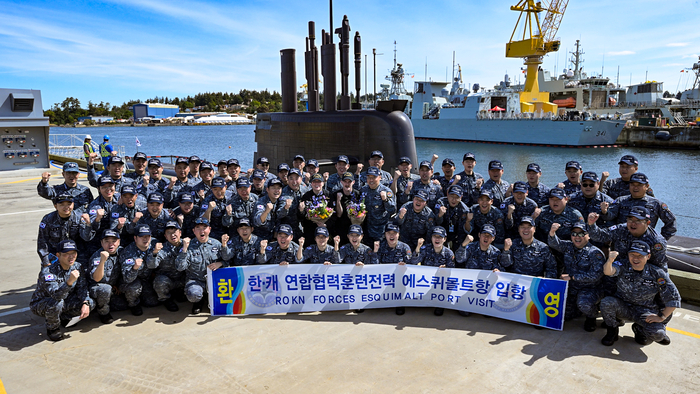
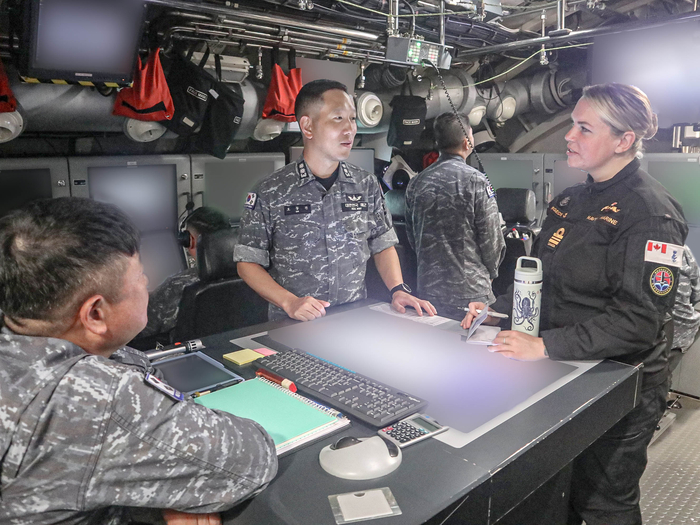
Additionally, from May 21 to 29, Chief of Naval Operations Kim Kyung-ryul visited Canada to discuss defense and naval-industrial cooperation with senior Canadian naval officials. On May 24, Lee Yong-chul attended a reception marking the arrival of ROKS Dosan Ahn Chang-ho and a Daejeon-class frigate in Victoria, underscoring South Korea’s engagement in the final phase of the process.
Not content with this, South Korea has launched a full-scale final push to secure the contract ahead of the CPSP’s final contractor selection scheduled for late June. Chief of Staff Kang Hoon-sik plans to visit Canada in early June in his capacity as Presidential Special Envoy for Strategic Economic Cooperation, leading a high-level delegation to attend the “Korea–Canada Resource Security Supply Chain Cooperation Forum.”
The delegation will include representatives from the Ministry of Trade, Industry and Energy, Korea Trade-Investment Promotion Agency (KOTRA), Korea National Oil Corporation (KNOC), Korea Gas Corporation (KOGAS), Korea Resources Corporation (KORES), Export-Import Bank of Korea, and Korea Trade Insurance Corporation.
From the private sector, energy and battery companies such as SK Energy, HD Hyundai Oilbank, POSCO Holdings, Hyundai Corporation, Samsung SDI, LG Energy Solution, and SK On, as well as equipment and industrial firms including Hyundai Engineering & Construction, Samsung C&T, Korea Zinc, LS MnM, and HD Hyundai Construction Equipment, are expected to participate in order to consolidate momentum.
The delegation’s strategy is to integrate economic and security objectives, placing resource security and resilient supply chains at the core of the proposal. Canada is endowed with critical mineral resources such as nickel, lithium, uranium, and rare earth elements, while South Korea maintains a concentrated industrial base capable of complementary cooperation across the battery, shipbuilding, defense, nuclear power, construction, and oil and gas sectors. The CPSP thus presents an opportunity to establish a comprehensive platform for long-term industrial cooperation between the two countries.
From Canada’s perspective, the objective extends beyond platform acquisition to securing a long-term partner capable of contributing to domestic industrial development and employment creation. If the CPSP contract is secured, it would evolve into a multi-decade program extending beyond defense exports to include shipbuilding, components, maintenance, financing, and localized investment, generating broad spillover effects across employment, exports, and the defense industrial ecosystem.
For South Korea, securing the CPSP contract would represent not only a significant economic opportunity but also a strategic milestone for its defense and shipbuilding industries. The domestic production ripple effect is estimated to exceed 40 trillion won, involving more than 300 partner companies and creating over 20,000 jobs.
The CPSP represents a watershed moment for South Korea’s defense sales diplomacy. If successful, it would position South Korea not merely as a defense exporter, but as a comprehensive strategic industrial partner spanning resources, energy, and global supply chains.
K-defense has emerged as a new growth engine for the Korean economy, supporting its transition toward a broader export-oriented industrial base and enhancing its international standing. More broadly, the development of South Korea’s defense industry will contribute to national prestige and reinforce its role as a contributor to global peace an stability.
With the end of June approaching, South Korea anticipates a positive outcome in securing the CPSP contract, supported by its demonstrated capabilities and sustained efforts to date. The outcome will be closely watched by all stakeholders.
-
PREV [Feature Article]
-
NEXT [Feature Article]