

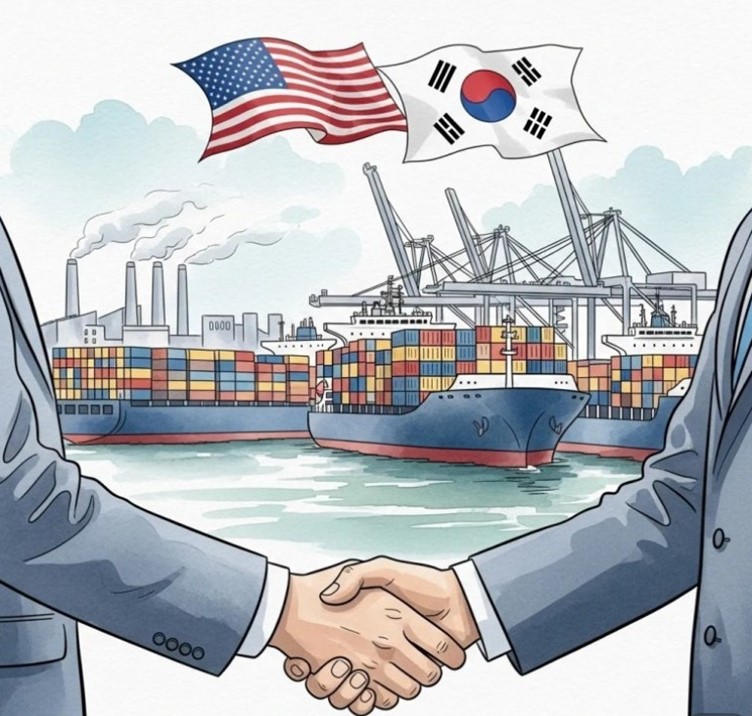
Alliance Logic behind the Joint Fact Sheet on the ROK-U.S. Summit Laid Out amid the Transitional International Order

BAN Kil Joo
KNDA
I. The Joint Fact Sheet Laid out under a Chaotic World
The post-war security order is at stake and transitional, where neither a realist lens nor a liberal lens is relevant to explain what is going on. In this sense, our world is chaotic in a sense. To top it off, the previously working alliance formula is less functional, surrounded by a transactional approach under the Trump administration.
With this in mind, the Joint Fact Sheet, which was open to the public on 14 November 2025, is better placed to grapple with challenges that both South Korea and the U.S. confront in the sense that it leads the alliance to make a win-win architecture. On the security front, differences between Seoul and Washington appear to be addressed, contributing to alliance cohesion.
First, the Sheet clarifies that South Korea will put more effort into enhancing its capability to defend itself, and in return, the USFK will remain committed while deterring North Korea as its primary mission. Second, South Korea and the U.S. agreed to maintain the 2006 strategic flexibility, which means the USFK will not be dispatched for missions off the Korean Peninsula without consultation with South Korea.
Meanwhile, the economic front was much trickier, mainly because U.S. President Trump focuses more on trade than security, and he defines himself as the best dealmaker. Despite this quagmire, Seoul was relatively successful in the negotiation with Washington in the sense that a tariff on automobiles turned out to be reduced, and the most-favored-nation status for semiconductors was secured with an original investment of 350 billion dollars.
Moreover, a 20 billion dollar investment per year is expected to be safe enough not to be entrapped in the foreign currency market crisis. In this sense, South Korea seems to have defended itself from harsh demands by the Trump administration relatively well. If so, what are the implications for the Joint Fact Sheet in analytic ways?
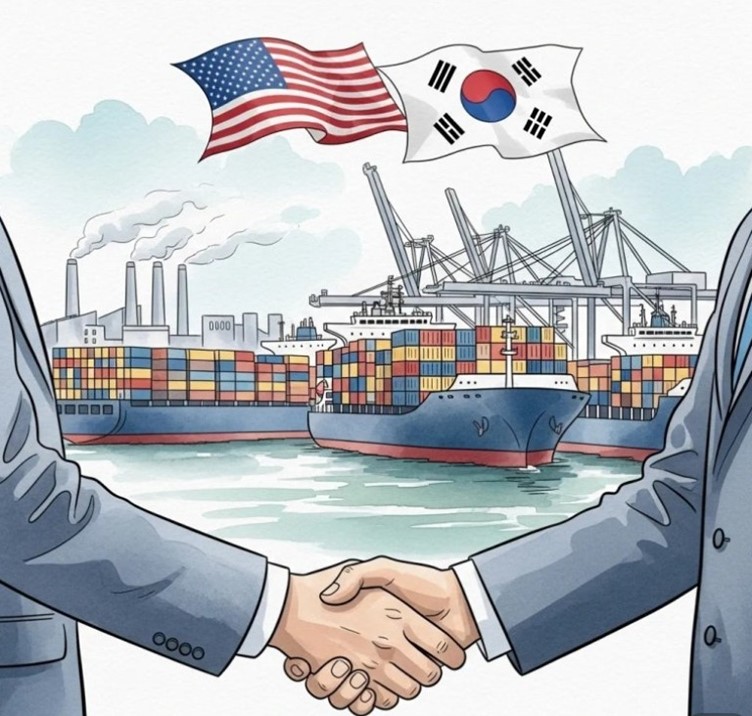
II. The Joint Fact Sheet as a Reference Point for Alliance Modernization
The Joint Fact Sheet could serve as a reference point to take a snapshot of whether the ROK-U.S. alliance architecture continues to be cohesive under an unpredictable and chaotic world or not. The Sheet can be summarized by the three points: 1) making exchanges between America’s economy and South Korea’s security, 2) mitigating alliance risks, and 3) making deals with unprecedented items.
First of all, the Sheet is the result of the congruence between South Korea’s focus on security and the U.S.’s focus on the economy. In return for South Korea’s acceptance of the U.S.’s request for massive investment based on a manageable calculation, the U.S. promised to guarantee its commitment to the Korean Peninsula and help South Korea enhance its military capabilities, such as nuclear-powered submarines. In this sense, this deal is not a trade-off between the two states but a win-win architecture.
Second, the Sheet contributes to mitigating alliance risks between Seoul and Washington. As the Trump administration is little interested in differentiating between allies and enemies. alliance risks are on the rise around the world. The Trump administration believes that its allies have taken advantage of the U.S. more than its adversaries, such as China.
Thus, the U.S. rushes to revise alliance architecture significantly, leading to the rise of alliance risks. These risks are on the rise around the world, including the NATO (North Atlantic Treaty Organization) alliance. Meanwhile, alliance modernization, which is specified in the Joint Fact Sheet, serves as a remedy to ease alliance risks in the sense that both sides remain committed to the value of the ROK-U.S. alliance.
Third, the Sheet shows that unprecedented items are on the table, and furthermore, they agreed to those, leading the alliance to be cohesive more comprehensively. New agendas that have never been made before appeared in the joint fact sheet, which includes uranium enrichment and spent fuel reprocessing as well as nuclear-powered submarines. The inclusion of very new items is expected to make the ROK-U.S. alliance robust in the sense that an old and weakening alliance finds it hard to raise new items.
All these points allow the ROK-U.S. alliance to become more symmetric than before. In this sense, the Joint Fact Sheet could serve as a symbolic moment for the more symmetric ROK-U.S. alliance.
III. Follow-up Tasks and Challenges Ahead
The Joint Fact Sheet serves as a positive sign to evolve the ROK-U.S. alliance, but challenges ahead should be paid attention to in an effort to make the alliance upgrade its symmetry much more. This point particularly matters in the sense that Trump’s negotiation formula is endless, and new items are hard to maintain without bipartisan support from both sides. Challenges will be on the rise without polishing follow-up tasks, such as clarifying the burden-sharing cost, determining a way of constructing submarines, and revising the 123 agreement.
First, the Sheet includes the new item, 33 billion dollars, which appears to be related to the burden-sharing cost, while explaining that this will be spent for comprehensively supporting the USFK. Through follow-up working-level talks, this ambiguity needs to be fully tackled in an effort to prevent both sides from making miscalculations later on.
At first glance, this item seems a burden-sharing cost related to the SMA (Special Measures Agreement), but this could help Seoul step up its leverage over Washington on other agendas if Seoul designs a smart strategy in the process. These multi-functions need to be taken into consideration.
Second, how to complete South Korea’s nuclear-powered submarines should be determined in a timely manner. In particular, a way of constructing nuclear-powered submarines should be determined with the two factors: 1) maximizing South Korea’s world-class shipbuilding capability, and 2) creating synergy for the MASGA project. How to accomplish this program should contribute not only to enhancing the MASGA project but also to expanding K-shipbuilding to the world.
Third, how to acquire nuclear fuel should not be procrastinated. To that end, South Korea and the U.S. should find a way to enrich uranium and reprocess spent fuel under the current 123 agreement, with a possibility of revising it in the near future. Public diplomacy, as well as government diplomacy, will be important to get things done.
IV. Conclusion: More Symmetric Alliance as a Sustainable Remedy
The Joint Fact Sheet is expected to serve as a stepping stone for a symmetric alliance between South Korea and the U.S. However, this is not the end of a symmetric alliance but the first step of a fulfilled symmetric alliance. In this sense, Seoul continues to prepare for any contingencies because Trump’s deal-making formula is an ongoing process without an end.
To top it off, since the U.S.’s National Security Strategy has not been published, South Korea should closely monitor what it looks like in an effort to ensure that the Sheet is harmonized with this document. South Korea should seize the golden moment to make the alliance much more symmetric indeed, leading it to a win-win architecture.
-
PREV [Feature Article]
-
NEXT [Feature Article]