

Reengaging North Korea Without Undermining Denuclearization:
A Strategic Dilemma
Jaechun Kim
Sogang University
The 80th United Nations General Assembly’s High-Level General Debate, held from September 23 to 29, 2025, at UN Headquarters in New York, marked a symbolic moment in global diplomacy. Commemorating the UN’s 80th anniversary, leaders from 193 member states gathered to reflect on the past and chart a course for the future. As expected, the discussions centered on pressing threats to international peace and security, with the wars in Ukraine and Gaza dominating the agenda.
UN Secretary-General António Guterres warned that the world is “entering an era of reckless destruction and endless human suffering.” While issues such as democratic backsliding, human rights, climate crisis, and the Sustainable Development Goals (SDGs) received attention, North Korea’s nuclear program and human rights violations were notably sidelined.
Just prior to the UNGA, on September 21, North Korean leader Kim Jong Un addressed the Supreme People’s Assembly, stating that if the United States abandoned its obsession with denuclearization and recognized North Korea as a nuclear-armed state, he would be willing to meet with President Trump.
Referring to their past interactions as “fond memories,” Kim’s remarks were widely interpreted as a conditional offer for dialogue—predicated on acceptance of North Korea’s nuclear status. In response, the U.S. reaffirmed its commitment to complete denuclearization.
State Department Deputy Spokesperson Mignon Houston reiterated in an interview with South Korea’s Yonhap News on September 24 that “the United States remains fully committed to the complete denuclearization of North Korea.” Reuters also reported on September 23 that President Trump had no immediate plans to meet Kim.
Meanwhile, the foreign ministers of South Korea, the U.S., and Japan convened in New York on September 22, issuing a joint statement reaffirming their unified stance on enforcing sanctions and pursuing complete denuclearization.
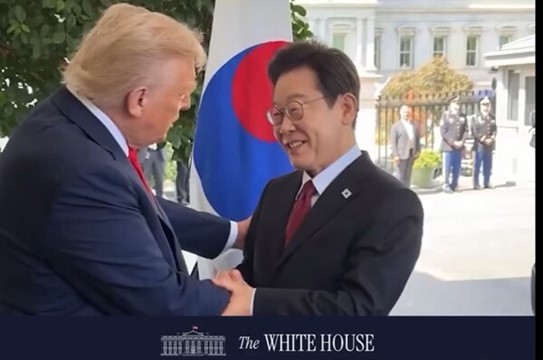
President Lee Jae-myung arrives at the White House on August 25 (local time) for the South Korea-U.S. summit, where
President Donald Trump greets him and exchanges welcoming remarks. 2025.08.26/Photo=White House SNS capture
President Trump’s desire to reengage Kim Jong Un is well known. During the August U.S.–South Korea summit, Trump described their relationship as one of “mutual respect” and expressed his hope to meet Kim again within the year. Since his 2024 campaign, Trump has repeatedly emphasized his rapport with Kim and referred to North Korea as a “nuclear power,” signaling a pragmatic acknowledgment of reality. However, in his 2025 UNGA speech, Trump made no mention of North Korea or the prospect of renewed dialogue.
While Trump’s use of the term “nuclear power” may suggest a tacit recognition of North Korea’s capabilities, it does not imply formal acceptance of North Korea as a legitimate nuclear-weapon state under international law. The U.S. administration continues to uphold denuclearization as a clear policy goal. Even if Trump personally seeks to revive summit diplomacy, doing so without anchoring it in a denuclearization framework would be politically risky.
Without tangible progress on denuclearization, Trump is unlikely to receive accolades such as the Nobel Peace Prize. Thus, while a renewed summit may hinge on Trump’s personal decision, the fundamental divergence between North Korea’s demand for recognition and the U.S.’s insistence on denuclearization remains the central obstacle.
North Korea, for its part, is actively pursuing diplomatic recognition as a nuclear-armed normal state. Kim Jong Un’s speech emphasized that “nuclear force is the lifeline of the nation,” reinforcing his intent to normalize North Korea’s nuclear status. His attendance at China’s Victory Day celebration on September 3—his first overseas trip since 2019 and his debut on a multilateral diplomatic stage—was a calculated move to project legitimacy.
Standing alongside Xi Jinping and Vladimir Putin, Kim sought to highlight trilateral solidarity and elevate North Korea’s international image. Notably, North Korea upgraded its UNGA representation, with Vice Foreign Minister Kim Son Kyong delivering the speech instead of the usual ambassador.
In his address, Kim declared that denuclearization demands were tantamount to “surrendering sovereignty and violating our constitution,” and vowed never to abandon nuclear weapons under any circumstances. While he did not explicitly mention U.S.–North Korea dialogue, he stated that “even countries with different ideologies and systems can engage in dialogue if they show respect.”
The so-called “New York Channel”—an informal communication line between North Korea’s UN mission and the U.S. State Department—has historically served as a backdoor for diplomacy. Whether it was activated during this year’s UNGA remains unclear, as both sides have declined to comment.
If informal contacts did occur, the upcoming APEC Summit in Gyeongju, South Korea, could present an opportunity for a surprise Trump–Kim meeting. Given North Korea’s designation of South Korea as a hostile state, Kim’s visit to the South is highly unlikely. A symbolic encounter at Panmunjom, reminiscent of 2019, appears more plausible. However, such a meeting would require Trump’s initiative and would carry significant political risks, especially given Kim’s uncompromising stance on denuclearization.
South Korea is making every effort to revive U.S.–North Korea dialogue. President Lee Jae-myung, during his summit with Trump, urged him to become a “peacemaker” who reopens the door to peace on the Korean Peninsula, pledging to act as a “pacemaker” in support. The Lee administration is actively promoting the possibility of a Trump–Kim summit at the upcoming APEC meeting, signaling its strong commitment to mediation.
At the UNGA, President Lee proposed a new peace initiative for the Korean Peninsula: the END strategy—Exchange, Normalization, Denuclearization. The idea is to build trust through multifaceted exchanges, including cultural, economic, and civil society interactions, even if official intergovernmental dialogue remains stalled.
Normalization aims to end the hostile status quo between the two Koreas, while Denuclearization seeks to halt, reduce, and ultimately dismantle North Korea’s nuclear arsenal. Rather than relying solely on pressure and sanctions, the END initiative adopts a functionalist approach rooted in engagement.
Yet, the question remains: will North Korea respond? Its adversarial “two-state theory” goes beyond asserting separate sovereignty—it treats inter-Korean exchange as a threat to regime stability. Exposure to South Korean culture, information, and democratic values is seen as undermining ideological discipline and weakening internal control. From Pyongyang’s perspective, exchange is not benign—it is infiltration. This strategic calculus explains why North Korea is likely to dismiss the END initiative.
Moreover, the END framework’s phased approach—“halt → reduce → dismantle”—risks tacitly acknowledging North Korea’s nuclear status. If normalization precedes denuclearization, Pyongyang may interpret this as de facto acceptance, leveraging it to bolster its claim to nuclear legitimacy and extract diplomatic concessions.
Realistically, North Korea is unlikely to denuclearize in the short term, and viable pathways to denuclearization remain elusive. However, lowering the bar for dialogue by sidelining denuclearization risks eroding the normative force of the denuclearization discourse. It could entrench North Korea’s preferred narrative of “peace without denuclearization” in the international arena.
Dialogue must continue—even during conflict, diplomacy remains essential. Engaging a nuclear-armed North Korea is not inherently wrong. But in pursuing renewed talks, we must not circumvent the imperative of denuclearization. To do so would be to sacrifice principle for expediency, and to risk legitimizing a nuclear North Korea in the eyes of the world.