


Nuclear Material Production Activity and Recent Construction and Demolition Works in Yongbyon, North Korea

Song-hak Chung
Ph.D. in Remote Sensing
Research Specialist at the Korea Space Security Research Institute
In September 2024, Kim Jong-un made a surprise visit to a key manufacturing facility for highly enriched uranium (HEU) and declared that he would "strengthen nuclear force," and the facility was unveiled for the first time to the outside world, drawing attention from the international community with concerns.
Since then, satellite images have captured the latest situation, such as North Korea's production of nuclear materials and improvement of facilities in Yongbyon, while North Korea is known to be all out in producing weapons-grade nuclear materials.
With the operation of nuclear reactors, cooling water is being discharged into the Kuryong River. In addition, a large building that appears to be a new uranium enrichment facility is being built in Yongbyon, and the old and aging 50 MWe reactor is being dismantled.
Key words: Yongbyon, Kangson, Uranium Enrichment Facility, Nuclear Material, 50 MWe Reactor
1. Reactors are up and running.
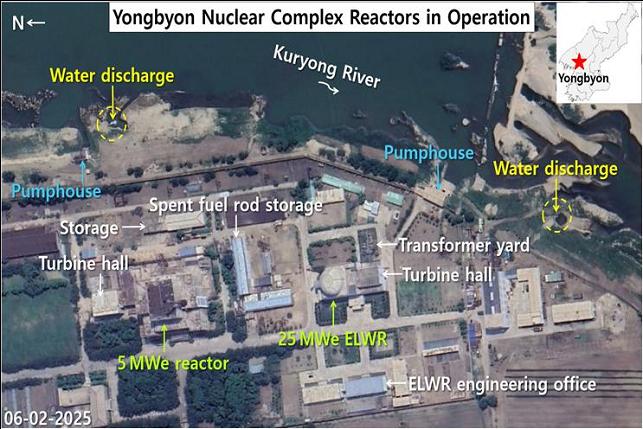
Cooling water is discharged from the Yongbyon nuclear reactors to the Kuryong River through the pump stations.
Both the 5 MWe Reactor and the Experimental Light Water Reactor are believed to be in operation. /Image: Google Earth
The operation of 5 MWe Reactor and Experimental Light Water Reactor (ELWR) in the Yongbyon nuclear complex in North Pyongan Province is mainly determined by the discharge of cooling water. Heat is generated when the nuclear fuel rod is burned to operate the reactors, when the water from the Kuryong River is drawn to cool down the high heat, and this water is discharged back to the river through the pump stations.
The cooling water discharged from the pumping stations is identified in the form of white foams on the riverside. The foam is small, so we have to zoom in on the satellite image. The pump stations are connected to the 5 MWe reactor and the ELWR one by one, and two buildings are installed along the river.
The remaining nuclear fuel rods are stored in storage, called waste fuel rods, and are later transferred to the Radiochemical Laboratory 19 kilometers away to be reprocessed to extract plutonium nuclear material. In a high-resolution satellite image taken in early June, white foam cooling water was discharged from the Kuryong River through two pumping stations, and both reactors were found to be in operation.
The 25 MWe ELWR was newly built in the 2010s, and North Korea began operating around October 2023, producing 5 times more electricity than the existing 5 MWe reactor. The 5 MWe reactor was built in the mid-1980s, and it is considered that the operation is irregular or inefficient due to the old facility and intensifying aging.
2. Recent Construction and Demolition Works

A new building that appears to be a uranium enrichment facility (UEF) has been built in the Yongbyon complex,
and the old 50 MWe reactor is being dismantled. /Image: Google Earth
A new building with a blue roof was built on the site between the Radiochemical Laboratory and the old 50 MWe reactor. It is 122m wide and 50m long, and is a large building comparable to a soccer field. The exterior appears to have been completed, but the purpose of the interior facility and building is not confirmed.
Construction of the fence and surrounding facilities is underway. According to Rafael Grossi, the secretary-general of the International Atomic Energy Agency (IAEA), the new building is believed to be similar to the one in Kangson, Nampo City, and it is estimated that the North is building an additional uranium-enrichment plant in Yongbyon following Kangson.
Meanwhile, about 400m north of the blue building is the old 50 MWe reactor, which is being dismantled recently. The old reactor is a building that was left unfinished. Construction of the 50 MWe reactor began in the mid-1980s.
Since then, construction has been suspended under the 1994 ‘Proliferation Ban and Denuclearization Agreement’ between the United States and North Korea in Geneva, Switzerland, and has been left in ruins for a long time. Some structures and auxiliary facilities have been dismantled since around 2021, and the full-scale demolition has been captured in recent satellite images.
North Korea's dismantling of the old 50 MWe reactor this time is believed to be taking down the structure to recover and recycle some materials, or to convert the site to other uses. In order to know the exact purpose of the facility and North Korea's intention, we need to watch the construction of the building and the dismantling of the old reactor through satellite imagery.
According to the analysis of the Korea Institute of Defense (KIDA), North Korea's nuclear weapons possession is estimated to have 80 to 90 nuclear warheads as of 2023, and North Korea is expected to have a base that can produce about 17 nuclear warheads annually by 2040.
-
PREV [Thematic Analysis]
-
NEXT [Analysis and suggestion]