

North Korea 30 Years After Kim Il-sung's Death: Past, Present, and Future (7)
Successors Who Inherited Kim Il-sung’s Political Traits

Kang In-deok
Former Minister of Unification of the Republic of Korea
We have briefly reviewed Kim Il-sung’s political journey from when he first came to power in October 1945 to his death in July 1994. In summary, he adopted the authoritarian methods of Joseph Stalin, who installed him as a leader. Kim Il-sung used brutal violence to eliminate not only his rivals but also anyone who posed a potential threat. For this reason, Kim Il-sung can be aptly described as a model Stalinist. Now, what about the political actions of his successors? Like Kim Il-sung, they used ruthless violence to crush any potential opposition. Let’s start by looking at his immediate successor, Kim Jong-il. Upon taking power, he declared:
People may betray one another, but a gun never does. It remains the eternal companion and ally of a revolutionary. This is my belief—my 'philosophy of the gun.' Military-first politics is my core political strategy, the universal sword that will lead our revolution to success... Our party, after analyzing the evolving social and class dynamics, was the first in revolutionary history to advocate ‘military-first, labor-second’, placing the People’s Army at the forefront of the revolution. The military is the party, the state, and the people.“
From Kim Jong-il’s remarks, it becomes clear that his political vision prioritized the military, creating a regime that promoted "military-first leadership" and established the tradition of "military-first, party-second." Under such a policy, it’s no surprise that the suffering of people enduring extreme poverty and hunger is of no concern to them. His indifference toward the people became more evident during his speech at Kim Il-sung University during the "Arduous March." He stated:
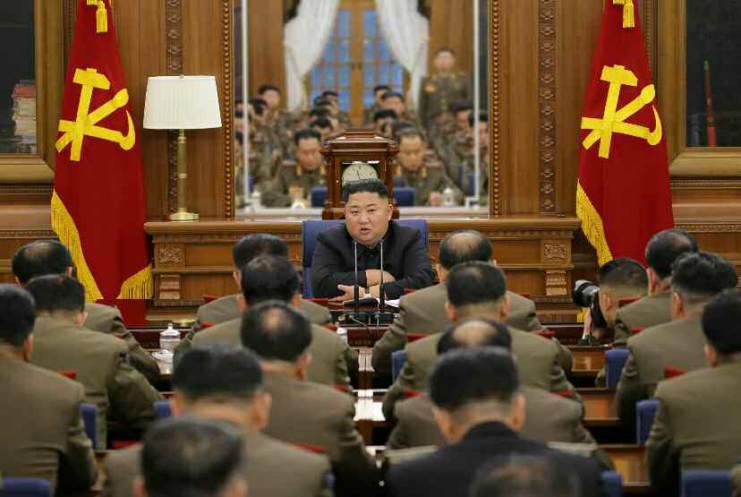
North Korean leader Kim Jong-un presides over a high-level military meeting in 2019 / Korean Central News Agency
"When I visited the Chollima Steel Complex, I saw people lined up along the road in search of food. The same was true in other regions, where the streets were packed with people looking for food. Today, anarchy reigns because of the food crisis, and the blame lies with the administrative and party officials who failed in their duties. The Central Committee officials did not demonstrate the revolutionary spirit required to handle their responsibilities... In a socialist society,
the food problem should be resolved through socialist methods, not left to individuals to handle on their own. If that happens, only markets and merchants will thrive, fostering selfishness among the people and weakening the party's class base. Our Suryong (leader) told me many times during his lifetime never to get involved in economic matters, warning that such involvement would hinder both party and military affairs."
How could a leader make such an irresponsible remark while witnessing the starvation of tens of thousands? As the nation's highest authority, shouldn’t he have used even a fraction of his billions to buy food and alleviate their suffering? Instead, Kim Jong-il shifted blame, executing the Deputy Premier responsible for agriculture. In short, he followed his predecessor's brutal tactics to strengthen his own power.
-
PREV [Analysis of issues]
-
NEXT [Feature Article Series]