

Driving Forces of Pyongyang’s Military and Diplomatic Assertiveness

Kyung Suk Lee (Incheon National University)
Why did Pyongyang adopt assertive nuclear postures indicating a preemptive use of nuclear weapons? What was the underlying rationale that Kim Jung Un called South Korea as a primary foe? Overall how can we fathom Pyongyang’s mounting military and diplomatic assertiveness? Answering these questions are important to contemplate North Korea’s possible military provocations and prevent costly military conflicts on the Korean peninsula.
Over the past couple of years, after Hanoi Summit and Russia’s invasion on Ukraine, it is strikingly obvious that North Korea has become more belligerent and aggressive. One notable example is North Korea’s Nuclear Forces Policy Law that was adopted in September 2022. North Korea initially pursued the atomic weapons as a defensive objective. The longstanding Washington’s antagonistic security policy towards Pyongyang pushed North Korea to nuclearize. In the face of security threats, the Kim family needed the bomb for regime survival. As stipulated in the 2013 country’s Law on Consolidating the Position of Nuclear Weapons, North Korea’s nuclear doctrine was designed as defensive. The use of nuclear weapons primarily aims to deter and repel invasion and attack from hostile forces.
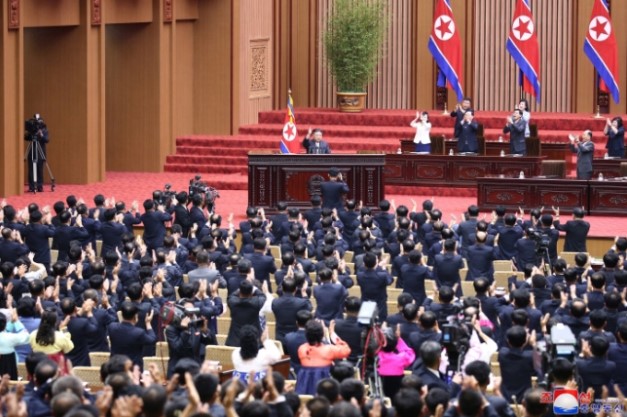
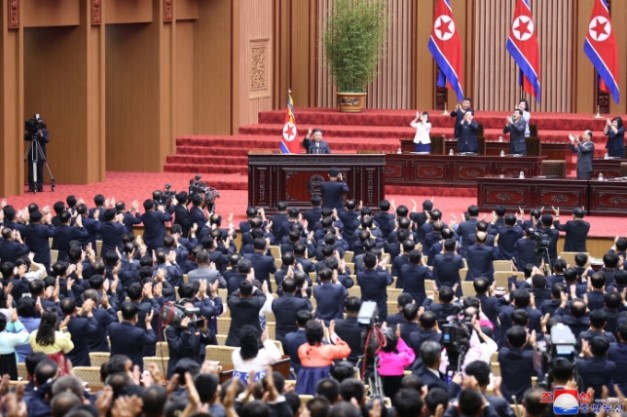
Kim Jong-un declares North Korea will never abandon its nuclear weapons at the 7th Plenary Meeting of the 14th Supreme People's Assembly
in Pyongyang on September 8, 2022, following the unanimous passage of the nuclear force policy. / Korean Central News Agency
However, the 2022 Nuclear Forces Policy Law lowered the threshold of nuclear use. It specifies five conditions under which North Korea can use the atomic weapons. This is a remarkable change compared to the 2013 Law implying North Korea can employ nuclear weapons more aggressively. In line with new conditions, North Korea not only established the state nuclear forces command organization with more belligerent nuclear command and control system, but also publicly showcased tactical nuclear warhead, Hwasan-31, with eight different delivery capabilities.
The second noteworthy example is that, in January 2024, Kim Jung Un insisted that the constitution should be amend to renounce the traditional One Korea policy and stipulate South Korea as a primary foe and invariable principal enemy. The North Korean leader also publicly announced the abolition of three organizations - the Committee for the Peaceful Reunification of the Fatherland, the National Economic Cooperation Bureau and the Mount Kumgang International Tourism Administration – that have played roles to enhance inter-Korean relations. He stressed that expressions such as “kinship”, “reconciliation” and “unification” should be no longer used to set up the relationship with South Korea. The key take from the North Korean supreme leader’s speech is that Pyongyang will adopt a fundamental shift in inter-Korean relations and the basic principle would be confrontation and competition.
Given North Korea’s changes in military and diplomatic strategies, we need to carefully analyze what propels North Korea’s assertiveness. First, after the fiasco of Hanoi summit, North Korea has been facing hawkish Yoon administration in South Korea and uncompromisable Biden administration. Under the Yoon government South Korea has implemented a hardline policy toward North Korea, so called “peace through strength”. A big turnaround from the previous Moon administration that focused on easing military tensions through improving inter-Korean relations. The Yoon administration instead has strengthened the South Korea-US extended deterrence posture and expanded the military cooperation with Japan to press North Korea. Moreover, although the Biden administration is open to a negotiation talk without preconditions, the Biden national security team has more conservative and uncompromisable standpoint in dealing with the North Korean nuclear issue. In this regard the most realistic policies that Kim Jung Un could adopt is intensifying the nuclear posture to deter external military aggression.
Second, the changes in assertive military and diplomatic policies offered Pyongyang more strategic benefits in the context of global geopolitical groupings. Under the flagship of United States, U.S. key allies in the Indo-Pacific and European regions formed the democratic bloc. On the other hand, led by China and Russia, North Korea, Iran and other autocratic countries forged the authoritarian bloc. Countries that do not align with either the democratic or authoritarian axis formed the Global South bloc. In the rising confrontations between democratic and authoritarian blocs, North Korea has evidently aligned itself with the authoritarian axis to advance its national interests. Particularly, North Korea has benefited significantly by emerging as a crucial security partner for Russia. Pyongyang has provided substantial artillery shells, military supplies, and ballistic missile to Moscow bolstering Russia's war in Ukraine. In exchange, North Korea stabilizes its economy with substantial support from Russia. Furthermore, it is likely that Moscow has provided North Korea sensitive military technologies such as nuclear submarine and ballistic missile technologies as a reward of Pyongyang’s unwavering military assistances.
Third, assertive military and diplomatic approaches are needed for Kim Jung Un to effectively strengthen internal control. Due to prevalent economic deprivations caused by ongoing economic sanctions, discontents against the Kim Jong Un regime continues to accumulate within North Korea. Although economic aids from Russia and China are reliefs for the North Korean economy, dissatisfactions are deeply embedded in the society. It is widely known that designating palpable external enemies and escalating tensions with them reinforce internal unity. By taking “us” and “them” framework, Kim Jung Un can divert the domestic discontents to the outsiders and justify why the regime should ramp up its nuclear and military capabilities. Additionally, the North Korean leader recognize that the spread of South Korean culture within North Korea poses a serious threat to the regime's survival. The majority of North Korean people have been already exposed to South Korean dramas and pop music. North Korea’s assertive standpoints toward South Korea aims to block the influence of South Korean culture and solidify Kim Jung Un’s political tenure.
In sum, confrontations and competition between the two Koreas will continue. South Korea, under Yoon government, is likely to stick to its hard-line policy toward North Korea and North Korea is unlikely to back down. The action-reaction dynamic would spiral up the military tensions on the Korean peninsula. A primary concern is that a trivial clash can easily escalate to uncontrolled military situations. To forestall worst-case scenarios, it might not an easy task to restore the direct communication channels between two Koreas. However the two parties need to agree on minimum conflict management frameworks to prevent any costly conflicts.