

Socialist Big Family
The concept of 'Socialist Big Family' views the entire North Korean society as a single-family unit, and perceives the relationship among the leader, party, and people similar to that between parents and their children. Rooted in this concept, North Korea highlights that showing loyalty and filial piety towards the leader is a natural response to benevolence.
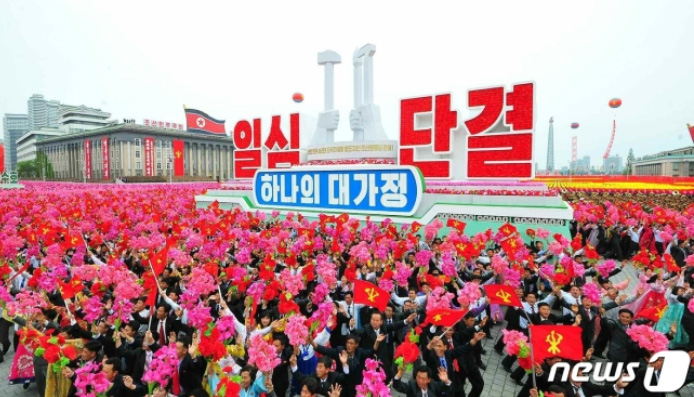
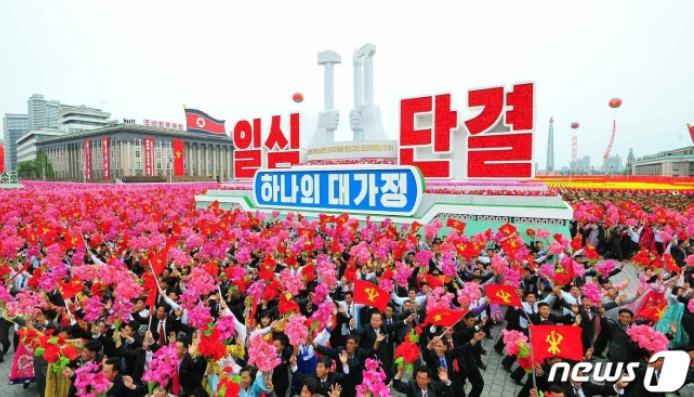
North Korean citizens waving the Workers' Party flag under the slogan "Unified heart, one family" (Photo by News1)
In his New Year's speech in 1962, Kim Il-sung stressed the need for the masses to demonstrate their patriotic dedication and heroic public spirit to transform society into a harmonious and united big family. This was aimed at consolidating the entire population into a unified big family through a collectivist spirit. Emerging in the 1960s, the Big Family concept has since evolved into discourses like the 'Red Big Family', 'Revolutionary Big Family', and 'Communist Big Family', solidifying its influential position in maintaining the socialist regime.
The Socialist Big Family concept essentially enlarges the image of the state to that of a family. By grafting the secondary group, 'the state', onto the primary group, 'the family', North Korea intends to argue that the Suryong, the supreme leader of the revolution, plays a more pivotal role than the biological parents in every household. Through the "domestication of the state", North Korea accentuates the love and trust between the Suryong and the masses, and the loyalty and filial piety of the masses towards the Suryong. This perspective is embedded in the education system, especially targeting children and teenagers, emphasizing them to grow up as 'loyal' and 'filial' to the Suryong. This is evident in the practice of reverently displaying pictures of Kim Il-sung and Kim Jong-il in the most prominent spots in households, acknowledging the Suryong as the 'true parents'. This fosters a state characterized by a patriarchal and organic nature, built upon the trinity relationship of 'Suryong-Party-People'.
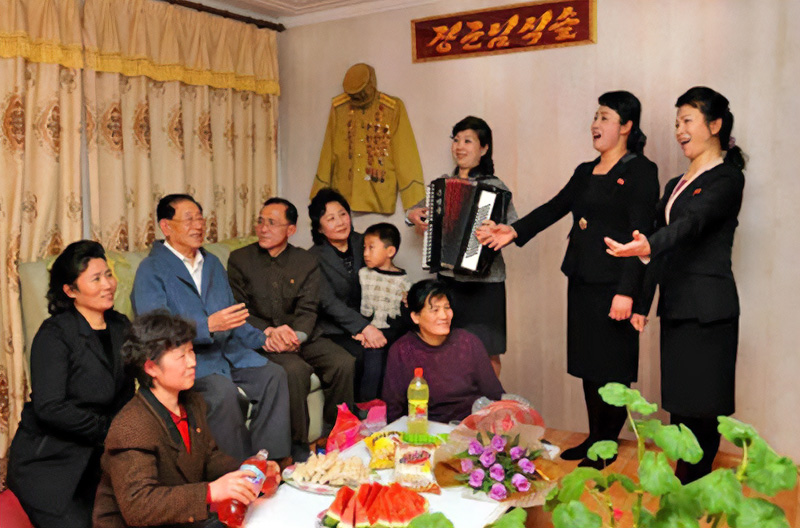
The entire society promotes unity under the "General's Guidance" within a single big family (Photo by Rodong Sinmun)
The emphasis on the Socialist Big Family ideology became pronounced in the 1990s. Faced with internal and external challenges, North Korea underscored the 'Socialist Big Family' concept that binds 'Suryong-Party-People' together, aiming to bolster its waning collectivism. By expanding the traditional family's social significance, the regime sought to solidify its legitimacy and stability. The idea behind the Socialist Big Family was to consolidate society with the Suryong at its pinnacle, especially during challenging times like the death of Kim Il-sung in the mid-1990s. This perspective also shapes a societal structure where party officials, executing directives from Kim Il-sung, Kim Jong-il, and Kim Jong-un, naturally dominate the masses. Under the recent Kim Jong-un regime, the emphasis on the Socialist Big Family concept has been revived.