

The Immortality of Kim Il-sung in North Korea:
The Black Hole of the 'Suryong, Great Leader Authoritative System'

Kyong-hui Choi, Research Director of SAND
a Ph.D. student in Politics from the University of Tokyo;
Defected from North Korea in 2001
As men, we are all equal in the presence of death.
On July 8, 1994, North Korean residents were devastated by the sudden news of Kim Il-sung's death. They believed that their country's future and their own fate relied on him, and his passing at the age of 82 shattered their hopes, leaving them with a sense of despair and uncertainty about the future.
The mourning of Kim Il-sung's death by North Korean residents is a natural response. They never considered the possibility of his mortality, as they viewed him as an immortal figure during his lifetime. In my doctoral thesis submitted to The University of Tokyo in 2015, I conducted interviews with 100 North Korean defectors who had resettled in Korea and Japan. I asked them if they ever contemplated the idea of Kim Il-sung's eventual death, given his human nature – I continue to pose this question whenever I have the chance to meet North Korean defectors— and surprisingly, their consistent response was that they never entertained such thoughts, perceiving Kim Il-sung as a divine being exempt from mortality. Even though I personally had a similar experience when I was 22 years old during Kim Il-sung's death in North Korea, I remained astounded by the steadfast mindset of the North Korean defectors who had lived in the country. This psychological phenomenon is challenging to comprehend from an external perspective.
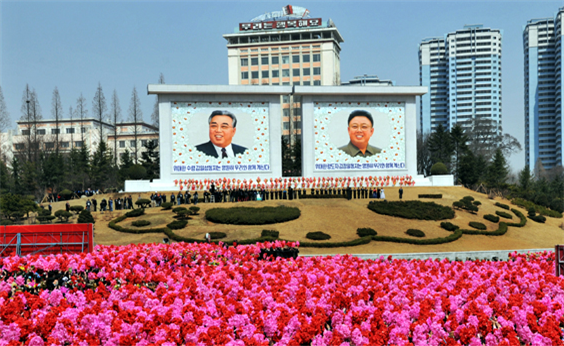
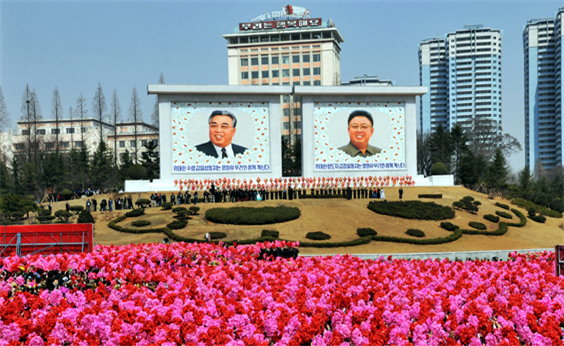
Throughout North Korea, murals with a sun emblem and the phrase "Suryong and General will be with us forever" can be seen. / by Rodong Sinmun
North Korea defines its political system as a "socio-political organism" that encompasses the Supreme Leader (Suryong), the Party, and the unified masses. This concept of a socio-political organism was introduced in a document titled "Several Problems Arising in the Ideological Education of Juche Idea,” which was initially announced on July 15, 1986, under the name of Kim Jong-il. Although the document was initially confidential, it was made public one year later, on July 15, 1987. At the core of the socio-political organism theory discussed in this document is the "Suryong-centric theory," which builds upon the "Suryong's existence theory" presented in “All about Juche Idea” announced by Kim Jong-il in March 1982. Within the Suryong-centric theory, Kim Jong-il assigns significant meaning to the dual relationship of absolute authority and succession, considering the dimensions of time and space.
The Suryong-centric theory is based on the power and authority of the Supreme Leader. In North Korea, the interpretation and establishment of ideology require the approval of Kim Il-sung. Without his approval, concepts like the existence theory, centrism, and socio-political organism theory of the Supreme Leader would not be possible. When Kim Jong-il was officially designated as the successor in February 1974, he declared the slogan, "Let's Kim Il-sung-ify the entire society." This reflected Kim Il-sung's intention to pass on his monopolistic position in ideology to Kim Jong-il, which he himself could not fully achieve.
The socio-political organism theory asserts that Suryong is the ultimate guiding force in North Korean society, occupying a position of absolute authority as the center of the past, present, and future. With a history of leading revolutionary efforts and nation-building, the Supreme Leader holds a central role in safeguarding and controlling all aspects of society. The Workers' Party of Korea, once considered the heart of the revolution, now functions as the central nervous system and organizational structure. The people are regarded as essential elements within this socio-political organism.
Kim Il-sung often used a metaphorical comparison to a peach when describing the North Korean regime in his discussions with foreigners and overseas compatriots. He explained that a peach has flesh on the outside, a hard shell inside, and a seed within. In this analogy, the seed represents the Suryong, the hard shell represents the party, and the flesh represents the masses. The objective was to strengthen the party by firmly uniting the masses around the core of the Suryong. This analogy reflects the closed system of the nation, with a Suryong-centric regime at its core, establishing an ideological and leadership system where individuals think and act according to the Suryong's understanding.
During this period, Kim Il-sung experienced a decline in both physical and mental functions as a result of the aging process, significantly impacting his life. From 1982 onwards, when Kim Il-sung was 70 years old, he began to suffer from hearing loss, which progressed to a serious impairment by the late 1980s (Selected Works of Kim Jong-il, Volume 12).
It is known that he battled heart disease for several years, underwent eye surgery, and due to fatigue, reports and novels were recorded using the voice of actress Yu Gyeong-ae (Kim Il-sung's Collected Works, Volume 43).
Kim Jong-il later revealed that despite the challenges posed by aging, Kim Il-sung "never took a break from work despite his illnesses," illustrahighlighting his relentless pursuit of power and his persistent drive to push himself to the limits.
As Kim Il-sung aged, Kim Jong-il's role and influence expanded, positioning him as the successor to the all-powerful Suryong Kim Il-sung. Tasked with supplementing Kim Il-sung's power, Kim Jong-il demonstrated unwavering loyalty and filial piety as a son. Selected as an absolute obedient follower who could never replace Suryong, Kim Jong-il became a presence like Suryong's incarnation, considering giving absolute loyalty to Kim Il-sung as his highest mission. In 1991, when presented with plans for Kim Jong-il’s statue at the Mansudae Art Studio, Kim Il-sung directly refused it, also refusing the establishment of memorials such as the "Jangjasan Memorial" and "Changgwangsan Memorial" that conveyed Kim Jong-il's achievements. However, he gave his approval for the construction of the "Three Revolutions Exhibition Hall," deliberately modifying it to emphasize Kim Jong-il's achievements and portray him as a loyal follower of Kim Il-sung. These facts provide a clear illustration of Kim Il-sung's monopolistic ambition for power.
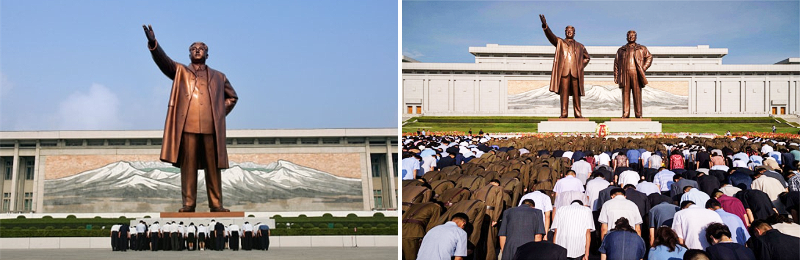
Pyongyang Mansu Hill Grand Monument – Statue erected in April 1972 to commemorate the 60th birthday of Kim Il-sung (Left). Statue erected after the death of Kim Jong-il in 2012 (Right), proclaiming the Kim Family Regime.
Kim Il-sung's power concept was manifested through revisions made to the socialist constitution and the restructuring of state institutions in April 1992. These changes legalized the state's command system under the leadership of the Chairman, granting executive authority to President Kim Jong-il. A similar approach was adopted in foreign policy as well.
In September 1990, Kim Il-sung directly raised the important issue of normalizing relations between Japan and North Korea during a visit by Kanemaru Shin, the vice president of Japan's Liberal Democratic Party. This demonstrated Kim Il-sung's active involvement in shaping foreign relations. Additionally, during the Second Inter-Korean High-Level Talks in Pyongyang in October, Kim Il-sung expressed a willingness to coexist with "two governments." In his New Year's speech for 1991, he further proposed a reunification plan characterized by "one nation, one state, two systems, two governments," which marked a departure from the previously held principle of a unified Korea. These actions reflected a significant shift in stance and a willingness to make concessions.
Even during the visit of former US President James Earl Carter Jr. to Pyongyang in June 1994, it was Kim Il-sung who held the ultimate decision-making authority. He aimed for negotiations with the US, conditional on halting nuclear development. Furthermore, it was Kim Il-sung, not Kim Jong-il, who made the decision to proceed with the Inter-Korean Summit on July 25 of the same year and expedited the preparations for it. He even had plans to visit Seoul in August 1995, on the occasion of the 50th anniversary of the Liberation of Korea, following the Summit in Pyongyang, with the intention of delivering a speech to the citizens of Seoul. These significant shifts in foreign policy were made possible due to Kim Il-sung's complete control over decision-making in all matters as the supreme authority of the socio-political organism, leaving no room for Kim Jong-il to participate in foreign policy matters.
Kim Il-sung planned for his 90th and even envisioned his 120th birthday, demonstrating his determination to maintain power indefinitely despite the effects of aging. While he succeeded in achieving his goal of eternal leadership, he fell short in fulfilling the policy objectives he had long proclaimed, including improving the lives of the people, resolving the reunification issue, and addressing hostilities with the United States. As the supreme leader of the nation, Kim Il-sung left behind a legacy of unfulfilled promises, leaving behind a burden of unaccomplished political tasks.
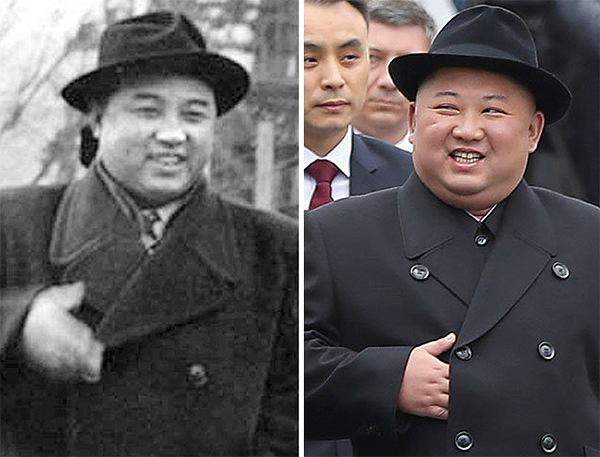
Kim Jong-un's arrival at Vladivostok railway station in Russia on April 24, 2019, caught people's attention due to its resemblance to Kim Il-sung's visit to Beijing in November 1953.
What Kim Il-sung left behind was the enduring Suryong system, a perpetual power structure that does not involve the transfer or separation of power. This system is upheld by the divine authority attributed to the Suryong, a principle that extends to the reigns of Kim Jong-il and Kim Jong-un as well. Following Kim Il-sung's passing, Kim Jong-il declared a three-year mourning period and implemented a system of hereditary rule. The teachings imparted by Kim Il-sung, who passed away decades ago, have become official policies, and governance practices have continued through the lineage, emphasizing the need to emulate the Suryong. This is referred to in North Korea as the "the Mount Paektu bloodline”. While Kim Il Sung's efforts on Anti-Japanese, the birth myths surrounding Kim Jong-il, and the founding myths may be fabrications, they serve to legitimize the power of the Suryong through the perceived legitimacy of tradition and lineage. It is crucial for the people of North Korea to liberate themselves from the deceptive grip of the Suryong system, which offers no progression, enlightenment, or intrinsic worth.
-
PREV [Defectors' Podium]
-
NEXT [Feature Article]