

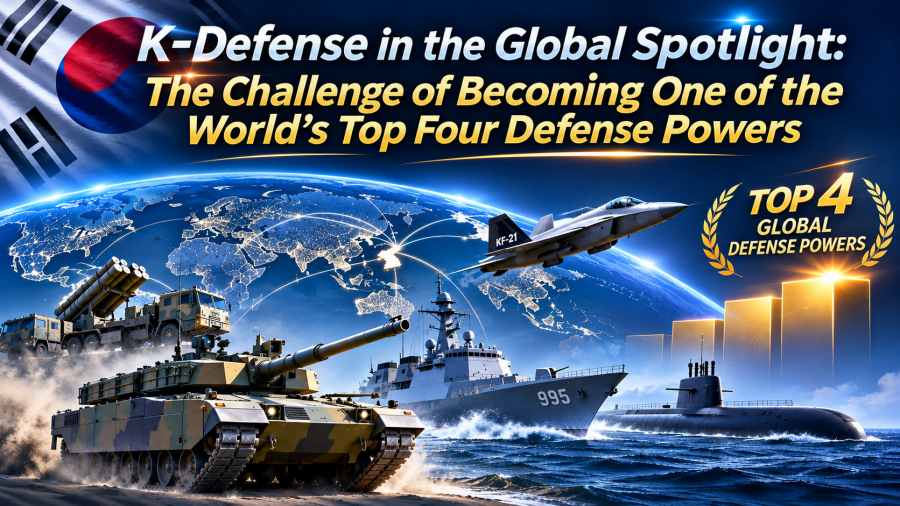
K-Defense in the Global Spotlight: The Challenge of Becoming One of the World’s Top Four Defense Powers

Chan Yang
Senior Researcher
Policy Research Center
Korea Defense Industry Promotion Association
South Korea’s defense industry has emerged as a strategic pillar of national security and an increasingly important driver of export growth. According to data released by the Stockholm International Peace Research Institute (SIPRI) in 2026, South Korea ranked as the world’s ninth-largest exporter of major arms for the 2021–2025 period, with the volume of its major arms exports increasing by 24 percent compared with the previous five-year period. This achievement is particularly significant because SIPRI’s figures measure the volume of actual international arms transfers rather than the monetary value of export contracts.
South Korea’s growing presence in the global defense market has become particularly evident since Russia’s invasion of Ukraine in 2022. As European countries have sought to strengthen their military capabilities, procurement decisions have increasingly emphasized not only the performance of weapons systems but also timely delivery, reliable supply, and long-term operational support. South Korea has responded to these requirements by securing major defense contracts with Poland for K2 main battle tanks, K9 self-propelled howitzers, FA-50 light combat aircraft, and K239 Chunmoo multiple rocket launchers, while proceeding with deliveries under these contracts.
More importantly, the success of South Korea’s defense industry should not be viewed merely as a temporary surge in exports. Rather, it reflects the convergence of several long-standing strengths: a defense industrial ecosystem developed over more than half a century; responsive production capabilities underpinned by a well-established manufacturing base; continuous improvements informed by operational experience and military training; and industrial partnerships with importing countries. Sustaining this momentum will require a clear understanding of these competitive advantages and continued efforts to build on them.
The Legacy of Defense Self-Reliance: A Distinctive Industrial Ecosystem Driven by Private-Sector Manufacturing
The foundations of South Korea’s defense industry lie in its longstanding commitment to defense self-reliance and the capabilities of its competitive private-sector manufacturing base. Since the establishment of the Agency for Defense Development (ADD) in the 1970s, South Korea has steadily expanded its defense research and development capabilities, progressing from the domestic production of basic firearms to the development of guided weapons and advanced weapons systems. The industry’s technological foundations have further strengthened as the military has established operational requirements and research institutions and private companies have accumulated experience in development, testing, and mass production.
A particular strength of South Korea’s defense industry lies in its ability to leverage technological capabilities developed in civilian industries, including automotive manufacturing, precision machinery, shipbuilding, electronics, and information and communications technology. Production and precision-machining technologies developed in the automotive and machinery sectors provide an industrial foundation for ground-based weapons systems. The shipbuilding industry’s design and construction capabilities support the development and production of naval vessels and submarines, while advances in electronics and information and communications technology underpin surveillance, communications, and command-and-control systems. Expertise in production management and quality assurance gained in civilian industries also contributes to the efficient mass production, reliability, and continuous improvement of complex weapons systems.
These capabilities, however, cannot be sustained by major defense contractors alone. An effective defense industrial ecosystem requires close coordination among the government, the military, defense research institutions, prime contractors, and specialized suppliers of materials, components, and equipment. Such coordination is essential to ensuring continuity throughout the entire life cycle of weapons systems, from research and development through production, sustainment, and modernization. Nevertheless, reducing dependence on critical materials, components, and foreign technologies remains an important challenge. Strengthening the technological capabilities of small and medium-sized suppliers while enhancing supply chain resilience will be essential to improving the long-term competitiveness of South Korea’s defense industrial base.
Competitive Cost-Performance and Rapid Delivery Capabilities
When procuring weapons systems, governments evaluate a broad range of factors, including operational performance, acquisition costs, delivery schedules, personnel requirements, and maintenance infrastructure. South Korea’s defense industry has gained a competitive advantage by offering integrated solutions that combine capable weapons systems, competitive pricing, reliable delivery, and comprehensive follow-on support. Its established production infrastructure and extensive experience in manufacturing equipment already in service with the Republic of Korea (ROK) Armed Forces provide an additional advantage in meeting urgent international procurement requirements.
Poland offers a particularly compelling example. Following the signing of the initial implementation contracts for K2 tanks and K9 self-propelled howitzers on August 26, 2022, the first shipment arrived in Poland on December 6 of that year. Completing the initial delivery within approximately four months demonstrated South Korea’s ability to mobilize its production and supply capabilities to meet a partner country’s urgent defense requirements. According to Poland’s Ministry of National Defence, deliveries of all 180 K2 tanks ordered under the 2022 contract had been completed by November 2025.
Enhancing Operational Reliability and Interoperability Through Military Operations and ROK-U.S. Combined Exercises
Another important strength of South Korea’s defense industry lies in the operational experience accumulated through the ROK Armed Forces’ sustained use of domestically developed weapons systems. Over many years, the ROK military has operated a wide range of platforms and conducted live-fire exercises, field maneuvers, maintenance operations, and capability upgrades. Technical shortcomings and operational requirements identified through these activities have informed design improvements, maintenance procedures, and measures to enhance equipment reliability. Although peacetime operational experience should not be equated with combat-proven performance for all systems, it nevertheless represents a significant competitive advantage.
The experience gained through ROK-U.S. combined exercises is another valuable asset. In modern warfare, operational effectiveness depends not only on the technical performance of individual weapons systems but also on the effective integration of intelligence, surveillance, reconnaissance, command and control, communications, and fire support. NATO’s approach to interoperability similarly extends beyond equipment compatibility to encompass operational procedures, training, and information exchange. South Korea’s extensive experience in combined operations therefore provides a valuable foundation for adapting its exported weapons systems to the operational requirements of partner countries.
The Polish K2 program is pursuing integration with the Polish military’s communications architecture and the battlefield management system used by its M1A2 tanks. Similarly, the Polish variant of the K239 Chunmoo, known as HOMAR-K, has been developed by integrating locally selected vehicle chassis and fire-control systems.
In the United States, South Korea’s Hanwha Defense USA signed a contract in August 2026 to provide six prototypes of the K9-based wheeled self-propelled howitzer, designated the K9MH, for the U.S. Army’s Maneuver Tactical Cannon (MTC) program. The company delivered the first prototype in October. Hanwha Aerospace also announced in November that it planned to conduct two live-fire tests of naval applications of Chunmoo guided missiles off the southern coast of the United States. In addition, the company is working with a U.S. partner to develop a launch system for unmanned surface vessels.
These initiatives illustrate the efforts of South Korean defense companies to expand the applications of their land and maritime technologies in response to the operational requirements of allied forces. It is important, however, to distinguish between development and evaluation activities and formal procurement decisions. The K9MH remains at the prototype stage, while the naval application of Chunmoo has yet to complete its planned testing. Neither system has been formally adopted by the U.S. military.
Country-Specific Technology Transfer and Long-Term Partnerships Centered on MRO
South Korea’s defense industry has distinguished itself through an export strategy that goes beyond the sale of finished weapons systems to encompass technology transfer, local production, and maintenance, repair, and overhaul (MRO) capabilities. This partnership-oriented approach aims to establish lasting industrial and security relationships with importing countries.
Today, countries acquiring advanced weapons systems increasingly seek the capacity to maintain and sustain those systems domestically while strengthening their own defense industrial bases. As demonstrated by Poland’s K2PL program, South Korea has made technology transfer, localized production, and supply chain cooperation integral components of its defense partnerships. Through this approach, South Korea seeks to position itself not merely as an equipment supplier but as a long-term security and industrial partner.
Given the extended service lives of major weapons systems, reliable access to spare parts and sustained MRO capabilities are directly linked to operational readiness and military effectiveness. By providing comprehensive logistics and sustainment support throughout the post-delivery period, South Korea helps partner countries maintain their defense capabilities over the long term while reinforcing confidence in the reliability of its defense exports.
Toward Becoming a Top-Four Global Defense Power: Strengthening Industry-Government-Military Cooperation
The growth of South Korea’s defense industry did not occur overnight. It reflects the combined contributions of sustained research and development efforts in pursuit of defense self-reliance, the technological and manufacturing strengths of the civilian industrial sector, the ROK Armed Forces’ extensive operational experience, and industrial cooperation tailored to the needs of international customers. Recent export growth has demonstrated that these accumulated capabilities can compete effectively in global defense markets. Nevertheless, becoming one of the world’s top four defense powers remains a strategic objective rather than an achievement already attained.
As international competitors expand their production capacities and importing countries place greater emphasis on localization and industrial participation, South Korea faces several important challenges. The government must strengthen the institutional foundations for timely defense acquisition, research and development, export financing, and international cooperation. Defense companies must continue to advance critical technologies, enhance supply chain resilience, and expand their post-delivery support capabilities. The military, for its part, must ensure that lessons learned from operations and training are systematically incorporated into research and development, production, and modernization programs. Particular attention should also be given to strengthening the broader industrial base, enabling small and medium-sized suppliers to grow alongside major defense contractors.
To remain a preferred partner in the global defense market, South Korea must recognize that fulfilling contractual commitments and sustaining long-term trust are just as important as securing new orders. Through close coordination among industry, government, and the military, the country can translate its recent export achievements into lasting industrial competitiveness.
Ultimately, the ambition to become one of the world’s top four defense powers is about more than increasing weapons exports. It requires South Korea to deliver reliable and effective defense capabilities, provide timely and sustained support, and build enduring partnerships that strengthen the defense capabilities and industrial bases of its allies and partner nations.
-
PREV [Current Affairs Analysis]
-
NEXT 다음 글이 없습니다.