

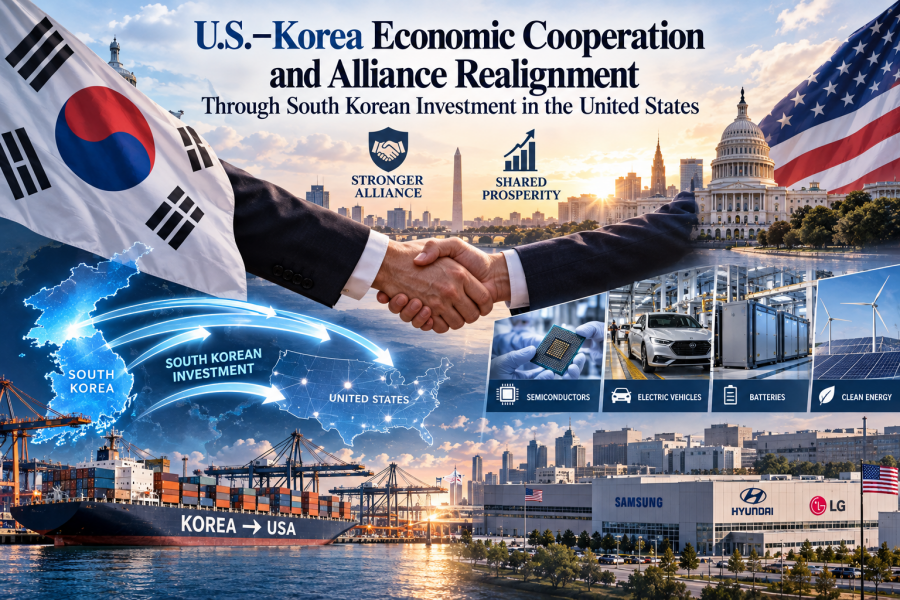
U.S.–Korea Economic Cooperation and Alliance Realignment Through South Korean Investment in the United States

Gu-sang Kang
Research Fellow
Korea Institute for International Economic Policy
One of the most significant recent developments in U.S.–Korea economic relations has been the rapid expansion of bilateral cooperation beyond traditional trade to encompass investment, production, and supply chain integration. As part of the 2025 bilateral trade negotiations, South Korea proposed a $350 billion investment package for the United States, comprising $150 billion for the shipbuilding sector and $200 billion for strategic industries, including energy and advanced technologies.
The Joint Fact Sheet released following the U.S.–Korea summit last November also identified semiconductors, pharmaceuticals, critical minerals, artificial intelligence, and quantum computing as priority areas for bilateral cooperation. These developments indicate that South Korean investment in the United States has evolved beyond individual corporate investment decisions to become a central mechanism for linking bilateral trade relations with broader economic security objectives.
The recently announced U.S.–Korea strategic investment projects further underscore the evolving nature of the bilateral economic relationship. In late September, the two countries unveiled three major initiatives: “Project Star,” which involves natural gas-fired power generation and electricity supply for data centers in Texas; “Project Power,” which aims to facilitate the construction of large-scale nuclear power plants in the United States; and “Project North,” which explores opportunities for liquefied natural gas (LNG) development in Alaska.
Specifically, Project Star involves an investment of approximately $22.3 billion to construct a combined-cycle natural gas power plant with a generating capacity of approximately 6.5 gigawatts in the Encinitas area of Texas. Project Power, meanwhile, establishes a public-private partnership framework for constructing eight large-scale nuclear power plants in the United States, with plans to mobilize up to $120 billion from the two countries’ strategic investment funds. Finally, although Project North remains subject to assessments of commercial viability and compliance with applicable domestic laws, its implementation could substantially broaden the scope of bilateral energy cooperation.
The United States has expressed considerable enthusiasm for South Korea’s proposed strategic investments. President Trump characterized the investment package as one of the largest energy infrastructure investment initiatives in U.S. history, emphasizing its potential to reinforce U.S. energy dominance and strengthen partnerships between the United States and South Korea, as well as across the broader Pacific region. The U.S. government has particularly emphasized that the proposed natural gas-fired power plant in Texas, nuclear power projects, and Alaska LNG development should be understood not merely as foreign investment initiatives, but as strategic undertakings designed to strengthen the U.S. energy supply chain and industrial base. This response offers a clear indication of how Washington views South Korean investment: not simply as an economic contribution, but as an instrument of broader strategic and industrial policy.
Three principal factors explain the high expectations surrounding South Korean investment in the United States. The first is the Trump administration’s second-term trade policy, which explicitly links tariffs to investment commitments. A central objective of this strategy is to reduce the U.S. trade deficit by imposing tariffs on imported goods while simultaneously encouraging foreign companies to relocate production facilities to the United States and expand their investment in the country.
Indeed, the Office of the United States Trade Representative has cited South Korea’s $350 billion investment commitment as a prominent example of an initiative supporting U.S. re-industrialization. From the administration’s perspective, tariffs and investment are not separate policy instruments but interrelated components of a broader strategy. Tariffs serve as leverage to encourage foreign companies to relocate production to the United States, while increased investment is one of the principal intended outcomes of that strategy.
Consequently, investment commitments in the United States have assumed unprecedented importance in the Trump administration’s trade negotiations with foreign partners.
In negotiations with major trading partners, including South Korea, Japan, and the European Union, large-scale investment commitments and purchases of U.S.-produced energy and manufactured goods have played a significant role in securing reductions in country-specific tariff rates. In South Korea’s case, for example, the two governments agreed to reduce the U.S. reciprocal tariff rate from the initially proposed 25 percent to 15 percent as part of a broader arrangement that included South Korea’s $350 billion investment package. Investment in the United States has thus emerged as an instrument of trade diplomacy through which partner countries seek to maintain stable access to the U.S. market.
The second factor is the rebuilding of the U.S. manufacturing and industrial base. Although the United States remains the world’s largest economy, structural weaknesses—including insufficient domestic production capacity, shortages of skilled workers, and vulnerabilities in critical supply chains—have long been recognized in strategic sectors such as shipbuilding, nuclear energy, and semiconductors. Washington welcomes South Korean investment because Korean companies offer far more than financial capital.
They also bring advanced manufacturing capabilities, production technologies, and extensive experience in managing complex global supply chains. The shipbuilding industry provides a particularly compelling example. In the joint briefing materials released following the U.S.–Korea summit, the U.S. government explicitly stated its expectation that South Korean investment would help modernize the American shipbuilding industry, expand production capacity, develop a skilled workforce, and strengthen critical supply chains.
The third factor is the rapid growth in energy demand associated with the AI era. It is no coincidence that a substantial share of the recently announced strategic investment projects focuses on energy infrastructure, including natural gas-fired power generation, nuclear power, and LNG. As the expansion of AI data centers has made reliable, large-scale electricity supplies a central concern of U.S. industrial policy, investment in power generation and transmission infrastructure has become increasingly integral to maintaining U.S. competitiveness in AI.
Project Star, which directly links natural gas-fired power generation to the electricity demands of data centers, exemplifies this emerging trend. Bilateral cooperation in advanced industries, initially concentrated on semiconductors and AI, is now expanding across the broader industrial ecosystem to encompass power generation, nuclear power, and LNG infrastructure.
These developments also have important implications for the future of U.S.–Korea economic cooperation. Historically, bilateral economic relations have focused primarily on expanding trade and liberalizing market access. The Korea–U.S. Free Trade Agreement, which entered into force in 2012, exemplifies this traditional approach.
More recently, however, the focus of bilateral cooperation has shifted from the extent to which each country should open its markets to broader strategic considerations: where production should be located, which partners should develop and control critical supply chains, and how strategic industrial capabilities should be distributed and shared. Recent South Korean investments in the United States illustrate this transition from trade-centered interdependence toward a model of interdependence increasingly shaped by production and supply chain integration.
As Korean companies manufacture semiconductors, batteries, and automobiles in the United States, expand the production capacity of American shipyards, and participate in the construction of conventional and nuclear power plants, bilateral economic ties will become deeper and more structurally integrated. This transformation will enhance the contribution of Korean companies to U.S. industrial competitiveness and employment while simultaneously increasing their exposure to developments in the U.S. market and regulatory environment.
This transformation also has significant implications for the U.S.–Korea alliance. Military security has traditionally served as the foundation of the alliance. However, as strategic competition between the United States and China intensifies and economic security assumes greater importance, the alliance is expanding beyond conventional defense cooperation to encompass strategic industries, including semiconductors, batteries, shipbuilding, energy, and artificial intelligence.
In particular, Washington’s growing reliance on South Korea’s accumulated industrial capabilities to address vulnerabilities in its own strategic sectors is enhancing Seoul’s strategic value within the alliance. In other words, South Korea is evolving from an ally whose role has centered primarily on receiving U.S. security guarantees into a strategic partner that also contributes directly to U.S. industrial resilience and supply chain security.
This development is particularly significant in light of growing U.S. concerns about South Korea’s economic ties with China, including Korean semiconductor investments in the Chinese market. Some members of Congress have increasingly viewed South Korea’s economic relationship with China through the lens of U.S. economic security. Against this backdrop, expanded South Korean investment in critical U.S. industries and energy infrastructure could deepen the economic interdependence between the two countries while further strengthening South Korea’s strategic importance within the alliance.
Nevertheless, large-scale investment in the United States does not automatically translate into economic or strategic benefits for South Korea. Realizing these benefits requires, above all, rigorous assessments of the commercial viability of individual projects.
The recent announcements of U.S.–Korea strategic investment projects also highlighted differences in emphasis between the two governments. While the U.S. side presented an ambitious investment agenda that included the Alaska LNG project, the South Korean government stressed that its participation in the Alaska initiative would remain contingent on commercial feasibility and compliance with applicable domestic laws. The strategic value of investment in strengthening bilateral relations does not justify pursuing projects that lack sufficient economic viability. This principle was reflected in the U.S.–Korea Strategic Investment Memorandum of Understanding signed by the two governments.
Equally important is ensuring meaningful participation by South Korean companies. Investment arrangements should be structured so that Korean capital does not merely finance U.S. infrastructure development but also creates opportunities for Korean firms to participate in equipment supply, engineering and design, construction, operations, and maintenance. Particularly in the nuclear energy and shipbuilding sectors, the objective should be to establish conditions under which Korean technological expertise and manufacturing capabilities help expand the U.S. industrial base while creating new commercial opportunities for Korean companies in the American market. Under such arrangements, investment in the United States could evolve into a mutually beneficial model of industrial cooperation rather than remain a one-way transfer of capital.
Moreover, South Korean investment in the United States should not be viewed solely as a unilateral concession or economic cost. If these large-scale investments strengthen U.S. manufacturing competitiveness, energy security, and supply chain resilience, their contributions should also be recognized as strategic assets that enhance Seoul’s position in broader bilateral economic and security discussions. Relevant issues include ensuring a stable and predictable business environment for Korean companies, securing nondiscriminatory regulatory treatment, facilitating the mobility of specialized personnel, and expanding cooperation in advanced technology sectors.
Investment, trade, economic security, and traditional defense cooperation should therefore be addressed within an integrated strategic framework. The significance of the recently announced investment projects lies less in their aggregate financial value than in what they reveal about the increasingly interconnected nature of economic and security cooperation within the U.S.–Korea alliance.
The United States needs not only South Korean capital but also the advanced industrial capabilities that Korean companies have developed in shipbuilding, nuclear energy, and semiconductors. Conversely, South Korea places considerable value on resilient supply chains and advanced technology cooperation with the United States, home to the world’s largest market. As these complementary interests deepen, the alliance has the potential to evolve beyond its traditional focus on military security into a comprehensive strategic partnership encompassing industry, technology, energy, and supply chains.
The central challenge going forward, therefore, will not simply be to increase the scale of South Korean investment in the United States, but to align U.S. strategic requirements with South Korea’s distinctive industrial strengths. At the same time, Seoul must continue to strengthen its domestic production capacity and research and development capabilities to ensure that expanding overseas investment does not undermine Korea’s domestic industrial base.
The objective should be to establish a virtuous cycle in which investment in the United States expands Korean companies’ access to the American market and creates new business opportunities, while the resulting technological advances, commercial gains, and accumulated expertise help strengthen South Korea’s domestic industrial competitiveness. Under this framework, investment in the United States can become a strategic asset that not only helps offset the costs associated with trade negotiations but also advances South Korea’s long-term economic interests and enhances the strategic value of the U.S.–Korea alliance.
-
PREV [Current Affairs Analysis] Peace on the Korean Peninsula
-
NEXT 다음 글이 없습니다.