

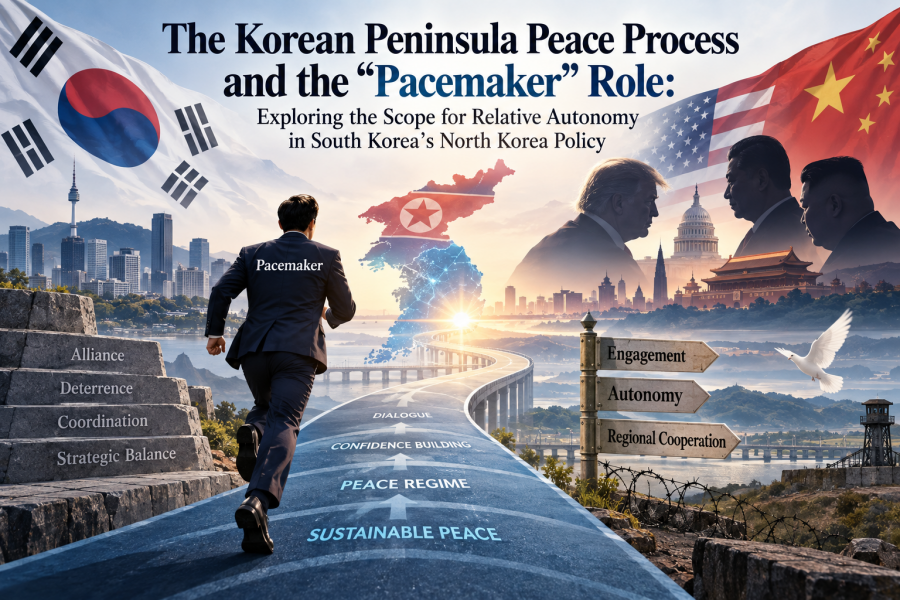
The Korean Peninsula Peace Process and the “Pacemaker” Role:
Exploring the Scope for Relative Autonomy in South Korea’s North Korea Policy

Sang-seok Moon
Professor of Sociology
Kangwon National University
1. Why a “Pacemaker”?
The central concept underpinning the Lee Jae-myung administration’s policy toward North Korea is that of a “pacemaker.” In a marathon, a pacemaker does not compete directly for victory but helps leading runners maintain a sustainable pace, conserve energy, and move steadily toward the finish line. Applied to the Korean Peninsula peace process, this analogy suggests that South Korea, as a key stakeholder, seeks to create diplomatic space and sustain momentum toward U.S.–North Korea dialogue rather than assume exclusive control over the negotiating process or its outcomes.
This approach has emerged in response to two principal developments: the prolonged impasse in U.S.–North Korea relations following the collapse of the Hanoi summit and the the prospect of the Trump administration pursuing direct negotiations with North Korea.
If South Korea remains on the sidelines, the prospect of so-called “Korea passing”—the marginalization of Seoul in decisions affecting the Korean Peninsula—could become a reality. Conversely, if Seoul moves too far ahead of the other parties, it risks undermining the confidence of both Washington and Pyongyang. The pacemaker role represents an effort to navigate between these two risks.
This article examines the principal elements of the pacemaker approach and assesses its realist foundations by comparing it with the previous South Korean administration’s “driver theory.” It further argues that the success of this approach requires South Korea to move beyond conventional assumptions about North Korea. While leaving negotiations over North Korea’s nuclear program primarily to the United States and China, Seoul should seek to shape the pace and direction of the peace process through a strategic agenda centered on human rights, economic cooperation, and people-to-people exchanges.
2. Key Elements of the “Pacemaker” Approach
a. South Korea as a Facilitator of U.S.–North Korea Dialogue
The first pillar of the pacemaker approach is to actively facilitate the resumption of U.S.–North Korea dialogue. President Lee Jae-myung has emphasized that South Korea should not remain a passive observer while diplomatic engagement remains deadlocked. Instead, Seoul should take proactive steps to create opportunities for renewed engagement. In this context, taking the initiative does not mean directly determining the agenda or outcomes of negotiations. Rather, it means creating the conditions and diplomatic environment necessary to bring both parties back to the negotiating table.
More importantly, the administration does not regard the resumption of U.S.–North Korea dialogue as an end in itself. Rather, it seeks to build on the resumption of such talks to establish a four-party dialogue involving South Korea, North Korea, the United States, and China, with the ultimate objective of transforming the armistice system that has governed the Korean Peninsula for more than seven decades into a durable peace regime. If U.S.–North Korea dialogue represents the starting point, four-party negotiations and the establishment of a peace regime constitute the ultimate destination. The pacemaker role, therefore, entails helping chart and sustain the diplomatic course toward these goals.
b. A Phased Approach Centered on Halting North Korea’s Nuclear Program
The second pillar concerns the approach to denuclearization. In his keynote address to the 81st session of the United Nations General Assembly in September 2026 and in subsequent media interviews, President Lee proposed a phased approach that would begin with halting further advances in North Korea’s nuclear and missile capabilities, potentially in exchange for calibrated sanctions relief. This approach is commonly described as a three-stage process: “freeze, reduction, and elimination.”
This approach reflects the assessment that achieving complete denuclearization through a single, comprehensive agreement is increasingly unrealistic. Given North Korea’s substantial existing nuclear capabilities, insisting on an immediate, all-encompassing settlement could prevent negotiations from getting off the ground. The proposed framework therefore seeks to halt further expansion of North Korea’s nuclear arsenal in the near term, pursue reductions over the medium term, and ultimately achieve a nuclear-free Korean Peninsula. In this sense, it seeks to preserve denuclearization as a long-term objective while establishing a more realistic, incremental pathway toward that goal.
3. Comparison with the “Driver Theory”: A Realist Choice
The distinctive features of the pacemaker approach become clearer when compared with the Moon Jae-in administration’s “driver theory.” The latter represented a proactive diplomatic vision in which South Korea sought to assume a leading role in shaping negotiations and directing developments on the Korean Peninsula. The series of inter-Korean and U.S.–North Korea summits in 2018 demonstrated that this approach could yield meaningful diplomatic results.
However, following the breakdown of the 2019 Hanoi summit, South Korea’s room for diplomatic maneuver narrowed considerably. North Korea subsequently expressed growing distrust of Seoul’s intermediary role and called on South Korea to stop acting as a mediator.
By contrast, the current administration recognizes the possibility that the Trump administration and North Korea may engage in direct talks without South Korea acting as an intermediary. Given President Trump’s preference for direct, leader-level diplomacy, this possibility is particularly salient. Under these circumstances, it would be unrealistic for Seoul to seek to regain full control over the diplomatic process. Instead, the administration has adopted a facilitator role, seeking to sustain momentum toward dialogue while avoiding South Korea’s marginalization. Even this more limited role, however, presents considerable challenges without clear support from both Washington and Pyongyang.
This choice reflects the structural constraints facing South Korea. First, South Korea was not a signatory to the 1953 Korean Armistice Agreement. Consequently, Seoul faces formal constraints relative to the United States, North Korea, and China in the legal and institutional process of replacing the armistice framework with a peace regime. Restrictions imposed by the U.S.-led United Nations Command on South Korean cabinet ministers and local government officials seeking access to certain facilities further illustrate the institutional constraints on the South Korean government’s autonomy.
Second, South Korea faces disadvantages relative to the United States and, in certain areas, Japan in accessing intelligence on North Korea. Because Seoul relies heavily on allied capabilities for critical intelligence functions, including satellite reconnaissance and signals intelligence, its ability to shape the parameters of negotiations independently remains constrained. This dependence on U.S. intelligence assets further complicates South Korea’s efforts to play a leading role in formulating policy toward North Korea. In light of these two structural constraints, the pacemaker approach can be understood as a pragmatic strategy pursued within the limits of South Korea’s available policy options.
4. Limitations and Challenges: Moving Beyond Outdated Perceptions of North Korea
Realism, however, does not necessarily guarantee effectiveness. For a pacemaker to fulfill its role successfully, it must accurately assess the position, capabilities, and intentions of the leading runner. If South Korea continues to view North Korea through outdated analytical frameworks, even a carefully designed phased approach may fail to reflect Pyongyang’s actual strategic calculations. For the pacemaker approach to be effective, Seoul must move beyond three conventional assumptions.
The first issue is the persistent question of whether North Korea should be regarded as a “normal state.” An analytical framework that characterizes North Korea exclusively as an unpredictable or irrational actor limits our ability to understand its interests and strategic calculations as a potential negotiating partner. North Korea operates according to its own strategic logic, prioritizing the survival of its political system and the stability of its leadership above other considerations. Recognizing this logic is a necessary starting point for developing policies capable of influencing North Korea’s behavior.
The second assumption is that North Korea is effectively a subordinate state of China. Despite the longstanding rhetoric of a “blood alliance,” relations between Pyongyang and Beijing are complex, shaped by mutual suspicion, competing interests, and pragmatic calculations. North Korea has historically sought to avoid excessive dependence on China and has viewed direct engagement with the United States as a means of broadening its strategic options. Treating Pyongyang merely as Beijing’s proxy risks obscuring these dynamics and overlooking potential diplomatic opportunities. South Korea, therefore, should also reassess its own reliance on China in addressing North Korea-related issues and explore a broader range of diplomatic options.
The third assumption is that the United States enjoys an overwhelming advantage over South Korea in all aspects of North Korea policy. Washington’s superiority in military capabilities and intelligence resources is evident. Nevertheless, the two Koreas share a common language, historical and cultural ties, the experience of national division, geographic proximity, and the potential for mutually beneficial economic relations. These constitute distinctive assets that the United States cannot readily replicate. If South Korea defines its role solely in terms of a subordinate partnership constrained by intelligence asymmetries, it risks overlooking these comparative advantages. Under such circumstances, the pacemaker role could be reduced to that of a supporting runner whose pace is ultimately determined by Washington. The limitations of the earlier driver theory likewise stemmed, in part, from its excessive reliance on successful U.S.–North Korea negotiations as a prerequisite for progress in inter-Korean relations.
5. Proposal: A Strategic Division of Roles and the Pacemaker Approach
Building on the preceding analysis, this article proposes redefining South Korea’s pacemaker role through a strategic division of responsibilities. Direct negotiations over North Korea’s nuclear program should be led primarily by the United States and China, while South Korea should strengthen its relative autonomy by shaping the pace and direction of the peace process through an independent yet complementary agenda focused on human rights, economic cooperation, and inter-Korean people-to-people exchanges.
Ultimately, the North Korean nuclear issue should be addressed primarily through U.S.–North Korea negotiations, alongside strategic engagement between Washington and Beijing. At its core, the issue concerns the strategic balance among nuclear-armed states, and a durable resolution will require both credible U.S. security guarantees and the exercise of Chinese influence over North Korea. If South Korea seeks to assume a leading role in these negotiations, Pyongyang may perceive Seoul as acting on Washington’s behalf, potentially exploiting this perception or excluding South Korea from substantive discussions. By allowing Washington and Beijing to take the lead on the nuclear dimension, Seoul could instead help prevent inter-Korean relations from remaining hostage to the nuclear issue. This would not constitute an abdication of responsibility, but rather a strategic adjustment of the negotiating framework to reflect prevailing geopolitical realities.
The second strategy is to cultivate bipartisan support for dialogue by building on emerging signals from the U.S. Congress. This approach is closely linked to the proposed division of responsibilities. Recent developments in Washington suggest that this framework is not merely theoretical. On September 29, Democratic Representatives Brad Sherman and Judy Chu, both from California, issued a joint statement welcoming President Trump’s efforts to resume dialogue with North Korean leader Kim Jong-un. Despite North Korea’s rejection of diplomatic overtures, the lawmakers emphasized that sustained dialogue and diplomacy remain the most effective means of protecting U.S. national security interests, addressing nuclear proliferation concerns, and achieving lasting peace on the Korean Peninsula.
This statement is significant for two reasons. First, with the November midterm elections approaching and both major parties competing intensely for control of Congress, expressions of support from opposition lawmakers for the incumbent president’s North Korea policy are noteworthy. Their position suggests that diplomatic engagement with Pyongyang may attract bipartisan support in U.S. domestic politics. Second, the lawmakers went beyond general expressions of support by proposing specific policy measures. They called on the State Department to (1) review restrictions on travel to North Korea by U.S. citizens; (2) pursue a formal agreement to legally end the Korean War; and (3) initiate negotiations to establish liaison offices between the United States and North Korea. They presented these measures as potential foundations for productive U.S.–North Korea summit diplomacy and as a means of advancing U.S. national interests.
Earlier, on September 10, Representative Sherman issued a separate statement calling for the removal of restrictions on U.S. citizens’ travel to North Korea. These proposals align closely with the pacemaker approach because they seek to create conditions conducive to nuclear negotiations rather than address the nuclear issue directly. A formal agreement to end the Korean War would also complement the proposed four-party dialogue aimed at transforming the existing armistice framework into a durable peace regime.
Similarly, the establishment of liaison offices and a review of travel restrictions would support an approach aimed at expanding people-to-people contacts and the exchange of information. South Korea should regard these expressions of support within the U.S. Congress as valuable diplomatic assets and pursue a form of pacemaker diplomacy that engages not only the executive branch in Washington but also Congress, thereby broadening the political foundations for renewed dialogue.
Third, human rights and humanitarian concerns represent areas in which South Korea can exercise greater independent initiative. Reunions of separated families, efforts to resolve issues involving detainees and abductees, and humanitarian assistance for infants, children, and other vulnerable populations can provide channels for building inter-Korean confidence while remaining consistent with applicable sanctions requirements. Environmental cooperation also offers opportunities for the two Koreas to address shared challenges and build mutual trust.
Moreover, framing human rights not merely as a basis for criticizing the North Korean regime but also as a practical agenda for improving the lives of ordinary North Koreans could help South Korea maintain international support while enhancing the prospects for engagement with Pyongyang. The proposal by Representatives Sherman and Chu to establish liaison offices also carries important implications for advancing the humanitarian and human rights agenda.
With permanent channels of communication in place, issues such as access to detainees, the repatriation of the remains of U.S. service members, and the monitoring of humanitarian assistance could be addressed through more institutionalized mechanisms. South Korea could take the initiative in bringing the concerns of separated families, abductees, and detainees into these emerging U.S.–North Korea communication channels, thereby helping transform human rights from an exclusively confrontational issue into an additional avenue for practical cooperation.
Finally, an economically oriented strategy is essential. Economic cooperation is closely linked to the proposed phased approach to denuclearization. If sanctions relief is introduced in exchange for verifiable constraints on North Korea’s nuclear activities, South Korea would be well positioned to translate such measures into tangible economic benefits. Seoul should therefore begin developing potential initiatives in cross-border cooperation, public health, forestry, and climate-related projects, alongside longer-term plans for railway connectivity and energy infrastructure.
The objective should be to ensure that North Korea perceives the benefits of halting further nuclear development not merely in terms of diplomatic assurances from Washington but also as tangible economic opportunities. In this way, South Korea’s pacemaker role could help sustain progress toward the ultimate goal of a durable peace on the Korean Peninsula. A formal agreement to end the Korean War and the establishment of liaison offices, both discussed in the U.S. Congress, could also help create more favorable institutional conditions for economic cooperation.
Addressing the legal framework governing the unresolved conflict and establishing permanent diplomatic channels could help build the confidence and institutional foundations necessary for implementing phased sanctions relief. South Korea should prepare potential project portfolios, financing mechanisms, and frameworks for cooperation with international financial institutions in advance, so that diplomatic progress between Washington and Pyongyang can be translated into concrete inter-Korean economic initiatives when political and legal conditions permit.
The movement of people is a critical link between human rights and economic cooperation. Representative Sherman’s repeated calls to lift restrictions on U.S. citizens’ travel to North Korea reflect a recognition that durable diplomatic agreements are difficult to sustain when people-to-people contacts remain severely constrained. These restrictions have also prevented Korean-Americans with relatives in North Korea from visiting their family members, creating a humanitarian concern in their own right. South Korea possesses distinctive capabilities to facilitate such exchanges that the United States cannot readily replicate.
A phased expansion of people-to-people engagement—including reunions and correspondence among separated family members, academic, cultural, and sports exchanges, visits by religious and civil society organizations, and tourism in border regions—could be pursued in areas not prohibited by sanctions or for which appropriate exemptions have been obtained. Greater mobility facilitates the exchange of information, while increased interpersonal contact can help challenge entrenched stereotypes and misconceptions. Such engagement would also offer a practical means of moving beyond the outdated assumptions about North Korea discussed earlier. If a review of U.S. travel restrictions were accompanied by expanded inter-Korean exchanges, the Korean Peninsula could begin building a body of concrete experience with peaceful coexistence without making every form of engagement contingent on progress in nuclear negotiations.
6. Conclusion
The pacemaker approach represents a realist response by South Korea to the uncertainty surrounding the prospect of direct U.S.–North Korea negotiations, given Seoul’s structural constraints, including its non-signatory status under the Korean Armistice Agreement and limited access to intelligence on North Korea. Its emphasis on facilitating bilateral dialogue, pursuing a phased approach that begins with halting further nuclear development, and ultimately establishing a peace regime through four-party negotiations reflects a pragmatic departure from the overly ambitious expectations associated with the earlier driver theory.
Nevertheless, if South Korea remains merely a supporting runner whose task is to maintain a pace set by others, the pacemaker approach risks becoming little more than a form of managed marginalization. For this role to acquire substantive meaning, Seoul must move beyond outdated assumptions that portray North Korea exclusively as an abnormal state, a subordinate actor dependent on China, or an object of U.S. strategic management. At the same time, while allowing the United States and China to take the lead in negotiations on the nuclear issue, Seoul should establish a complementary division of responsibilities by independently developing the substantive foundations for peace through human rights initiatives, humanitarian engagement, and economic cooperation.
Ultimately, an effective pacemaker is remembered not necessarily for crossing the finish line first, but for setting a pace that enables the entire race to move forward. South Korea’s success in this role should therefore be assessed not simply by asking, “Who occupied a seat at the negotiating table?” but rather, “Who helped shape the pace and direction of peace on the Korean Peninsula?” This is the essence of the relative autonomy South Korea can exercise—not only in its relations with the four major powers surrounding the Korean Peninsula, but also in its engagement with North Korea and its efforts to build domestic policy consensus. Strengthening this autonomy is an essential starting point for enhancing South Korea’s capacity to contribute meaningfully to a durable peace regime on the Korean Peninsula.