

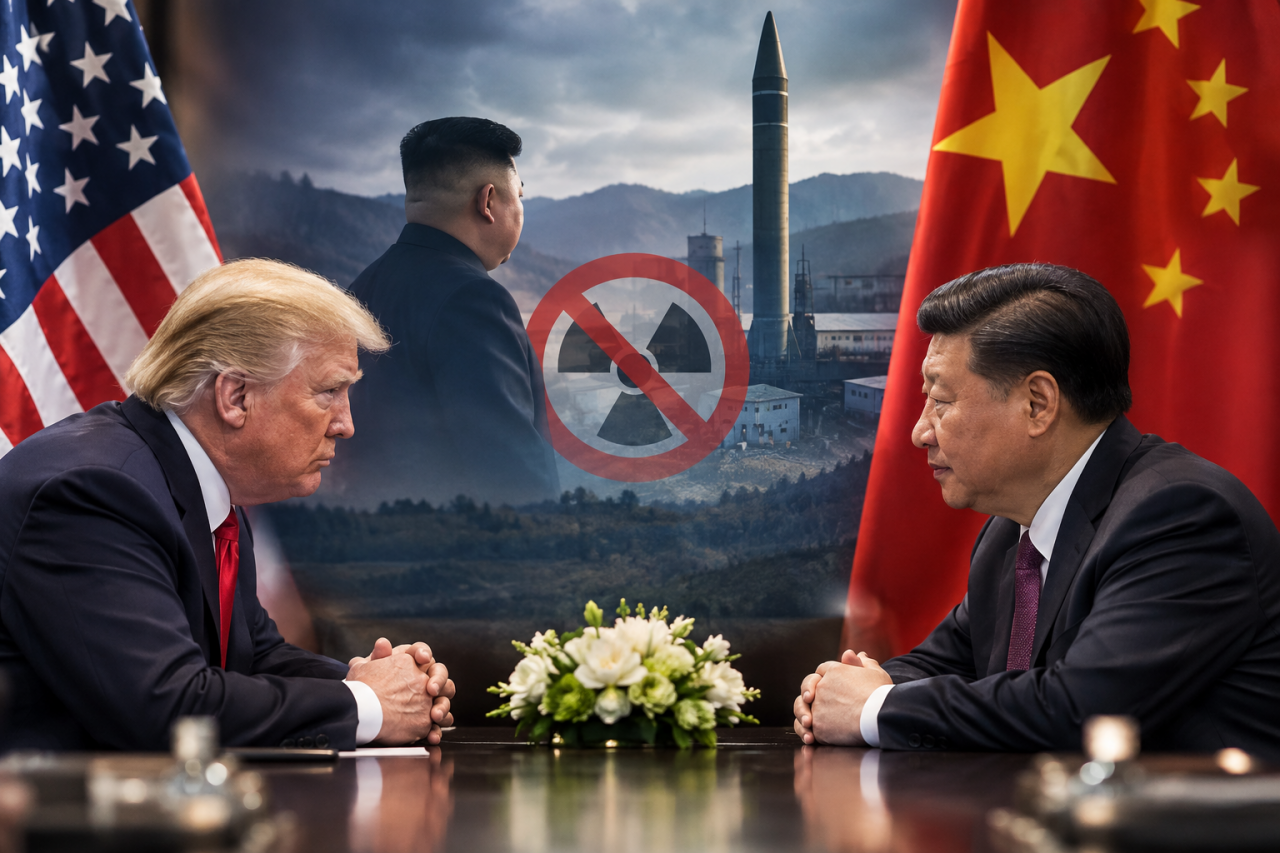
Xi Jinping’s Visit to the United States Should Put “Halting North Korea’s Nuclear Program” on the Agenda

Professor. Choi Jae duk
Seoul School of Integrated Science and Technology
Chinese President Xi Jinping is scheduled to visit the United States on September 24 for a summit with President Donald Trump. This will be their first meeting in four months, following their summit in Beijing in May. Issues expected to be on the negotiating table include Chinese purchases of U.S. agricultural products and aircraft, tariffs, artificial intelligence (AI) and semiconductors, rare earth elements, and Taiwan. Given President Trump’s stated intention to meet with North Korean leader Kim Jong-un before the end of the year, the North Korean nuclear issue could also feature in their discussions.
However, the number of issues on the agenda does not necessarily mean that the summit will produce a major agreement. U.S.-China competition has evolved into a long-term strategic rivalry that extends beyond trade and advanced technology to encompass supply chains, military and security affairs, and global influence. The summit is therefore more likely to focus on reviewing existing agreements and managing outstanding issues that require adjustment than on reaching a grand compromise that would fundamentally alter the course of bilateral relations.
Ahead of the November midterm elections, the Trump administration needs short-term achievements it can present to voters, including increased Chinese purchases of U.S. products, the creation of manufacturing jobs, and an improvement in the trade balance. China, meanwhile, is likely to use purchases of U.S. products and the supply of rare earth elements as bargaining chips in seeking tariff reductions and an easing of technology restrictions. While Washington is seeking tangible results in the near term, Beijing is placing relatively greater emphasis on limiting additional pressure and buying time to respond.
The United States is likely to demand additional Chinese purchases of agricultural and livestock products, including soybeans, corn, and beef, as well as Boeing aircraft. In May, China agreed to purchase 200 Boeing aircraft and at least $17 billion worth of U.S. agricultural products annually. At the upcoming summit, implementation of these existing commitments and improved access to the Chinese market are likely to be key issues. Although there may be limited room for negotiation on AI, semiconductors, and rare earth elements, the two countries’ fundamental strategic objectives—maintaining U.S. technological leadership and advancing China’s technological self-reliance—are unlikely to change.
The Taiwan issue offers less room for negotiation than economic and technological matters. China may seek to persuade the United States to scale back arms sales to Taiwan and limit high-level exchanges, but Washington would find it difficult to alter its existing policy, which is closely linked to Indo-Pacific security and advanced semiconductor supply chains. Ultimately, the outcome of the summit will depend more on the substance of any agreements than on the number of issues discussed. Even if the two countries reach economic agreements, it would be difficult to interpret them as evidence of an overall improvement in U.S.-China relations if their fundamental positions on advanced technology and Taiwan remain unchanged.
The same applies to the North Korean nuclear issue. Reaffirming the principle of denuclearization at a summit is fundamentally different from establishing substantive U.S.-China cooperation on North Korea. Washington may seek Beijing’s cooperation in deterring further North Korean provocations and facilitating the resumption of U.S.-North Korea dialogue. Beijing, for its part, is likely to emphasize the need for a political resolution to the Korean Peninsula issue and the importance of dialogue. This reflects China’s strategic dilemma: while concerned about the advancement of North Korea’s nuclear capabilities, Beijing remains wary of instability within the North Korean regime and of an expansion of U.S. military influence on the Korean Peninsula.
Furthermore, North Korea has expanded its diplomatic options and sources of external support through growing military and economic cooperation with Russia. As China’s influence over North Korea has become more limited than in the past, even a reaffirmation of the principle of denuclearization by the U.S. and Chinese leaders would not necessarily lead to agreement on the level of pressure to be applied to Pyongyang or on specific measures to address North Korea’s nuclear program.
That said, the North Korean nuclear issue should not be treated as a secondary item on the summit agenda. With North Korea’s possession of nuclear weapons now an established reality, efforts to achieve denuclearization of the Korean Peninsula have reached a critical juncture requiring new strategic choices. North Korea has declared its intention to continue expanding its nuclear arsenal and has rejected denuclearization negotiations altogether. While the United States continues to adhere to the principle of complete denuclearization, it has yet to establish a concrete negotiating pathway toward that objective. As international coordination on pressure against North Korea also weakens, existing approaches alone are unlikely to produce a breakthrough.
Against this backdrop, Xi Jinping’s visit to the United States could provide an important opportunity to pursue a diplomatic breakthrough on the North Korean nuclear issue.
The United States and China, both of which possess significant leverage that could help curb North Korea’s nuclear development, should make the issue a central component of their summit-level dialogue. In particular, they should move beyond merely reaffirming the long-term goal of complete denuclearization and establish “Halting North Korea’s Nuclear Program” as a concrete joint agenda item, prioritizing measures to prevent further expansion of North Korea’s nuclear capabilities.
Maintain the Principle of Denuclearization, but First Halt the Expansion of North Korea’s Nuclear Capabilities
The starting point for U.S.-China cooperation should be the establishment of an immediate and achievable common objective without abandoning the ultimate goal of denuclearization. A situation in which North Korea’s nuclear capabilities expand to a level that becomes increasingly difficult to manage would impose significant costs on both countries. For the United States, it would intensify direct nuclear and missile threats. For China, it would exacerbate the regional arms race and heighten military tensions in Northeast Asia.
Building on these shared interests, the two countries could prioritize efforts to halt the further expansion of North Korea’s nuclear capabilities. One practical approach would be to establish the following as initial negotiating objectives: halting the production of additional nuclear materials, prohibiting the export of nuclear materials abroad, and halting the development of intercontinental ballistic missile (ICBM) technology. This approach would seek to prevent the existing nuclear threat from growing further without recognizing North Korea’s possession of nuclear weapons as legitimate.
“Stopping North Korea’s nuclear program” does not represent a retreat from the principle of denuclearization. Rather, it is a phased approach that seeks to halt the further expansion of North Korea’s nuclear capabilities while preserving the ultimate objective of denuclearization and establishing a pathway toward their subsequent reduction and dismantlement. It is an effort to create realistic conditions for resuming negotiations at a time when North Korea rejects denuclearization talks altogether.
The United States could take the lead in defining the agenda for renewed dialogue with North Korea, while China could play a role in encouraging Pyongyang to engage in negotiations. If both countries use their respective influence to halt the expansion of North Korea’s nuclear capabilities, they could take an initial step toward substantially reducing the nuclear threat and moving beyond the prolonged stalemate over the principle of denuclearization.
This approach is also consistent with the phased and pragmatic approach to the North Korean nuclear issue proposed by the South Korean government. In its Fifth Basic Plan for the Development of Inter-Korean Relations (2026–2030), South Korea’s Ministry of Unification identified “substantial progress on the North Korean nuclear issue through a phased and pragmatic approach” as a key policy priority. The objective is to create conditions conducive to inter-Korean and U.S.-North Korea dialogue while pursuing meaningful progress toward resolving the nuclear issue.
In practical terms, this approach consists of three phases: “Stopping, Reduction, and Dismantlement” of North Korea’s nuclear program. The process would begin by halting North Korea’s nuclear and missile programs, proceed to reducing its nuclear capabilities, and ultimately lead to their dismantlement. It is a realistic strategy that prioritizes halting the further expansion of North Korea’s nuclear capabilities while maintaining the ultimate objective of denuclearization.
For South Korea’s plan to be effective, it must be supported by cooperation between the United States and China. Seoul should actively encourage Washington and Beijing to make halting North Korea’s nuclear program a joint agenda item. It should emphasize to the United States that, while the principle of complete denuclearization must be maintained, realistic interim objectives are necessary to facilitate negotiations. At the same time, South Korea should persuade China that halting the expansion of North Korea’s nuclear capabilities is consistent with maintaining stability on the Korean Peninsula and safeguarding regional security.
We Must Be Wary of North Korea’s Strategy to Consolidate Its Status as a Nuclear-Weapon State
Of course, there is no guarantee that North Korea will accept a proposal to halt its nuclear program. In the results of the Workers’ Party Plenary Meeting released on June 23, Kim Jong-un emphasized the continued expansion and strengthening of North Korea’s nuclear forces and the consolidation and exercise of its status as a nuclear-weapon state. He identified U.S.-South Korea military exercises and reconnaissance activities as factors contributing to the worsening situation on the Korean Peninsula, while defining nuclear forces as the foundation of military sovereignty and war deterrence.
This indicates that North Korea is treating its status as a nuclear-armed state not as a subject for negotiation, but as a precondition for negotiations. Rather than accepting South Korea’s “Stop, Reduction, and Denuclearization” framework, Pyongyang is likely to seek to redefine the negotiating framework itself around nuclear disarmament or arms control.
This is also why China’s role is becoming increasingly important. The fact that the denuclearization of the Korean Peninsula was not publicly emphasized during Xi Jinping’s visit to Pyongyang in June suggests a shift in China’s approach. While Beijing remains concerned about the advancement of North Korea’s nuclear capabilities, it appears to be managing the Korean Peninsula issue within a broader strategic context that includes the restoration of North Korea-China relations, U.S.-China strategic competition, growing North Korea-Russia cooperation, and expanding security cooperation among South Korea, the United States, and Japan.
It is unrealistic to expect cooperation to emerge solely from increased Chinese pressure on North Korea. Any viable approach must take into account China’s concerns about instability in the North Korean regime and the escalation of military tensions on the Korean Peninsula. U.S.-China cooperation should not be aimed at bringing about the collapse of the North Korean regime. Rather, it should focus on halting the further expansion of North Korea’s nuclear capabilities and reducing military risks on the Korean Peninsula.
“Stopping North Korea’s nuclear program” could provide a realistic basis for Chinese participation. An approach that seeks to reduce the nuclear threat through dialogue and negotiations, without recognizing North Korea as a nuclear-weapon state, could align the U.S. objective of preventing further nuclear proliferation with China’s interest in maintaining stability on the Korean Peninsula.
South Korea must pay close attention not only to whether the North Korean nuclear issue is included on the U.S.-China summit agenda, but also to the substance and scope of the discussions. The talks may be limited to reaffirming the principles of denuclearization and regional stability. However, they could also address China’s potential role in facilitating the resumption of U.S.-North Korea dialogue. If the discussions lead to follow-up negotiations on North Korea’s nuclear program, the South Korean government should consult closely with the United States to ensure that South Korea’s interests, policy objectives, and role are adequately reflected.
Even if the North Korean nuclear issue is discussed during Xi Jinping’s visit to the United States, Washington and Beijing are unlikely to reach an immediate agreement on a common policy toward North Korea. The United States will continue to call for complete denuclearization, while China is likely to emphasize a political resolution and stability on the Korean Peninsula. North Korea, for its part, is likely to maintain its claim to nuclear-weapon-state status and continue expanding its nuclear capabilities.
These differences, however, do not diminish the need for U.S.-China cooperation. On the contrary, as international coordination on the North Korean nuclear issue weakens and North Korea’s nuclear capabilities continue to advance, identifying realistic areas for cooperation between the two countries has become increasingly important.
If the United States and China establish stopping North Korea’s nuclear program as a joint agenda item at the summit and lay the groundwork for substantive cooperation, this could provide new momentum for the denuclearization process on the Korean Peninsula. South Korea should actively facilitate U.S.-China cooperation while working to define the scope of the proposed halt, verification mechanisms, and phased reciprocal measures. These arrangements must ensure that South Korea’s security interests are not sidelined in the negotiating process.
Ultimately, the priority should not be to repeat a declaratory standoff over whether North Korea’s possession of nuclear weapons should be recognized. Instead, the focus should be on establishing substantive measures to halt the further expansion of North Korea’s nuclear capabilities and creating a negotiating framework that links these measures to verification, reduction, and eventual dismantlement.
Stopping North Korea’s nuclear program is not a departure from denuclearization. Rather, it is a necessary step toward achieving that objective under current conditions. Xi’s visit to the United States should serve as a starting point for substantive U.S.-China cooperation on the North Korean nuclear issue, moving beyond a mere reaffirmation of principles.