


Ju-yeon Lee
Northeast Asian History Foundation
At the ceremony commemorating the 81st anniversary of Liberation Day, President Lee Jae-myung stated, “We will embark on a journey to end the war and transform the unstable armistice regime on the Korean Peninsula into a peace regime,” thereby calling for multilateral discussions aimed at formally ending the war and establishing a peace regime on the Korean Peninsula. President Lee also explained that such multilateral discussions could lead to effective measures to halt North Korea’s nuclear development. In other words, he signaled that a multilateral framework could ultimately contribute to achieving both peace and denuclearization on the Korean Peninsula.
Regarding Lee’s proposal for multilateral discussions, experts have offered both positive and negative assessments. From a positive perspective, such discussions could help break the prolonged deadlock in inter-Korean dialogue and provide a starting point for renewed engagement. Furthermore, the participation of relevant countries could help manage potential crises on the Korean Peninsula and in Northeast Asia. In particular, given that recent international conflicts have tended to erupt and escalate rapidly, sometimes as a result of miscalculation or unintended developments, multilateral discussions are viewed favorably for their potential to reduce the risk of military conflict.
On the other hand, a critical perspective expresses skepticism about the prospects for multilateral talks. This skepticism stems largely from the failure of the Six-Party Talks in the past to produce substantive results, with the negotiations yielding largely declaratory outcomes. Furthermore, there is concern that security instability on the Korean Peninsula could actually worsen if such talks were to face strong opposition from the United States, which has traditionally been South Korea’s principal security partner.
However, despite the debate between proponents and critics, the Lee Jae-myung administration’s proposal for multilateral talks can be viewed as having more potential benefits than drawbacks. This is because, among the various approaches to bringing North Korea back to the negotiating table to address issues of peace and denuclearization on the Korean Peninsula, a multilateral dialogue framework currently appears to be one of the most promising options.
Of course, judging from Unification Minister Jeong Dong-young’s assertion that four-party talks involving South Korea, North Korea, the United States, and China should follow the U.S. decision to scale back South Korea-U.S. joint military exercises, and that efforts to promote such talks are necessary, it appears that these four countries would be the principal participants in the proposed multilateral discussions.
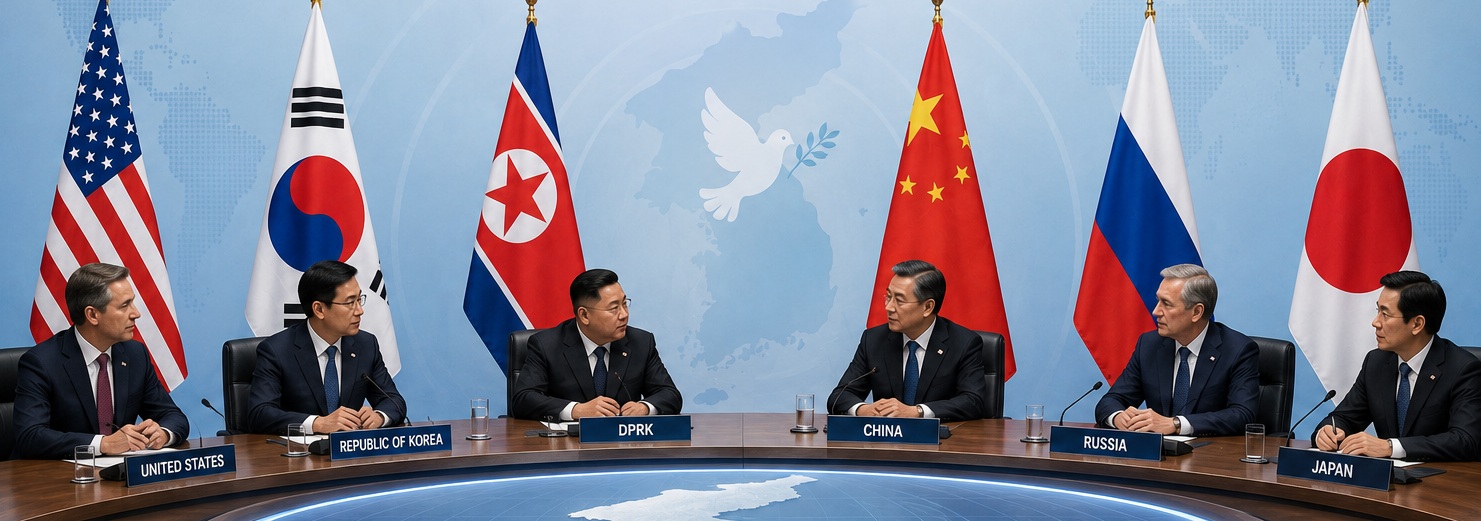
So, is establishing a consultative mechanism in the form of four-party talks the right approach to advancing peace on the Korean Peninsula? Compared with the Six-Party Talks (South Korea, North Korea, the United States, China, Russia, and Japan) held in the past, the principal advantage of the four-party talks (South Korea, North Korea, the United States, and China) is that, with fewer stakeholders involved, the parties would be able to focus on and address the core agenda items more effectively. For instance, organizing a six-party talks would require complex coordination of the schedules of representatives from all six countries, as well as the selection and preparation of a suitable venue, potentially resulting in substantial administrative burdens and costs. Furthermore, reducing the number of stakeholders through a four-party format could make decision-making on key issues more efficient.
In particular, if issues such as Japan’s abductee problem are incorporated into the broader agenda, it could become more difficult to maintain a clear focus on peace on the Korean Peninsula. Consequently, if the multilateral discussions pursued by the Lee Jae-myung administration take the form of four-party talks, a negotiating forum could be established relatively quickly, providing a basis for institutionalizing future multilateral discussions and, above all, potentially achieving tangible results more rapidly.
While it is true that the four-party format offers significant advantages, the four parties—South Korea, North Korea, the United States, and China—would not be sufficient for multilateral discussions aimed at promoting peace on the Korean Peninsula and throughout Northeast Asia. In particular, conducting multilateral discussions without Russia appears inconsistent with the current geopolitical realities of Northeast Asia and the broader international security environment. Of course, as noted earlier, it is difficult to deny that the Six-Party Talks in the past failed to produce tangible results. However, given that Russia–North Korea relations have effectively reached the level of a military alliance amid the ongoing Russia–Ukraine war, excluding Russia would significantly constrain efforts to engage North Korea.
Furthermore, as the aftermath of the Russia–Ukraine war has deepened divisions within the international community and geopolitical tensions between the South Korea–U.S.–Japan and North Korea–China–Russia alignments have become increasingly entrenched in Northeast Asia, it is necessary to move beyond simply establishing an agenda for peace on the Korean Peninsula and consider creating a consultative mechanism dedicated to peace and stability in the broader Northeast Asian region. From this perspective, including Japan in the multilateral discussions would be more reasonable than excluding it.
Of course, there are significant challenges to immediately reconvening the Six-Party Talks under the current circumstances. Above all, given Russia’s invasion of Ukraine, establishing a multilateral platform that includes Russia remains highly contentious. Furthermore, with President Putin’s recent visit to the Kuril Islands, Russia–Japan relations appear to be entering an increasingly confrontational phase. In other words, as noted above, establishing a multilateral dialogue framework would itself be extremely difficult under the current circumstances.
Therefore, I propose establishing multilateral talks in a phased and gradual manner. First, because restoring a channel of communication with North Korea is of paramount importance, we should initiate dialogue through a four-party format involving South Korea, North Korea, the United States, and China. Then, if we succeed in institutionalizing the four-party talks as a regular forum, we should consider expanding the framework into broader multilateral formats, such as “4+1” or “4+2.” In other words, we should distinguish between the four core parties—South Korea, North Korea, the United States, and China—and additional participants, such as Russia and Japan, and gradually broaden the framework.
There is a Korean proverb that says, “Too many cooks spoil the broth.” In other words, even if the Six-Party Talks are reconvened, they could potentially produce undesirable or counterproductive outcomes. However, another Korean proverb says, “Even a sheet of paper is easier to lift together,” while an African proverb states, “Alone we go fast, but together we go far.” In short, from a long-term perspective, we must establish a peace regime on the Korean Peninsula—and, by extension, a durable peace and security framework in Northeast Asia—through the creation of a multilateral dialogue framework.