

The Excellence of K-Defense: Lessons from the Ukraine Case

Hyungsuk Kim
Adjunct Professor
Graduate School of Defense Science
Hansung University
1. Introduction
The world is running short of interceptor missiles. Reuters reported on August 7, 2026, that the United States had already consumed roughly 65 percent of its Patriot interceptor stockpile during that year alone.[1] Conditions elsewhere are no better. The U.S. Army has nearly exhausted its stocks of long-range strike missiles, including ATACMS (Army Tactical Missile System) and PrSM (Precision Strike Missile), while South Korean industry reports indicate that Patriot and THAAD (Terminal High Altitude Area Defense) inventories have declined by more than 60 percent.[2] Armin Papperger, chief executive of Germany’s Rheinmetall, estimates that rebuilding allied inventories to normal levels will take at least two years.[2]
The fact that the country with the world’s largest defense budget cannot resupply itself quickly enough is more than a procurement problem. It raises a harder question: What does modern warfare actually demand of an air defense system, and how many nations are capable of meeting that demand?
This paper addresses that question using daily strike data from the Russia-Ukraine air war, covering the period from September 28, 2022, through August 14, 2026. The analysis proceeds in four steps. It first establishes what a sustained war of attrition requires of air defenses. It then identifies which types of attacks defeat those defenses. Next, it explains why so few countries can supply what is needed. Finally, it shows how Korea has already demonstrated, in practice, that it can.
2. The Math of Attrition
The figures used throughout this paper come from a publicly available dataset that compiles the daily engagement reports issued by the Air Force Command and the General Staff of the Armed Forces of Ukraine.[8] These are operational reports rather than audited statistics, and the author has reorganized them by weapon type, year, and individual salvo. They should therefore be understood as indicative of scale and trends rather than as official accounting.
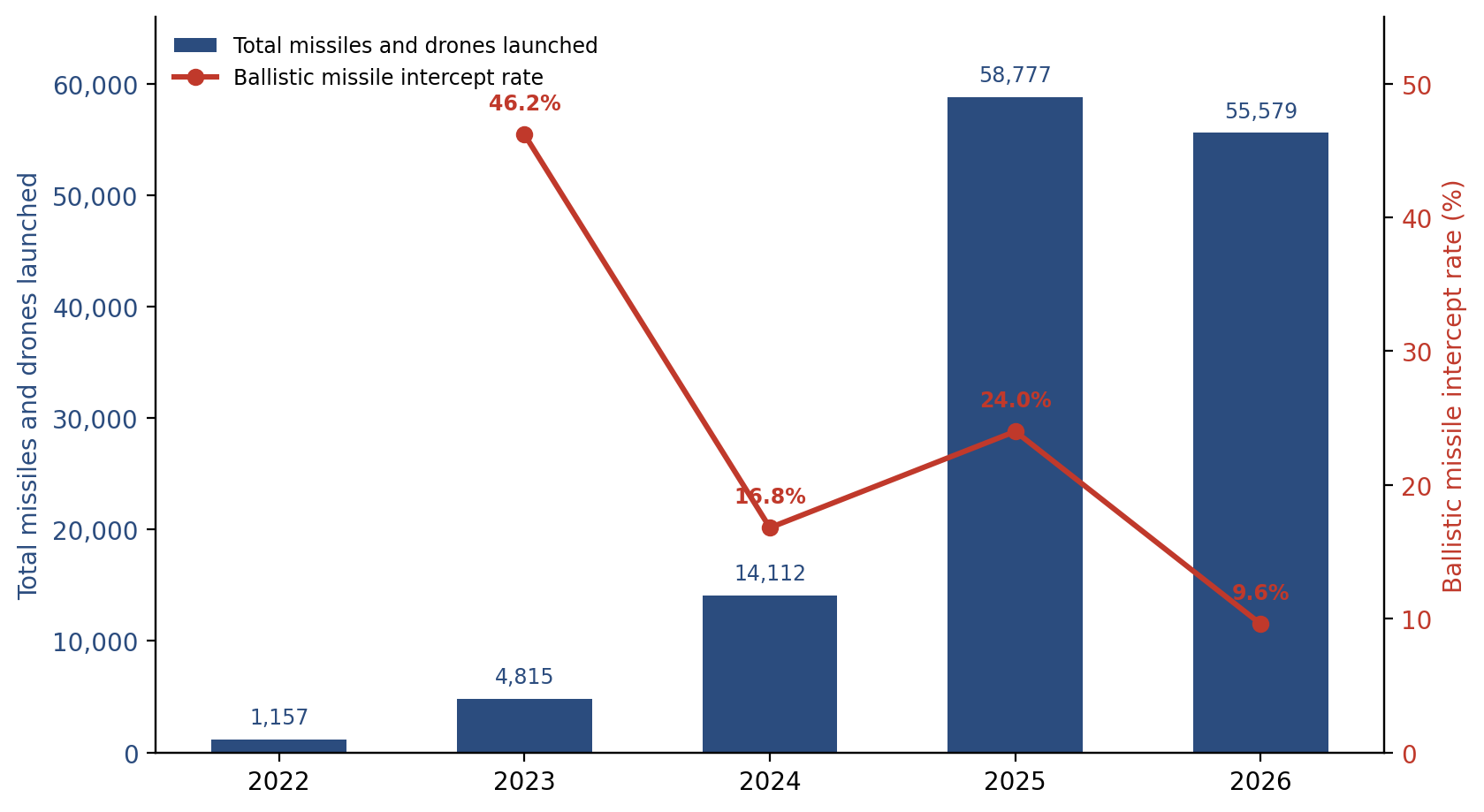
On that basis, more than 134,000 missiles and drones have been launched against Ukraine since the war began, and the annual volume has risen steeply. Ukraine recorded 1,157 launches in 2022, 4,815 in 2023, and 14,112 in 2024. By 2025, the figure had reached 58,777—roughly 50 times the 2022 total—and the 2026 count stood at 55,579 by mid-August. Figure 1 plots this growth against the intercept rate achieved specifically against ballistic missiles, and the divergence between the two lines is the central finding of this paper.
Figure 1. Attack Volume and Ballistic Missile Intercept Rate: 2022-2026
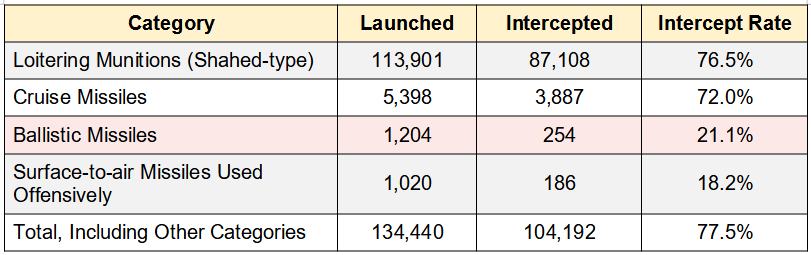
Volume alone, however, understates the problem because intercept performance varies enormously by threat type. Table 1 sets out the cumulative record. Ukrainian defenses stopped 76.5 percent of Shahed-type loitering munitions and 72.0 percent of cruise missiles, but only 21.1 percent of ballistic missiles. In other words, these defenses cope reasonably well with cheap, high-volume threats but remain structurally weak against the fastest and most demanding ones. The final row of the table exceeds the sum of the rows above it because several minor categories, including guided bombs and a small number of intercontinental ballistic missiles, are not listed separately.
Table 1. Intercept Rates by Weapon Type: September 28, 2022 - August 14, 2026
Nor has this weakness eased over time. As Figure 1 shows, the ballistic missile intercept rate fell from 46.2 percent in 2023 to 16.8 percent in 2024, recovered modestly to 24.0 percent in 2025, and slipped again to 9.6 percent in 2026. Over a period in which attack volume grew nearly fiftyfold, performance against the most dangerous class of weapon did not improve; it merely fluctuated. One conclusion follows directly: current interceptor supplies cannot keep pace with sustained, high-intensity warfare.
3. What Kinds of Attacks Defeat Air Defenses
The aggregate figures conceal a sharper pattern that emerges only when individual salvos are examined. The dataset separately records fourteen attacks involving multiple missile types, and sorting these salvos by composition reveals the contrast shown in Table 2.
Table 2. Intercept Rates for Combined Salvos by Composition

The difference is striking. When Russia combined cruise and air-launched weapons such as the Kh-101, the Kalibr, and the Iskander-K, Ukrainian defenses intercepted 88.4 percent of the incoming rounds. That is a higher rate than either category achieved on its own. When ballistic missiles were added to the mix, however, the intercept rate collapsed to 37.2 percent, and in two of those salvos, not a single round was stopped.
The lesson is not that combined attacks are inherently harder to defeat. Rather, it is that the presence of ballistic missiles, rather than the mixing itself, is what breaks through a defense. Fourteen salvos is admittedly a small sample, and the percentages should be interpreted with that in mind, but the direction of the result is consistent with the cumulative figures in Table 1.
A second pattern reinforces the point. Ballistic missiles fired in ones and twos were intercepted only 8.5 percent of the time, whereas salvos of eleven or more were intercepted at a rate of 34.5 percent. This may appear counterintuitive, but the likely explanation is straightforward: large salvos are typically directed at Kyiv and other population centers where interceptor batteries are concentrated, while isolated launches often strike locations outside dedicated ballistic missile defense coverage. Capability alone, therefore, does not determine outcomes. Coverage and magazine depth do.
The identity of the missiles involved gives this analysis particular significance for the Korean Peninsula. Table 3 breaks down the ballistic missile total by type, and the third and fourth rows deserve close attention. Ukrainian reporting uses the compound designation Iskander-M/KN-23 when Russian and North Korean short-range ballistic missiles cannot be distinguished from one another, and the KN-23 is a North Korean weapon. Taken together with the rounds identified as KN-23 outright, 372 of the 1,204 ballistic missiles fired at Ukraine—roughly three in ten—belong to a category in which a North Korean weapon may be involved. Against a defense network built around Patriot, those rounds were intercepted about a quarter of the time.
Table 3. Ballistic Missile Intercept Rates by Type
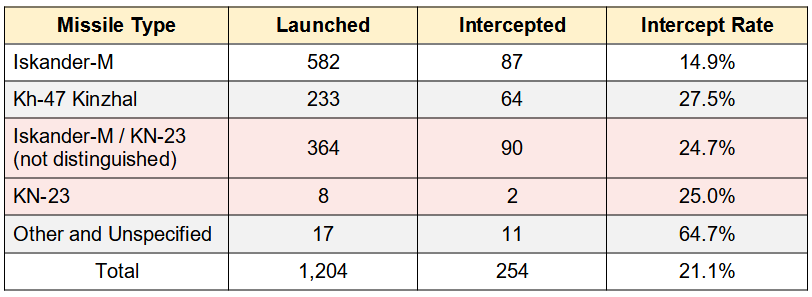
That table describes the same class of weapon that Korean air defenses were built to counter, and this is where South Korea’s position differs from that of most other producers. For other countries, defeating short-range ballistic missiles is one requirement among many. For Korea, it has been the organizing principle of air-defense development for decades. Cheongung-II, Cheongung-III, and L-SAM were not designed for an export market and later adapted to address this threat. They were designed specifically to counter this threat, and the market followed.
4. The Bottleneck Is Industrial, Not Financial
If the demand is now clear, the obvious response would be to build more interceptors. The Patriot shortage shows why that is harder than it sounds—and why the constraint is industrial rather than financial.
In September 2025, the U.S. Army awarded Lockheed Martin a multi-year contract worth $9.8 billion for 1,970 PAC-3 MSE (Patriot Advanced Capability-3 Missile Segment Enhancement) interceptors, the system’s principal interceptor, and followed it in April 2026 with a further $4.7 billion to accelerate production. Together, these awards aim to more than triple annual production capacity, from roughly 600 missiles to about 2,000. Yet Lockheed Martin increased production by only 60 percent over the preceding two years, reaching a record 620 missiles in 2025. At that rate, the new target remains distant.[1]
Efforts to widen the industrial base have encountered the same obstacle. A plan to raise U.S. interceptor production from about 500 to more than 750 missiles a year by expanding licensed production in Japan stalled because of a shortage of seeker units supplied by Boeing. Mitsubishi Heavy Industries builds roughly 30 PAC-3 rounds a year and could, in principle, double that figure, but it was unable to do so while the seeker bottleneck persisted.[3]
The implication is uncomfortable. When the country with the world’s largest defense budget and deepest industrial base cannot expand output on demand because of a single constrained component, the capacity to build advanced weapons quickly, reliably, and at scale is genuinely scarce. Competitiveness in air defense is therefore not a matter of technology alone. It requires design capability, stable production lines, a resilient supplier network, and close coordination among government, the military, and industry, all operating together and at speed. Few countries possess all four.
5. What South Korea Has Demonstrated: Precision, Speed, and Scale
South Korea is one of the few countries that has recently demonstrated that it can.
Precision. In March 2026, an assessment by Ahmed Sharif, a military analyst in the United Arab Emirates (UAE), attracted wide attention. Sharif reported that during the opening days of the U.S.-Iran conflict, Iran launched 137 missiles at targets in the UAE, including American bases, and that the country’s layered air defense network destroyed 132 of them, an intercept rate of 96 percent. Including drones, the network stopped 327 of 346 incoming weapons, or 95 percent.[4]
That network comprises Patriot, THAAD, Israel’s Arrow, and South Korea’s Cheongung-II, a medium-range system also designated M-SAM (Medium-range Surface-to-Air Missile). The 96 percent figure therefore describes the combined performance of all four systems, not that of Cheongung-II alone, although some South Korean outlets have since reported it as a measure of the Korean system’s performance by itself.[5] The distinction matters for accuracy, but it does not diminish the underlying point. This marked the first combat employment of a South Korean-exported weapon system, and evidence from actual combat carries a weight that no brochure can match.
South Korea is building on that result. Cheongung-III, a successor designed to engage ballistic missiles at higher altitudes, entered development under a 2025 contract with the Defense Acquisition Program Administration,[5] while L-SAM (Long-range Surface-to-Air Missile) is being fielded as the upper tier of a layered architecture. Read against Section 3, the purpose of that architecture is unmistakable: the layer South Korea is now building is precisely the one that failed in Ukraine.
Speed. South Korea’s K9 howitzer program in Poland offers the clearest illustration. Poland signed an initial contract for 212 K9A1 howitzers with Hanwha Aerospace in August 2022, and the first 24 units arrived just four months later, in December of that year.[7] Meeting that schedule owed less to factory capacity than to the ability of government, the military, and industry to operate as a single team.[6] Poland has since expanded its order to 364 units across two contracts, establishing the K9 as a mainstay of its artillery force, with provision for as many as 672 units under the original framework agreement.[7]
Scale. Cheongung-II has generated approximately $9.5 billion in cumulative export orders for South Korea.[5] The UAE signed the first major contract in January 2022, worth about $3.5 billion for ten batteries, followed by Saudi Arabia and Iraq with agreements worth roughly $2.9 billion and $2.6 billion, respectively.[4] Negotiations with Qatar and Kuwait could add close to $2 billion more.[5] Taken together, these are not the marks of a single fortunate sale but evidence of a durable industrial capability.
Precision, speed, and scale—each demonstrated in combat or delivery records rather than in projections—are capabilities that few countries can claim to possess.
6. Beyond Arms Sales: Toward Genuine Partnership
The logical next step for South Korea is not a series of one-off transactions but lasting partnerships, and the Poland program already indicates the form they should take. Immediate requirements are met with finished systems built in Korea. Local production, MRO (maintenance, repair, and overhaul) cooperation, and progressive supply-chain localization then follow in sequence.[6][7]
This model does more than serve the customer. It addresses the structural problem identified in Section 4 because distributing production across more countries reduces the risk that a single national bottleneck can leave the world short of air defense systems.
Such partnerships complement the U.S.-led alliance supply system rather than competing with it. Where American industry cannot meet demand in sufficient volume or within the required timeframe, Korea can, drawing on proven performance and rapid production. The benefit extends beyond any single buyer, since a more diversified supplier base makes allied deterrence more resilient as a whole.
7. Conclusion
Three findings converge. Modern attrition warfare demands volume, speed, and precision simultaneously, and the Ukrainian record shows what happens when that demand goes unmet—above all against ballistic missiles and where coverage is thin. Very few countries can close that gap. Even the world’s largest defense budget is currently constrained by an industrial base that cannot be expanded on demand.
South Korea belongs to that small group, and not merely by an accident of timing. The systems now drawing interest abroad were developed to address the most demanding version of the problem described by the Ukrainian data, and they are produced by an industrial base that has repeatedly delivered at speed and scale. Combat performance in the Gulf, deliveries to Poland within four months of the initial contract, and a $9.5 billion order book are three independent measures of the same underlying capability.
What follows is a question of role rather than capacity. The world is not short of air defense designs; it is short of producers able to build them in the quantities and on the timelines that sustained conflict now requires. Korea has demonstrated that it can. For allied nations seeking to strengthen and diversify their air defense capabilities, the partner they are looking for is already in the field.
[1] "Patriot Missile Shortage Deepens As Global Demand Outpaces Interceptor Production," TheDefenseWatch.com, August 8, 2026 (citing Reuters, August 7, 2026; includes PAC-3 MSE contract values and production-capacity figures). https://thedefensewatch.com/military-ordnance/patriot-missile-shortage-interceptor-production/
[2] Kim Hyun-jung, "US Missile Stockpiles Running Low: Korean Defense Firms Fill the Global Supply Gap," MTN (Money Today Broadcasting), August 11, 2026. https://v.daum.net/v/20260811060706009
[3] Vadim Kushnikov, "U.S. Patriot Missile Production Hampered by Boeing Component Shortage," Militarnyi, July 21, 2024 (citing Reuters). https://militarnyi.com/en/news/u-s-patriot-missile-production-hampered-by-boeing-component-shortage/
[4] Jung Han-gyeol, "Korean-Made Cheongung-II, Exported to the UAE, Intercepts Iranian Missiles in First Combat Use," Money Today, March 3, 2026. Won-denominated contract values converted at approximately 1,450 won to the dollar. https://www.mt.co.kr/politics/2026/03/03/2026030319073899508
[5] Kim Ji-hyun, "'A Surprising Hit Rate': Cheongung-II Draws Growing Interest After $9.5 Billion in Exports," Money Today, June 27, 2026 (updated August 11, 2026). https://www.mt.co.kr/industry/2026/06/27/2026062613402352093
[6] Kang Eun-ho (Professor, Jeonbuk National University; former Commissioner, Defense Acquisition Program Administration), "Poland Surprised by Rapid K9 Deliveries: 'A True Defense Partner'," Hankook Ilbo, August 11, 2026. https://www.hankookilbo.com/news/article/A2026081014290002438
[7] Yoon Tae-hee, "'364 Korean K9s': Poland's Emergency Purchase Becomes Its Main Artillery," Now News (Seoul Sinmun), July 6, 2026. https://nownews.seoul.co.kr/news/newsView.php?id=20260706601006
[8] Petro Ivaniuk, "Massive Missile Attacks on Ukraine" (Kaggle dataset, compiled from daily reports of the Air Force Command and General Staff of the Armed Forces of Ukraine), version accessed August 15, 2026. https://www.kaggle.com/datasets/piterfm/massive-missile-attacks-on-ukraine
-
PREV [NK Focus]
-
NEXT [Feature Article]