

The April 27 Panmunjom Declaration and the DMZ Peace Trail: Toward Peaceful Coexistence on the Korean Peninsula
Deok haeng Lee
Former Presidential Secretary for Unification Affairs
April 27 marked the eighth anniversary of the 2018 Inter-Korean summit. In retrospect, the Panmunjom Declaration—the agreement reached at that summit—represented a significant breakthrough, helping to alleviate the persistent frustration arising from the intractable North Korean nuclear issue and the prolonged stagnation of inter-Korean relations.
Following its first nuclear test in 2006, North Korea accelerated its nuclear development program. In particular, during the two-year period from 2016 to 2017, it conducted three nuclear tests and multiple long-range missile launches, culminating in its declaration on November 29, 2017, of the “completion of its nuclear force.”
In response, the international community—including the United States and the United Nations—intensified pressure on North Korea through economic sanctions, while South Korea adopted stringent measures such as the closure of the Gaeseong Industrial Complex in February 2016. However, these actions largely resulted in the severance of inter-Korean ties and failed to produce tangible outcomes.
The Push for the 2018 Inter-Korean Summit and Its Aftermath
Inter-Korean relations, which had remained at an impasse through 2017, began to shift in early January 2018. Following North Korean leader Kim Jong-un’s New Year’s address, dialogue resumed with high-level talks on January 9, 2018.
This process was accompanied by a series of exchanges, including visits by senior North Korean officials such as Kim Yo-jong and Kim Yong-nam, as well as cultural delegations. Momentum for dialogue was further reinforced by North Korea’s participation in the PyeongChang Winter Olympics in February 2018, ultimately leading to the third inter-Korean summit at Panmunjom on April 27, 2018.
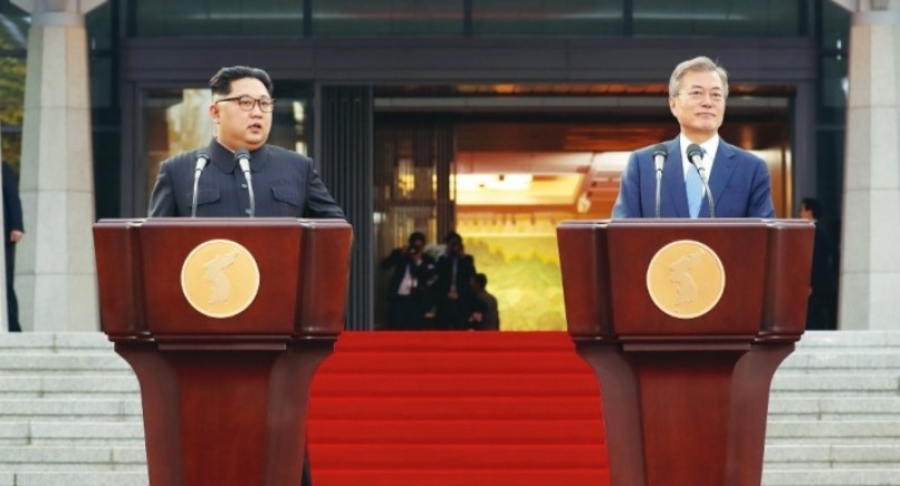
Ahead of the planned U.S.–North Korea summit in June 2018, an additional inter-Korean summit was convened at Panmunjom on May 26. Subsequently, in September 2018, the leaders of North and South Korea met again in Pyongyang and adopted the September Pyongyang Joint Declaration.
At the U.S.–North Korea level, the first-ever summit between the two countries was held in Singapore on June 12, 2018, resulting in a joint statement outlining commitments to establish a peace regime on the Korean Peninsula and to pursue complete denuclearization. A second summit, held in Hanoi, Vietnam, on February 27–28, 2019, failed to produce an agreement or joint statement.
On June 30, 2019, President Donald Trump and Chairman Kim Jong-un held an impromptu meeting at Panmunjom during Trump’s visit to South Korea; however, this encounter likewise failed to yield substantive results.
As U.S.–North Korea relations failed to produce meaningful progress, inter-Korean relations subsequently deteriorated. The Inter-Korean Liaison Office—established just prior to the September 2018 summit—was later demolished, and both official and unofficial communication channels between the two Koreas were severed. Since advancing the “two hostile states” doctrine in late 2023, North Korea has consistently reaffirmed this position, including at the Ninth Congress of the Korea Workers’ Party and during sessions of the Supreme People’s Assembly in 2026.
The broader international environment has also proven unfavorable to improving inter-Korean and U.S.–North Korea relations. North Korea and Russia signed a Russia–North Korea Alliance Treaty in June 2024, followed by the deployment of North Korean troops to Russia in November of the same year. Additionally, the conflict involving the United States and Israel against Iran, which began in February, has further complicated efforts to address issues on the Korean Peninsula.
The Significance of the April 27 Inter-Korean Summit
Among the five inter-Korean summits held to date, the June 15, 2000 summit marked a “transition from hostility to reconciliation” and represented the true beginning of substantive inter-Korean engagement, while the October 2007 summit expanded relations into the realm of comprehensive economic cooperation. The April 2018 summit further advanced these efforts by addressing denuclearization and military issues in a more comprehensive manner.
In the Panmunjom Declaration, the two Koreas agreed on: (1) the complete denuclearization of the Korean Peninsula and the establishment of a peace regime; (2) the easing of military tensions and a commitment to mutual non-aggression; and (3) the comprehensive and forward-looking development of inter-Korean relations.
Notably, the agreement to pursue the establishment of a peace regime—including a declaration to formally end the Korean War within the year—and the shared commitment to “gradual denuclearization” established an important precedent for subsequent discussions among relevant stakeholders, particularly in the context of U.S.–North Korea dialogue.
The Panmunjom Declaration is particularly significant in that it consolidated the core issues of military tension reduction, the transition to a peace regime, and denuclearization within a single framework. It also outlined relatively concrete implementation measures in the military domain. Measures such as the cessation of hostile acts, the restoration of military communication channels, and the establishment of mechanisms to prevent armed clashes were partially implemented through the September Pyongyang Joint Declaration and the September 19 Military Agreement.
Although the objectives set forth in the declaration have yet to be fully realized, its significance remains intact. First, it established a policy framework that treats denuclearization and the establishment of a peace regime as a unified package. Second, it provided a practical model and experiential foundation for reducing military tensions between the two Koreas. Third, it serves as a reference point for future negotiations should inter-Korean dialogue resume.
Whenever the need for tension reduction and cooperation reemerges, the Panmunjom Declaration is likely to be revisited. In this regard, the April 27 Summit retains enduring relevance as a mid- to long-term roadmap for addressing the North Korean nuclear issue and shaping the future trajectory of inter-Korean relations.
Recommendations for Restoring Inter-Korean Relations
It can be argued that North Korea’s primary objectives in engaging in the April 27 inter-Korean summit and subsequent U.S.–North Korea summits included securing regime survival through resolving the nuclear issue, ending international isolation, and overcoming economic challenges. In particular, improving relations with the United States as a pathway to achieving normalized statehood appears to have been a central strategic objective.
In light of these considerations, several policy measures merit consideration.
First, it is necessary to create conditions conducive to the resumption of U.S.–North Korea dialogue, which remains a priority for Pyongyang. Efforts should be made to elevate the urgency of engagement so that issues on the Korean Peninsula are not marginalized amid competing global crises, including the ongoing Russia–Ukraine war and tensions involving the United States, Israel, and Iran.
At the same time, achieving a durable resolution of the North Korean nuclear issue will require progress toward normalizing North Korea’s external relations—including with the United States—as well as integrating the country into the international community.
Second, establishing a permanent and sustainable peace structure on the Korean Peninsula is essential. Recent global conflicts underscore the urgency of transitioning from the current armistice system to a formal peace regime.
The inter-Korean summit agreements explicitly refer to the need to replace the Armistice Agreement with a peace treaty and call for the convening of trilateral (South–North–U.S.) or quadrilateral (South–North–U.S.–China) negotiations. Accordingly, close coordination with neighboring countries will be critical to advancing a peace regime in parallel with improvements in inter-Korean relations.
Third, it is essential to secure sufficient policy flexibility to pursue inter-Korean cooperation projects with a degree of autonomy. Under the current sanctions regime imposed by the international community—including the United States and the United Nations—it remains extremely difficult to implement exchange and cooperation initiatives, including humanitarian assistance.
As a result, agreements reached at the September 2018 Pyongyang summit—such as the normalization of the Gaeseong Industrial Complex and the resumption of Mount Geumgang tourism—have not been implemented, contributing significantly to the current stalemate in inter-Korean relations. Addressing this issue will require measures such as negotiating sanctions exemptions, in coordination with the United States and other relevant stakeholders, for projects agreed upon by the two Koreas.
In addition, continued efforts to transform the Demilitarized Zone (DMZ) into a peace zone are essential for institutionalizing peaceful coexistence. Successive South Korean administrations have pursued this objective, and in 2018, meaningful progress was made through inter-Korean agreements and related follow-up measures. Notably, the April 27 Panmunjom Declaration included a commitment to transform the DMZ into a “substantive peace zone.”
In this context, the South Korean government is advancing the “DMZ Peace Trail” initiative to promote peace in the DMZ and support the development of border regions. From April 17 to November 30, twelve themed routes across border areas in Incheon Metropolitan City, Gangwon Special Self-Governing Province, and Gyeonggi Province have been fully opened and are now in operation.
Finally, in order to reopen channels of communication with North Korea, South Korea’s policy approach must consistently convey that its objectives are not driven by abrupt shifts in the security environment, but rather reflect a sustained commitment to maintaining peace and stability while pursuing a future of shared prosperity.
The government should continue to pursue a range of diplomatic efforts, including advocating for improvements in inter-Korean relations at every available opportunity and communicating its policy positions through U.S.–North Korea diplomatic channels, as well as through countries that maintain close ties with North Korea, such as China and Russia.
-
PREV [Current Affairs Analysis]
-
NEXT [Feature Article]