

The Strength of K-Defense as Reflected in the Middle East Situation

Chi-beom Shin
Professor of Military Science
Konyang University
Director of External Affairs
Future Society
The recent escalation of military tensions in the Middle East, centered on Iran and Israel, underscores that the character of modern warfare has evolved beyond simple contests of firepower into an integrated construct combining precision-strike capabilities with multi-layered defense systems.
In particular, the current conflict—having moved beyond the confines of a “shadow war” into overt confrontation—conveys a clear signal to the global defense market: operational reliability validated in combat and system-level integrity constitute the core foundations of national security. In this context, the recent rise of “K-defense,” which has gained substantial traction in the Middle Eastern market, carries strategic significance that extends well beyond export metrics.
The Paradigm Shift in Modern Warfare and the Middle East’s Strategic Choice
Whereas earlier Middle Eastern conflicts were characterized by conventional force-on-force engagements centered on tanks and fighter aircraft, the current environment reflects a decisive contest involving unmanned aerial systems (UAS), hypersonic weapons, and integrated air and missile defense architectures designed to counter them. As illustrated by Iran’s large-scale airstrike attempt, the ability to counter low-cost, high-effect asymmetric threats requires a seamless, multi-layered defensive framework.
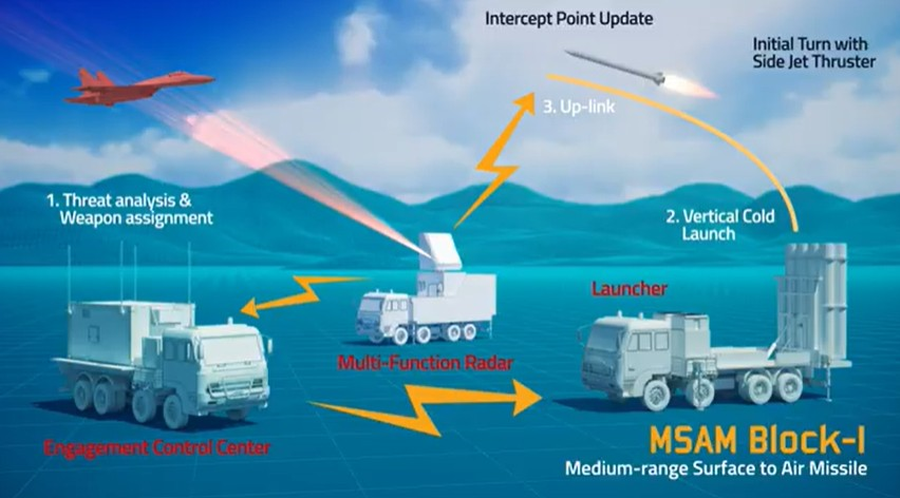
Against this backdrop, a central question arises: why are Middle Eastern states, including the United Arab Emirates, demonstrating a marked preference for South Korean systems such as the Cheongung-II (M-SAM), the Hyunmoo series, and the K9 self-propelled howitzer, despite the availability of numerous Western alternatives? The answer lies in three defining attributes of Korean defense systems: readiness, reliability, and tailored strategic alignment.
The Decisive Advantages of K-Defense
First, these systems have been refined under sustained, real-world operational pressures. The Korean Peninsula represents a uniquely dense operational environment, where some of the world’s highest concentrations of military capabilities remain in persistent confrontation. K-defense platforms have undergone decades of iterative development to address North Korea’s asymmetric threat profile.
The missile and unmanned systems challenges faced by Middle Eastern states closely parallel those for which South Korea has long prepared. It is therefore not coincidental that the Korean-developed medium-range surface-to-air missile system Cheongung-II, currently deployed in the United Arab Emirates, has been selected to provide air defense coverage in the region, demonstrating a notably high interception rate even under harsh desert conditions. Reports indicate that Cheongung-II recently achieved an interception rate of approximate 96 percent in countering a large-scale aerial attack attributed to Iran.
Second, South Korea’s comparative advantage lies in system integration and lifecycle sustainment. In contemporary warfare, the effectiveness of software integration and maintenance, repair, and overhaul (MRO) functions often outweighs the performance of individual platforms considered in isolation.
Leveraging its strengths as an advanced information technology economy, South Korea has prioritized interoperability across its defense systems. Moreover, in contrast to the extended delivery timelines and restrictive conditions often associated with U.S. and European systems, South Korea offers expedited delivery schedules and a more flexible approach to technology transfer, thereby directly addressing the urgent operational requirements of partner nations seeking to minimize capability gaps.
Third, K-defense offers a compelling value proposition. By maintaining cost competitiveness relative to U.S. and European systems while delivering comparable operational performance, South Korean platforms present an attractive option for countries facing fiscal constraints. This advantage is particularly salient for states pursuing large-scale procurement programs.
Fourth, rapid delivery and scalable production capacity constitute critical strengths. Drawing on industrial capabilities developed across the shipbuilding, automotive, and electronics sectors, South Korea is able to support high-volume production within compressed timelines. This capability has proven decisive for countries confronting acute security challenges and has played a key role in securing major contracts in both Europe and the Middle East.
Taken together, K-defense is expanding its global footprint on the basis of four pillars: technological capability, cost competitiveness, delivery speed, and strategic partnership. As it evolves beyond a narrow export industry into a broader instrument of national competitiveness and diplomatic leverage, there is growing recognition of its substantial long-term growth potential.
K-Defense as a Diplomatic Asset for K-Security
The value of K-defense should now be elevated beyond its economic dimension to serve as a strategic instrument of “defense diplomacy.” As its presence in the Middle East becomes more firmly established, South Korea is well positioned to consolidate its role as a “security solutions provider” within the international community. This, in turn, presents an opportunity to deepen relations with Middle Eastern partners—whose importance is closely tied to energy security—transforming these ties from resource-based ties into comprehensive security partnerships.
At the same time, complacency must be avoided. As demonstrated in the Iran-Israel conflict, the emergence of artificial intelligence-enabled targeting and autonomous weapons systems is redefining the technological frontier of defense. For K-defense to sustain its momentum following its expansion in the Middle East, a forward-looking transition toward manned–unmanned teaming (MUM-T) and the development of space-based defense capabilities will be essential.
Conclusion: Strategic Pathways Toward the Future
Amid ongoing instability in the Middle East, K-defense has demonstrated its capabilities. As global attention increasingly turns to South Korea’s defense industry, the country must move beyond the role of a conventional arms exporter and contribute to the establishment of both technical and normative standards that promote international peace and stability.
The enduring principle that credible deterrence is the most effective means of preventing conflict remains as relevant as ever. The precision defensive systems and advanced strike capabilities embodied in K-defense have the potential to serve as stabilizing factors in an increasingly volatile regional environment.
In this regard, South Korea’s defense industry is evolving into a critical pillar supporting not only national security but also the broader objective of sustainable global peace. The emergence of K-defense as a source of national pride reflects its growing role at the center of this strategic trajectory.
-
PREV [Feature Article]
-
NEXT [Current Affairs Analysis]