

The Importance of Maintaining Peace on the Korean Peninsula and the ROK–U.S. Alliance in Light of the Middle East Situation

Sang-hyun Lee
Honorary Research Fellow
Sejong Institute
Why Are the U.S. and Israel Attacking Iran?
Even before the ink had dried on the Gaza Peace Committee agreement initiated by President Trump, the Middle East was once again engulfed in conflict. On February 28, 2026, the United States and Israel launched a military operation that included preemptive strikes against Iran, citing the need to support anti-government protest movements and to disrupt Tehran’s nuclear weapons development program.
In response, Iran launched an unprecedented retaliatory ballistic missile attack targeting U.S. military bases in Bahrain, the United Arab Emirates, and Kuwait, as well as Israeli territory. This escalation transformed the Iranian crisis from a bilateral confrontation into a regional conflict affecting much of the Middle East, with the exception of Egypt. Iran’s threat to block the Strait of Hormuz further sent shockwaves through the global oil market.
The primary motivation behind U.S. and Israeli military actions has been to prevent Iran from developing nuclear weapons. Following the collapse of the Joint Comprehensive Plan of Action (JCPOA), Tehran has steadily expanded its uranium enrichment capabilities. Both Israel and the United States assess that these programs are unlikely to remain purely civilian and pose a significant risk of evolving into a nuclear weapons program. Israel, in particular, views a nuclear-armed Iran as an existential threat.
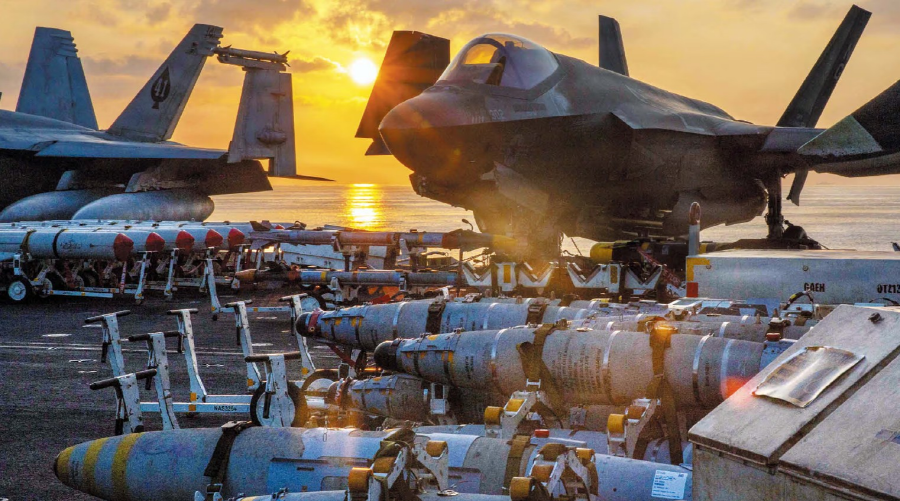
If Iran were to acquire nuclear weapons, it could establish a credible deterrent against Israel and potentially undermine Israel’s long-standing military superiority in the region. Another major concern is Iran’s expanding regional influence. Tehran has supported Hezbollah in Lebanon, Hamas in Gaza, pro-Iranian militias in Iraq, the Houthi movement in Yemen, and allied forces in Syria.
Israel and the United States interpret these networks as part of Iran’s effort to construct a de facto anti-American and anti-Israeli military apparatus across the region. Accordingly, the objectives of U.S. and Israeli military action include degrading Iran’s military infrastructure and the Islamic Revolutionary Guard Corps, disrupting regional weapons supply chains, and suppressing proxy forces operating throughout the Middle East.
From Washington’s perspective, demonstrating credible military deterrence is essential. Failure to prevent Iranian provocations could undermine the credibility of U.S. alliance commitments, leading regional partners—particularly Saudi Arabia, the United Arab Emirates, and Israel—to question the reliability of American security guarantees.
The United States and Israel describe the operation as a preemptive strike aimed at eliminating Iran’s nuclear and missile capabilities. However, many countries and legal scholars argue that preemptive attacks conducted without an imminent threat of armed aggression raise serious concerns regarding sovereignty and international law. From an international relations perspective, Israel and the U.S. emphasize the necessity of preventive action to restore deterrence, whereas critics contend that the operation violates Iran’s right to self-defense and undermines the global order.
At the same time, U.S. and Israeli actions appear intended to encourage regime change by supporting anti-regime movements within Iran. These efforts aim to weaken the theocratic system and signal opposition to the potential succession of Supreme Leader Ali Khamenei by his second son, Mojtaba Khamenei.
The Link Between Geopolitical Risk and Geoeconomic Shock
The recent U.S. and Israeli attacks on Iran represent the latest episode in a series of global geopolitical upheavals that have unfolded since Russia’s invasion of Ukraine on February 24, 2022. On June 22, 2025, the United States launched Operation Midnight Hammer, striking multiple Iranian nuclear facilities, including the Fordow uranium enrichment plant, the Natanz complex, and a suspected nuclear site in Isfahan.
On January 3, 2026, a U.S.-led special operation in Venezuela resulted in the seizure of the capital and the arrest of President Nicolás Maduro and his spouse. These developments, culminating in the ongoing military operation against Iran, signal the gradual erosion of international norms and the emergence of a period increasingly defined by the diplomacy of force.
In today’s globalized economy, geopolitical risks quickly generate geoeconomic repercussions, transmitting shocks to financial markets and spilling over into the real economy. Under these conditions, the distinction between geopolitical risk and geoeconomic impact becomes increasingly blurred. Actions such as Russia’s disregard for territorial sovereignty or the U.S.’s arrest of a foreign head of state intensify debates over legal uncertainty while signaling to markets that major powers remain willing to use force to achieve their strategic objectives.
Financial markets typically interpret such developments as global risk events. Heightened geopolitical uncertainty drives risk-off behavior, shifting investment away from equities and high-yield bonds toward safe-haven assets such as government bonds, gold, and cash. This dynamic often results in appreciation of the U.S. dollar, reflecting increased global demand for safe assets.
Iran’s response—including threats to neighboring states and the potential closure of the Strait of Hormuz—illustrates the close link between geopolitical tensions, supply chain disruptions, and oil price volatility. The Strait of Hormuz is a critical chokepoint, transporting over 20 million barrels of oil per day, which accounts for more than 20 percent of global crude oil trade. Analysts warn that a prolonged closure could push prices above $150 per barrel, delivering a direct shock to economies such as South Korea’s by affecting interest rates, exchange rates, and consumer sentiment.
As the Iran conflict risks becoming protracted, global oil prices have already begun to fluctuate sharply. In early March 2026, West Texas Intermediate (WTI) crude surpassed $80 per barrel, reaching its highest level since the start of the second Trump administration. Rising energy costs contribute to higher consumer prices, reducing real purchasing power—particularly for low-income households—and exacerbating existing affordability concerns. Ongoing uncertainty regarding the conflict’s resolution has further intensified price volatility.
These developments compound existing shocks from earlier trade disputes and supply chain disruptions, generating long-term negative effects on the global economy. Geopolitical crises are not isolated events; they accelerate structural transformations in the international economic system, particularly the convergence of security, finance, and commodities. Rising geopolitical risk contributes to the securityization of energy transactions, reinforces the strength of the U.S. dollar, tightens financial conditions in emerging markets, and intensifies capital outflow pressures.
Emerging markets face heightened vulnerabilities due to sanctions exposure and alignment risks, which may reinforce bloc formation in global energy and financial systems. Countries such as South Korea, with high external economic dependence and limited domestic energy resources, must prepare for multiple risks, including stronger linkages between energy prices and exchange rates, fragmentation of export markets, and structurally elevated demand for foreign currency liquidity and financial hedging mechanisms.
The Importance of Peace on the Korean Peninsula and the ROK–U.S. Alliance
The situation in the Middle East also carries important implications for peace on the Korean Peninsula. The recently convened Ninth KWP Congress reaffirmed the consolidation of Kim Jong-un’s rule across both the power structure and the regime’s policy orientation, while once again confirming his firm control over the Party, the military, and the cabinet.
The congress further reiterated the regime’s commitment to a nuclear and military path as the “core of the national strategy,” while emphasizing the continued “institutionalization of nuclear weapons possession.” This reflects Pyongyang’s perception that nuclear weapons are no longer merely a bargaining chip but rather a permanent guarantee of regime security.
North Korea’s external posture has correspondingly hardened, framing South Korea and the United States as “hostile forces” while adhering to a strategy centered on self-reliance and prolonged confrontation. In the military and nuclear domains, the regime reaffirmed its trajectory toward the development, diversification, and qualitative advancement of tactical nuclear weapons, emphasizing expanded nuclear and missile capabilities, including intercontinental ballistic missiles (ICBMs), solid-fuel propulsion, hypersonic technologies, and submarine-launched systems.
By emphasizing swift and severe retaliation in times of crisis and employing rhetoric that lowers the threshold for deterrent use, the regime appears to signal a doctrine incorporating elements of preemptive and automated response. Moreover, by prioritizing the allocation of national resources to military and scientific–technological sectors, Pyongyang continues to place the development of strategic weapons at the top of its national agenda, even under sustained international sanctions.
Regarding its message to the United States, North Korea signaled the possibility of resuming dialogue, stating that if Washington were to recognize North Korea’s status as a nuclear power and abandon its hostile policy, there would be no reason to refrain from talks.
This approach reflects a strategy of engaging the United States while sidelining South Korea, effectively signaling that Pyongyang is willing to negotiate with Washington only on the condition that its nuclear status is acknowledged. At the same time, former President Donald Trump has repeatedly suggested that maintaining a constructive relationship with Kim Jong-un, despite North Korea’s nuclear capabilities, could be advantageous.
He has on several occasions referred to North Korea as a “nuclear power,” fueling speculation about the possibility of a surprise summit between Kim Jong-un and Trump during the latter’s anticipated visit to Beijing in April. Under these circumstances, the possibility cannot be ruled out that Trump might pursue a partial sanctions-relief arrangement in exchange for a freeze on North Korea’s nuclear program, presenting it as a diplomatic achievement.
Particularly troubling for South Korea is the message directed at Seoul. North Korea has characterized South Korea as its “eternal principal enemy,” explicitly excluding it from the category of “compatriots” and further institutionalizing the doctrine of “two hostile states.”
As a result, prospects for the resumption of inter-Korean dialogue remain bleak for the foreseeable future. Pyongyang criticized the current South Korean government’s conciliatory posture as deceptive and insincere, asserting that there is nothing to discuss with the Republic of Korea and declaring its intention to permanently remove South Korea from the category of fellow countrymen.
It further stated that it would neither pursue dialogue nor cooperation with South Korea under any pretext, effectively signaling that a form of “cold peace”—in which neither dialogue nor open conflict occurs—is the model of inter-Korean relations North Korea now seeks. This posture poses a significant challenge for the Lee Jae-myung administration, which has pursued a policy of proactive engagement toward the North.
The evolving geopolitical turbulence—from the war in Ukraine to the recent escalation in the Middle East—offers several important lessons for the Korean Peninsula. First, these developments send a clear message to North Korean leader Kim Jong‑un.
Observing that regimes such as those in Venezuela and Iran could become targets of decisive U.S. military operations—operations that have included precision strikes on leadership and nuclear infrastructure—North Korea may become even more inward‑looking and further intensify its reliance on nuclear deterrence.
Analysts note that Pyongyang is likely observing these developments with heightened anxiety and a strengthened determination to retain its nuclear arsenal, perceiving that the United States’ capability and willingness to remove hostile leaders has shifted from theory to practice.
The U.S. capture of Venezuelan President Nicolás Maduro and the unprecedented military operations targeting Iranian leadership and nuclear infrastructure send a powerful signal about the potential consequences of strategic miscalculation.
For North Korea—often viewed as a parallel case in the development of weapons of mass destruction—such developments reinforce the perception that nuclear weapons constitute the ultimate guarantee of regime survival. If Pyongyang internalizes this lesson, its willingness to engage in denuclearization or arms‑reduction negotiations could diminish significantly, leaving the Korean Peninsula in a persistently fragile and tense security environment.
Second, if U.S. military operations in Iran become protracted, South Korea faces the serious concern that certain assets of United States Forces Korea (USFK) could be redeployed to the Middle East. Reports indicate that air defense systems, including Patriot (PAC‑3) and Terminal High Altitude Area Defense (THAAD) units previously stationed under the USFK framework, have already been transferred to the region.
A substantial redeployment of these air defense capabilities—key components of deterrence against North Korea—could undermine South Korea’s defensive posture and create opportunities for miscalculation by Pyongyang. Accordingly, Seoul and Washington must ensure that complementary measures are in place to prevent gaps in their joint deterrence capabilities.
The challenge is further compounded by indications that the Iran conflict may become protracted. Despite heavy U.S. strikes, Iran has reportedly designated Mojtaba Khamenei, the strongly anti-American second son of the late Supreme Leader Ali Khamenei, as successor, signaling Tehran’s readiness for a sustained confrontation.
Third, South Korea must prepare for the broader geopolitical repercussions of the Iran crisis. A potential blockade of the Strait of Hormuz would sharply increase global logistics costs. Given its heavy reliance on the Middle East for crude oil imports and its near-total dependence on maritime transportation for an export-driven manufacturing sector, South Korea would be particularly vulnerable to such disruptions.
With approximately 68.8 percent of its crude oil imports coming from the Middle East, responding to a potential Strait of Hormuz blockade and surging energy prices presents a critical policy challenge for South Korea. The most urgent priority is to diversify energy supply chains to reduce risk exposure.
The experience of European countries— which quickly reduced dependence on Russian natural gas and diversified supply routes following Russia’s invasion of Ukraine in 2022—offers a useful precedent. Over the longer term, increasing the share of renewable energy sources, including solar, wind, and hydrogen, will be essential for reducing reliance on fossil fuels.
In conclusion, maintaining peace on the Korean Peninsula is increasingly critical amid growing instability in the Middle East and the broader international environment. As the risk of international conflict spreads, ensuring stability and a managed peace on the peninsula is essential not only for regional security but also for the broader international order.
The most realistic foundation for sustaining peace on the Korean Peninsula remains the ROK–U.S. alliance. Strengthening this alliance through credible deterrence and close strategic coordination is essential for preventing provocations and maintaining a stable framework of peace.
Ultimately, peace on the peninsula must not be allowed to fluctuate in response to external crises. Even amid an increasingly unstable international environment, sustaining firm security cooperation anchored in the ROK–U.S. alliance—and leveraging this partnership to reinforce a durable peace structure—remains indispensable.