

An Analysis of North Korea’s Ninth Party Congress and the Tasks for Peace on the Korean Peninsula

Hyung-joong Park
Former Senior Research Fellow
Korea Institute for National Unification
North Korea's 2017 declaration that it had completed its national nuclear force signaled that it had acquired the capacity to independently guarantee its military security. From that juncture, Pyongyang recalibrated its external security policy during the period of Eighth Korea Workers’ Party (KWP) Congress (2021–2025).
In particular, it institutionalized the permanent retention of its nuclear arsenal and fundamentally altered the trajectory of its policies toward the United States and South Korea. The Ninth Party Congress systematically consolidated and reaffirmed these policy adjustments.
Following North Korea's reaffirmation of its “hostile two states” policy at the Ninth Party Congress in mid-to-late February, South Korean President Lee Jae-myung reiterated his North Korea policy in his March 1 commemorative address.
He called upon the two Koreas to “end the era of conflict and confrontation and move resolutely toward a peaceful and coexisting Korean Peninsula,” pledging to “consistently and persistently pursue the necessary steps” to that end. A comparative reading of North Korea's Ninth Party Congress and South Korea's March 1 address confirms that the two sides’ respective positions remain fundamentally irreconcilable.
South Korea appeals to North Korea in terms of peace, trust, mutual restraint, a shared future, and peaceful coexistence. By contrast, North Korea’s discourse toward South Korea is grounded in the institutionalization of hostility, the permanence of nuclear deterrence, a strength-based military balance, the asserted will and readiness to conduct preemptive strikes, and the doctrinalization of a hostile-state framework.
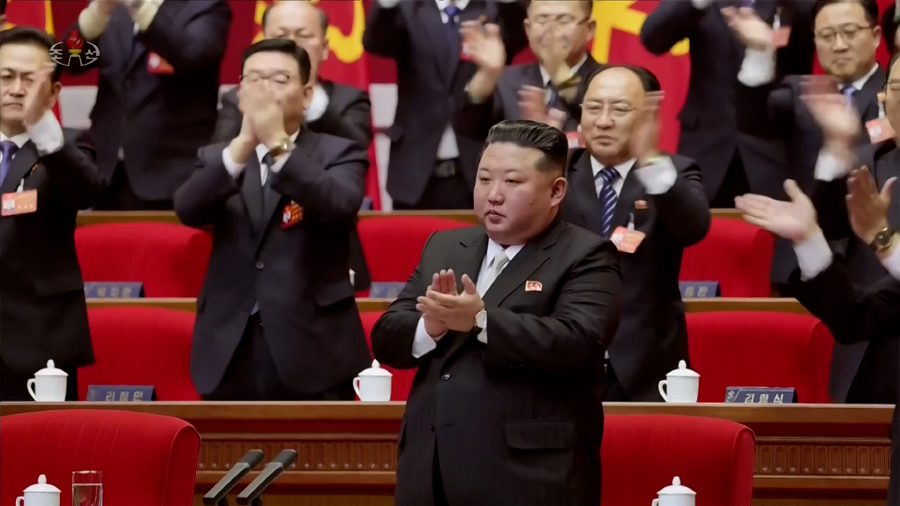
This article advances three principal themes. First, it analyzes the foundational direction of North Korea's external security strategy that forms the backdrop to the Ninth Party Congress. Second, it examines the security and diplomatic assessments and policy lines articulated in the Ninth Party Congress report. Third, it assesses prospective developments.
1. The Security Landscape on the Korean Peninsula and North Korea's Strategic Direction Since 2017
North Korea's 2017 declaration of “completing its national nuclear force” indicated that it had attained a basic capability to independently secure its survival through nuclear weapons. While seeking to leverage the diplomatic capital generated by this capability, North Korea undertook a structural transformation of its external security strategy.
Through iterative engagement and recalibration between 2018 and 2019, it consolidated an external and inter-Korean security strategy predicated on the permanence of nuclear deterrence and the policy of two hostile states, particularly during the period of the Eighth Party Congress. The Ninth Party Congress reaffirmed this strategic orientation.
Permanence of Nuclear Deterrence
Through the enactment of the Nuclear Forces Law in 2022 and the constitutional codification in 2023 of the continued advancement of nuclear capabilities, North Korea formally established that nuclear weapons are not a provisional bargaining instrument but a permanent strategic asset. This development carries three principal implications:
First, North Korea will not relinquish its nuclear arsenal, and it expects the United States to acknowledge its nuclear status.
Second, nuclear deterrence constitutes the central mechanism of war prevention, thereby alleviating the regime’s perceived vulnerability to external military intervention.
Third, all future policy formulation proceeds from the premise of sustained nuclear possession. Put differently, North Korea’s central strategic question has shifted to the following: given the secured status of its nuclear capability, how can the state be managed in a safe and durable manner?
Hostile Two-State Policy
Since the Ninth Plenary Meeting of the Eighth KWP Central Committee in December 2023, North Korea has formally designated South Korea as its most hostile external enemy. While nuclear deterrence has foreclosed the possibility of absorption by the South, North Korea remains structurally inferior in most non-military domains. It perceives no viable means of neutralizing the internal security risks associated with this asymmetry.
The hostile two-state policy thus functions as a strategic mechanism—underwritten by nuclear-backed military security—to preemptively eliminate internal political vulnerabilities arising rom South Korea’s comparative superiority through institutionalized hostility and comprehensive severance.
Abandoning the long-standing objective of unification, which it now regards as unattainable, North Korea instead seeks protracted coexistence premised on adversarial separation. This strategic recalibration, which treats South Korea as a hostile foreign state, has redefined North Korea’s conception of security and diplomacy on the Korean Peninsula and has implicitly expanded the doctrinal scope for potential nuclear employment against the South.
Institutionalized Conflict
The 2019 declaration of a “long-term confrontation” with the United States and the December 2023 articulation of the hostile two-state policy indicate that North Korea conceptualizes its antagonism with both the United States and South Korea not as episodic, but as structurally enduring. This orientation entails the three implications:
First, nuclear deterrence must be sustained indefinitely, with the military apparatus maintained in a state of continuous readiness.
Second, legal and policy frameworks are constructed on the presumption of protracted conflict.
Third, North Korea does not anticipate the near-term normalization of inter-Korean relations.
Pursuing Stabilization Over Expansion
At present, North Korea does not appear to be pursuing territorial expansion or a fundamental reordering of the peninsula’s structure. With regime security underwritten by nuclear deterrence, its policy orientation is twofold. First, it seeks to tighten internal governance, achieve incremental economic improvement, and consolidate systemic stability.
Second, it continues military modernization and calibrated provocations toward the South to preserve deterrence credibility and sustain hostility. This approach is oriented toward maintaining the status quo while avoiding escalatory thresholds that could jeopardize regime survival.
Whereas the pre-2017 period emphasized regime survival, deterrence construction, and systemic revision, the current phase prioritizes the consolidation of established deterrent capabilities and assurance of their continuous operational viability. North Korea seeks to avoid acute instability or large-scale war that could threaten regime continuity.
Long-Term Equilibrium in Inter-Korean and U.S.–North Korea Rivalry
North Korea appears to assess that its strategic competition with both the United States and South Korea has entered a stable equilibrium. Although hostility persists, mutual nuclear deterrence constrains unilateral attempts to revise the status quo.
None of the principal actors—North Korea, South Korea, or the United States—can pursue transformative change without incurring unacceptable nuclear risk. Accordingly, while large-scale war is deemed unlikely, genuine peace remains absent. Instead, a durable yet frozen adversarial standoff prevails. This condition is likely to persist as long as the mutual nuclear deterrence configuration between the South Korea–U.S. alliance and North Korea remains intact.
2. Security and Foreign Policy Assessments and Policy Directives from the Ninth Party Congress
The assessments of the international environment, the United States, and South Korea, as articulated in the Ninth Party Congress report, largely reaffirm positions consolidated during the period of the Eighth Party Congress. Compared with that earlier period, however, the Ninth Party Congress reflects a somewhat more confident and proactive posture.
International Environment and Perception of the United States
First, the report asserts that “the current international order, dominated by the predatory logic of the strong devouring the weak, has entered a vortex of turmoil and upheaval.” Within this framing, emerging multipolarity offers North Korea opportunities to leverage other major powers to counterbalance the United States.
Second, it contends that international law is effective in the absent of material power, asserting that “the United States’ inherent hostility and coercive disposition, institutionalized through force, remain unchanged.”
Third, it reiterates that only power guarantees survival, maintaining that “so long as the global order remains unaltered, our abandonment of nuclear weapons is categorically impossible.”
Fourth, it characterizes hostility with the United States as enduring and declares that North Korea will “continue thorough preparations for confrontation and firmly uphold the strongest posture as the immutable foundation of its U.S. policy.”
Fifth, it states that “if the United States recognizes North Korea’s status as a nuclear state, peaceful coexistence may be feasible; otherwise, confrontation will persist.” This appears less an overture for dialogue than the articulation of preconditions that are structurally difficult for Washington to accept.
Sixth, it emphasizes that “adversaries must not discern North Korea’s intentions,” viewing strategic ambiguity as a means of reinforcing deterrence credibility.
Perception of South Korea
First, the report contends that “South Korea’s ruling forces have consistently sought to erode our system under the guise of reconciliation and cooperation,” asserting that South Korea’s designation as the “primary adversary and immutable main enemy” constitutes a historical determination.
Second, it declares that “regardless of South Korea’s alliances or military expenditures, the dynamics established by nuclear-armed states on the Korean Peninsula will remain unchanged. The only path to safety for South Korea is to sever all entanglements with North Korea and refrain from interference.”
Third, it warns that “should South Korea undertake actions that disrupt the prevailing stability, North Korea will employ all physical means appropriate to an enemy state, and within that continuum the possibility of South Korea’s complete collapse cannot be excluded.”
Collectively, these positions entrench the permanence of the hostile two-state framework and reflect North Korea’s assessment that the peninsula’s military balance is structurally fixed by its nuclear deterrent. Any South Korean effort to enhance pressure or pursue military superiority is construed as destabilizing, warranting a recalibration of operational criteria to those applicable to hostile foreign states.
National Defense Capability Development
The defense capability agenda articulated at the Ninth Party Congress provides the military foundation for the hostile two-state doctrine. Systems identified for development include ground- and submarine-launched intercontinental ballistic missiles, nuclear-powered naval platforms, AI-enabled unmanned strike swarms, anti-satellite assets, electronic warfare capabilities designed to incapacitate adversary command-and-control networks, and enhanced reconnaissance satellites.
Additionally, North Korea seeks to secure tactical escalation dominance vis-à-vis South Korea through the deployment of 600-millimeter multiple rocket launchers, 240-millimeter systems, and integrated tactical missile complexes. This trajectory indicates a concerted effort to institutionalize credible nuclear warfighting capabilities, particularly at the tactical level.
3. Conclusion
In light of the prevailing security architecture on the Korean Peninsula, North Korea’s military modernization trajectory, and the entrenched policy positions of both Koreas, several conclusions can be drawn.
First, within the structured framework of mutual nuclear deterrence between the South Korea–U.S. alliance and North Korea, the likelihood of full-scale war appears constrained. However, deterrence equilibrium does not necessarily equate to durable stability.
Second, while deterrence functions, crisis stability remains fragile. North Korea’s entrenched hostility, the prolonged suspension of inter-Korean dialogue, sustained high-readiness postures on both sides, North Korea’s preemptive tactical nuclear doctrine, and reciprocal preemptive strike and rapid-retaliation capabilities collectively heighten the risk of miscalculation. Given the persistent potential for escalation once tensions materialize, the refinement of crisis management mechanisms is imperative.
Third, North Korea is likely to persist in military modernization and limited provocations to offset any relative erosion of deterrence resulting from South Korea–U.S. advancements, while reinforcing domestic cohesion through sustained hostility toward the South. A dual-track strategy—reinforces credible deterrence while establishing robust management mechanisms to prevent inadvertent clashes—is therefore required.
Fourth, North Korea’s pursuit of permanently entrenched nuclear deterrence is unlikely to change in the near term, and the hostile two-state framework is likely to endure. Policy approaches must therefore be realistic, phased, and carefully calibrated to these structural constraints.
Fifth, inter-Korean relations are likely to remain characterized by adversarial coexistence under a heavily militarized deterrence balance. While overt conflict may be averted, such peace would constitute an inherently unstable equilibrium, grounded in mutual armament, fragile crisis stability, and sustained hostility. Accordingly, efforts to maintain deterrence credibility must proceed in parallel with the gradual restoration of institutional and diplomatic mechanisms aimed at reducing tensions.
As actors fundamentally obligated to pursue peaceful coexistence, the restoration of inter-Korean dialogue constitutes a public good with implications that extend beyond the peninsula, directly affecting peace in Northeast Asia and the broader international community. Sustained international engagement and support are therefore indispensable.
The Government of the Republic of Korea has consistently affirmed its determination to eliminate the risk of war and nuclear threats on the Korean Peninsula and to establish a durable framework for peaceful coexistence. As a responsible middle power with growing global responsibilities, the Republic of Korea recognizes that peace on the peninsula is intrinsically linked to regional stability in Northeast Asia and to global security. It will therefore continue to work in concert with the international community to translate this vision into concrete and sustainable outcomes.