

Why K-Defense Is Recognized for Its Excellence and Competitiveness in the International Community

Chi-beom Shin
Professor, Department of Military Science
Konyang University
Planning Director, Future Society Association
The international security order is undergoing a profound structural realignment. Protracted conflicts, the reconfiguration of alliance networks, and the strategic weaponization of supply chains are reshaping not only the geopolitical landscape but also the underlying logic of the defense industry. Defense can no longer be understood as a transactional marketplace for discrete weapons platforms; It has become an extension of national strategic capacity, institutional credibility, and long-term reliability.
Over the past decade, South Korea has markedly expanded its defense exports and consolidated its position in the global market. In 2022, it recorded approximately $17 billion in defense exports—a historic high—and in 2023 diversified its export portfolio through major contracts in the Middle East, Eastern Europe, and Asia.
Performance across core platforms—including self-propelled artillery, main battle tanks, multiple launch rocket systems, aircraft, and submarines—demonstrates not only technological maturity but also a balanced industrial ecosystem that is not dependent on a single flagship system.
Importantly, international recognition of South Korean defense capabilities has not been driven solely by export volume. Rather, it reflects demonstrated performance in schedule adherence, large-scale contract execution, and comprehensive life-cycle management, including follow-on logistics and sustainment.
In an era defined by supply-chain disruption and strategic uncertainty, the ability to ensure delivery continuity under crisis conditions has become a central criterion in defense partnerships. South Korea’s track record suggests that, beyond production capacity, it has accumulated policy consistency, contractual reliability, and institutional coherence.
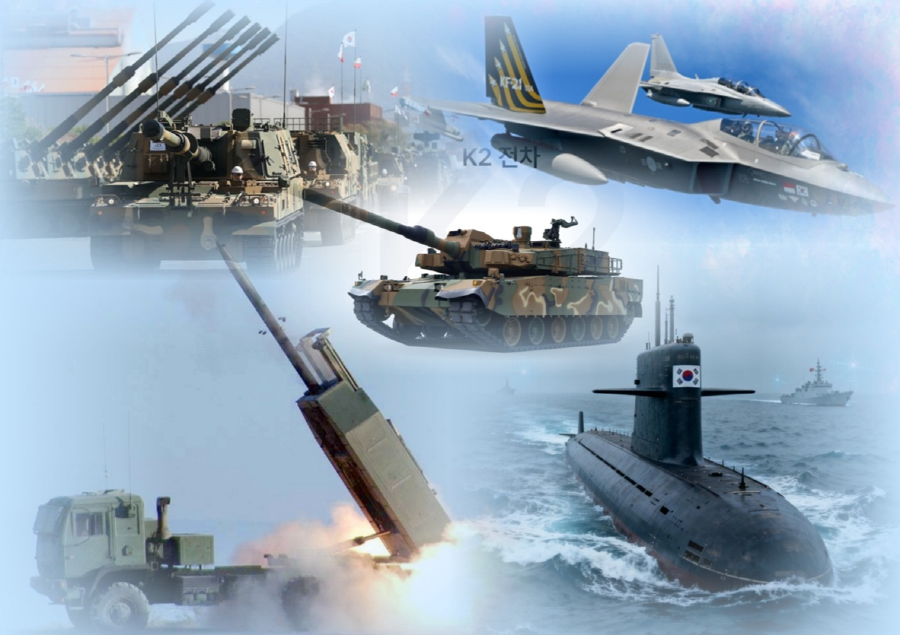
National Strategy and the Top Four Objective
The South Korean government has articulated the advancement of “K-defense” as a core national policy agenda, setting forth the strategic objective of becoming a “top four global defense powerhouse.” This formulation should not be misconstrued as a narrow pursuit of numerical ranking; rather, it signals an intent to position South Korea as a responsible defense partner—one capable of contributing to supply-chain resilience, strengthening technological self-reliance, and fostering long-term, trust-based security cooperation.
Defense policy is increasingly integrated with diplomatic strategy and national security planning. In this context, K-defense represents not merely an industrial export sector, but a component of comprehensive national power.
South Korea’s competitive advantages are structural rather than episodic. They include comparatively rapid delivery timelines, flexible production systems, cost-effectiveness, and political reliability. These attributes are rooted in decades of accumulated industrial capacity, operational military experience, and institutional support mechanisms that align government policy with industry performance.
Canada’s Submarine Program: A Structural Partnership Question
Within this strategic environment, Canada’s Canadian Patrol Submarine Project (CPSP) should be understood as more than a procurement competition. Submarines are inherently long-duration strategic assets, requiring integrated solutions encompassing design, construction, maintenance, modernization, and interoperability over several decades. As such, decisions on submarine acquisition shape enduring security partnerships.
South Korea’s KSS-III program demonstrates advanced capabilities, including indigenous design competence, air-independent propulsion (AIP) systems, long-range strike capacity, and high levels of automation. South Korea’s experience in large-scale shipbuilding and complex systems integration further supports disciplined schedule management and cost control—factors particularly salient in submarine acquisition programs, which are historically prone to delays and cost overruns.
With respect to Canada’s operational requirements—Arctic-capable performance, long-term sustainability, and interoperability with allied forces—South Korea is positioned to propose a cooperative framework that extends beyond a platform sale. A joint development or co-production model, incorporating technology collaboration and industrial participation, could evolve into a durable strategic partnership rather than a transactional export arrangement.
The Strategic Implications of Overseas Defense Orders
Defense cooperation today carries systemic implications that transcend bilateral commercial interests. As supply chains in critical sectors become overly concentrated geographically, global security becomes correspondingly vulnerable. Consequently, many states are actively seeking to diversify their defense suppliers in order to mitigate strategic risk.
In this context, South Korea has emerged as a credible alternative supplier—one capable of combining production stability with timely delivery. Its flexible approaches, including technology transfer, local production arrangements, and joint research and development initiatives, further enhance its attractiveness as a partner.
Securing overseas contracts, therefore, is not solely a matter of expanding export revenues; it carries strategic significance insofar as it contributes to strengthening partner nations’ defense capacities while reinforcing broader supply-chain resilience. In this sense, defense exports function as instruments of cooperative security architecture.
From Industrial Brand to Strategic Trust
K-defense has evolved beyond a commercial label. It increasingly represents a policy choice for countries seeking stable, predictable, and institutionally reliable partners within a fluid international security environment.
The aspiration to rank among the world’s top four defense powers should thus be interpreted as a strategic vision rather than a symbolic benchmark. It reflects an intention to act as a globally responsible stakeholder—one that contributes to supply-chain stability, cultivates enduring partnerships, and shares advanced technological capabilities within a framework of mutual trust.
In contemporary defense markets, trust has become as consequential as technological sophistication. Nations do not merely purchase platforms; they invest in long-term relationships. By demonstrating performance reliability, policy coherence, and strategic alignment, South Korea has positioned itself as a credible and realistic option for states seeking such partnerships.
South Korea has accumulated trust through consistent execution.
The next phase lies in institutionalizing that trust within a durable strategic architecture.
-
PREV [Thematic Analysis]
-
NEXT [Thematic Analysis]