

Managing Bilateral Friction Through Practical Diplomacy: Korea–Japan Shuttle Diplomacy and the Containment of Negative Variables

Min-young Yoo
Research Fellow, Institute for Asian Studies, Korea University
For many Koreans, Horyuji Temple in Nara Prefecture, Japan is associated with the Golden Hall murals traditionally attributed to the Goguryeo monk Damjing. Older generations recall learning about Damjing’s alleged role from school history textbooks. Although subsequent scholarship has questioned whether Damjing personally painted the murals, there is broad academic consensus that artisans and monks from the Korean Peninsula, particularly from Goguryeo and Baekje, played a significant role in the construction of Horyuji and in the formation of Japan’s early Nara-period culture more than 1,300 years ago.
In Japan, Horyuji is widely regarded as a national cultural symbol and is celebrated as the world’s oldest surviving wooden structure. Its architectural form has been carefully preserved for over a millennium, and in 1993 it was designated Japan’s first UNESCO World Cultural Heritage site.
Against this backdrop, the decision by the leaders of South Korea and Japan to visit Horyuji following their summit carries layered diplomatic meaning. For the Korean public, the visit evokes the long history of premodern exchange between the two countries and implicitly encourages a broader historical lens— one that acknowledges cooperation and cultural transmission alongside the painful legacy of modern history. It also resonates with a sense of national pride rooted in the recognition that the Korean Peninsula contributed meaningfully to the foundations of Japanese civilization.
For the Japanese public, the visit similarly recalls early bilateral exchanges, but more importantly, the presence of a South Korean president at one of Japan’s most revered historical sites conveys respect for Japanese cultural heritage. In this sense, the symbolism is comparable to the impression that might be created if a foreign leader were to visit Korea’s Bulguksa Temple and Seokguram Grotto—sites deeply embedded in Korean historical identity.
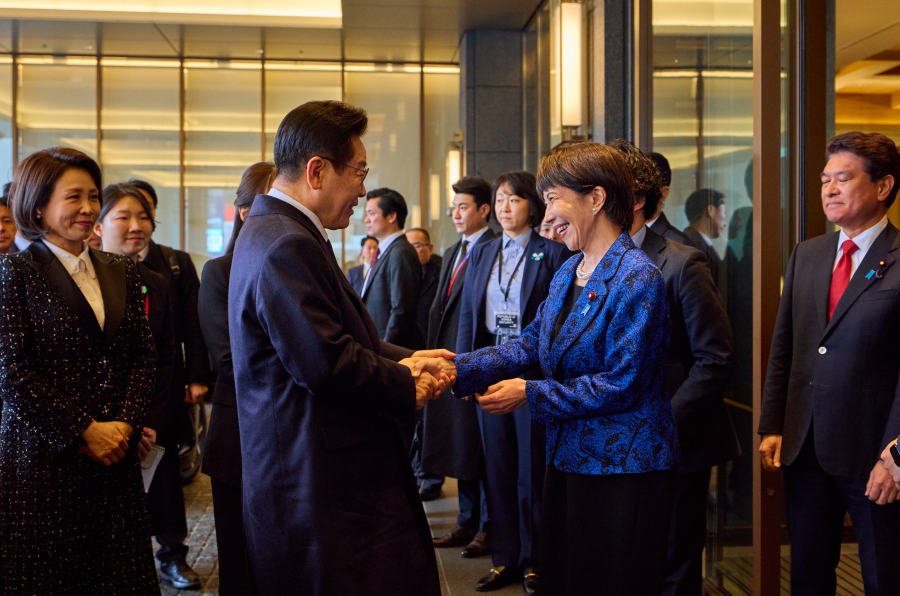
Beyond symbolism, both leaders sought to shape positive public perceptions at home. Their joint cultural performance, including playing drums together—an activity associated with Prime Minister Takaichi’s student years—projected personal a sense of rapport. The choice of music, including “Golden” from K-Pop Demon Hunters and BTS’s “Dynamite,” further underscored cultural familiarity and mutual openness.
Substantively, Japan’s decision to raise the excavation of remains and DNA identification related to the 1942 Chosei Coal Mine flooding accident as the first agenda item of the summit was particularly notable. The South Korean side responded positively, interpreting the initiative as an effort to address unresolved issues stemming from the colonial period and forced mobilization—topics that remain politically sensitive within Japan.
The leaders also discussed practical cooperation across a range of functional areas, including economic security, coordination within global supply chains, denuclearization of the Korean Peninsula, and joint law enforcement responses to transnational organized crime. While progress varied across issues, concrete implementation plans are reportedly advancing in certain areas.
On more contentious topics—such as South Korea’s accession to the CPTPP, Japanese seafood imports, and the abductees issue—no agreements were reached. Nevertheless, both sides emphasized that their respective positions were fully conveyed and understood. This approach reflects an effort to expand cooperation where feasible while managing, rather than escalating, points of disagreement.
At the same time, limitations remain evident. Although progress on the Chosei Mine project is meaningful, Japanese media outlets such as Sankei Shimbun have noted that this issue is one of the few historical cases where confrontation is relatively muted. It differs fundamentally from issues involving legal responsibility and compensation—such as forced labor or the comfort women issue—where positions remain sharply opposed.
From Tokyo’s perspective, cooperation on the Chosei Mine represents a relatively low-risk historical issue, unlikely to provoke backlash from domestic conservative constituencies. While this may reflect pragmatic issue selection, it would be premature to interpret it as evidence of a broader political willingness to confront more contentious historical questions.
The durability of shuttle diplomacy also warrants careful scrutiny. President Lee Jae-myung’s reference to a future visit “next time in Andong” signals an intention to institutionalize reciprocal leader-level visits. However, historical precedent counsels caution. Shuttle diplomacy, first articulated in the 1998 Kim Dae-jung–Obuchi Declaration, has repeatedly proven vulnerable to disruption.
Initiated in 2004 between President Roh Moo-hyun and Prime Minister Junichiro Koizumi, it was suspended within a year following Koizumi’s visits to Yasukuni Shrine. It resumed in 2008 under President Lee Myung-bak and Prime Minister Yasuo Fukuda, only to stall again in 2011 amid renewed historical disputes. Japanese media continue to view the current phase through this historical lens, offering restrained and cautious assessments.
After a 12-year hiatus, shuttle diplomacy was revived in 2023 under President Yoon Suk-yeol and Prime Minister Fumio Kishida. Despite subsequent leadership changes in both countries, the framework has thus far remained intact. Both President Lee Jae-myung and Prime Minister Takaichi have publicly affirmed their commitment to its continuation. Nonetheless, unresolved historical and territorial issues remain latent disruptors.
Moreover, domestic political uncertainty in Japan—including the contrast between Prime Minister Takaichi’s personal popularity and the Liberal Democratic Party’s comparatively weaker standing—introduces additional variables. Scenarios ranging from cabinet reshuffles to coalition realignments or even a change in government could all affect the trajectory of bilateral engagement.
Despite these risks, one encouraging development is President Lee Jae-myung’s articulated approach to South Korea–Japan relations. During the summit, he emphasized that “uncomfortable or negative issues must be managed carefully and minimized.” Following the impeachment and removal of former President Yoon Suk-yeol—who had actively pursued rapprochement with Japan—there was considerable concern within Japanese diplomatic circles that a Democratic Party administration might reverse prior progress.
Contrary to those expectations, President Lee has adopted a pragmatic stance. While acknowledging the persistence of historical and territorial disputes, he has argued against either neglecting them or allowing them to dominate the bilateral agenda. Instead, he has framed them as issues to be managed in parallel with expanded cooperation.
If sustained, this approach could enable tangible policy outcomes for South Korea by broadening functional cooperation with Japan while containing domestic political backlash from hardline critics. In this sense, the current phase of shuttle diplomacy reflects not an absence of friction, but a shared recognition that managing disagreement—rather than resolving it outright—may be the most realistic foundation for stable Korea–Japan relations.
-
PREV [Thematic Analysis]
-
NEXT [Thematic Analysis]