

North Korea’s Allegations of South Korean Drone Airspace Violations: Intent and Policy Responses

Sung-mook Moon
Director, Unification Strategy Center
Korea Institute for National Strategy
I. Background: North Korea’s Allegations and South Korea’s Official Response
On January 9, the North Korean General Staff released a spokesperson’s statement alleging that the Republic of Korea (ROK) had committed a “grave violation of sovereignty” by deploying a drone into North Korean airspace at the beginning of the new year.
The statement claimed that North Korea’s Border Air Defense Surveillance Unit detected and tracked an aerial object over Songhae-myeon, Ganghwa County, Incheon, on January 4. It further asserted that North Korean forces deliberately allowed the object to penetrate approximately eight kilometers into North Korean airspace before neutralizing it with specialized electronic warfare assets, causing it to crash.
North Korea claimed that the downed drone was equipped with reconnaissance equipment and publicly released photographs of the wreckage, along with selected images allegedly obtained by the drone and a purported flight plan.
The statement also referenced an earlier alleged incident on September 27, 2025, in which a South Korean-origin unmanned aerial vehicle (UAV), reportedly launched from the vicinity of Jeokseong-myeon in Paju, intruded into airspace near Pyeongsan County in North Hwanghae Province and was disabled by the electronic attack capabilities of North Korea’s Second Corps.
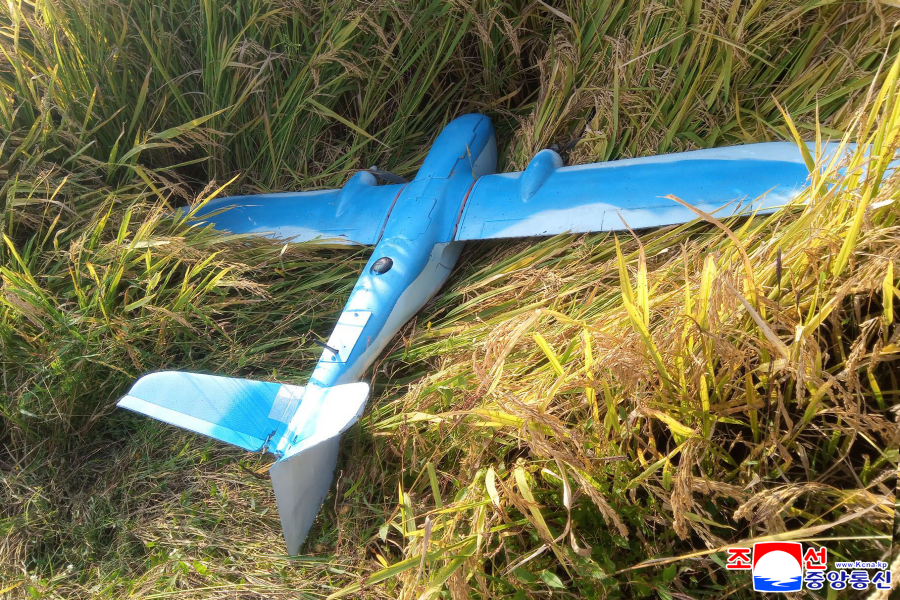
The General Staff argued that the daytime launch of a drone from a sensitive frontline area in South Korea made attribution self-evident and placed responsibility squarely on the ROK military. It also criticized President Lee Jae-myung’s remarks emphasizing the importance of preserving even minimal channels of inter-Korean communication, portraying such statements as reinforcing what it described as South Korea’s hostile posture.
In response, the South Korean government convened a working-level National Security Council (NSC) coordination meeting chaired by Kim Hyun-jong, First Deputy Director of the National Security Office, to assess the situation and consider countermeasures.
The Ministry of National Defense (MND) categorically rejected North Korea’s claims, stating that initial investigations confirmed that the ROK military neither possessed nor operated the drone described by Pyongyang during the relevant period. The ministry further indicated that the possibility of civilian drone involvement would be thoroughly examined in cooperation with relevant government agencies.
The MND reiterated that South Korea had no intention of provoking or escalating tensions with North Korea and reaffirmed its commitment to practical confidence-building and de-escalatory measures. President Lee subsequently directed the establishment of a joint military–police investigative task force to conduct a swift and comprehensive inquiry into the incident.
Following these responses, Kim Yo-jong, Vice Department Director of the Workers’ Party of Korea, issued a statement rejecting South Korea’s explanation. While dismissing Seoul’s position that civilian involvement would be investigated, she asserted that South Korean authorities could not evade responsibility for what Pyongyang characterized as a violation of sovereignty.
Although she described the MND’s non-provocation statement as a “wise choice,” she emphasized that, in North Korea’s view, responsibility rested with South Korea regardless of whether the drone was military or civilian. She further warned that attempts to shift blame to civilian actors would not absolve the South of responsibility and hinted at possible retaliatory measures.
II. Why Is North Korea Raising the Drone Issue Now?
The key question is not merely the credibility of North Korea’s claims, but the regime’s strategic intent in elevating this issue at the outset of the new year—while invoking alleged incidents from October 2024 and September 2015. The timing and framing suggest that Pyongyang’s objectives extend beyond the immediate tactical issue of airspace violations.
In reality, North Korea lacks moral standing to raise accusations regarding drone provocations. Over the past decade, it has conducted more than ten UAV incursions into South Korean airspace, including a 2022 incident in which a North Korean drone penetrated airspace over the Yongsan Presidential Office. Pyongyang has never acknowledged or explained these actions. Against this backdrop, the current allegations should be understood primarily as instruments of political and strategic messaging rather than genuine security grievances.
While North Korea’s intentions may be multifaceted, they can be broadly categorized into three core objectives.
III. Strategic Intentions Behind North Korea’s Actions
1. Reinforcing the Legitimacy of Kim Jong-un’s “Hostile Two-State” Doctrine
Since the 2023 Workers’ Party plenary meeting, Kim Jong Un has formally redefined inter-Korean relations as relations between hostile states, designating the Republic of Korea as the principal enemy. Under this framework, all institutional channels for inter-Korean dialogue have been dismantled. This “hostile two-state” doctrine serves a critical domestic purpose: insulating North Korean society from external influence and consolidating internal cohesion through a heightened perception of threat.
With the Ninth Party Congress approaching, Kim Jong-un faces the task of codifying this doctrine into the Party Constitution. The drone incident provided a timely pretext. The General Staff spokesperson explicitly stated that South Korea constitutes North Korea’s most hostile enemy and an entity that must be destroyed in the event of an attack. Kim Yo-jong similarly asserted that the alleged drone intrusion further reinforced South Korea’s image as a hostile and illegitimate entity.
Notably, North Korean statements consistently refer to the South as the “Republic of Korea” and describe the Military Demarcation Line as an international “border,” thereby emphasizing the concept of two separate states. These messages, disseminated through Rodong Sinmun and other domestic outlets, clearly reflect Pyongyang’s intent to justify the hostile two-state narrative, incite anti-South sentiment, and rally domestic support around Kim Jong Un’s leadership.
2. Distorting the Causes of Tension and Justifying Nuclear Armament
A second objective is to shift responsibility for heightened tensions on the Korean Peninsula. North Korea has long argued that U.S. “hostile policy,” the presence of U.S. forces in South Korea, and ROK–U.S. joint military exercises constitute preparations for invasion. Within this narrative, North Korea’s nuclear arsenal is framed as an entirely legitimate and defensive necessity.
By emphasizing alleged South Korean provocations such as drone incursions, Pyongyang seeks to reinforce its claim that the prevailing security environment compels nuclear armament. This narrative underpins its rejection of UN Security Council sanctions, its declaration that denuclearization will not occur, and its stated intention to further expand its nuclear capabilities. Diplomatic backing from China and Russia has further emboldened this posture.
Recent developments—such as the reaffirmation of denuclearization at the ROK–U.S. summit and President Lee Jae-myung’s request for China to play a mediating role in promoting peace on the Peninsula—likely heightened Pyongyang’s sense of strategic unease.
Against this backdrop, the drone allegations appear intended to reassert the regime’s justification for nuclear possession and shift blame onto South Korea. This intent is explicitly reflected in the General Staff’s assertion that the international community must “clearly understand the root cause of escalating tensions on the Korean Peninsula.”
3. Undermining the Lee Jae-myung Administration’s Peace Agenda and Creating Conditions for Further Provocations
Since its inauguration in June of last year, the Lee Jae-myung administration has pursued a policy of peace coexistence grounded in respect for the North Korean regime, the non-pursuit of absorption-based unification, and the avoidance of hostile actions. Measures such as suspending loudspeaker broadcasts near the Demilitarized Zone, halting radio transmissions, and proposing inter-Korean military talks have aimed to reduce tensions and build trust.
In 2026, the administration articulated its intention to designate the year as the starting point of a “Peace and Trust Process” on the Korean Peninsula. President Lee’s remarks emphasizing the need to make every possible effort to restore communication channels should be understood within this broader context.
However, the Kim Jong Un regime—focused primarily on regime survival—appears unwilling or unable to respond positively to these initiatives. At the same time, outright rejection carries political and strategic Consequently, Pyongyang’s drone allegations appear designed to portray the Lee administration as disingenuous, thereby obstructing momentum toward dialogue while accumulating justification for future provocations. With major ROK–U.S. joint military exercises scheduled for March, North Korea may seek to use this narrative as a pretext for additional escalatory actions.
IV. Implications for Policy and Strategic Response Options
South Korea should avoid being drawn into North Korea’s tactical messaging. Having already articulated its fundamental position, Seoul should proceed calmly and in accordance with established legal and institutional procedures. The joint military–police task force must conduct a thorough, high-level investigation to determine both the origin of the drone and the intent behind its operation.
If it is confirmed that the drone crossed the Military Demarcation Line from the South, this would constitute a violation of the Armistice Agreement, necessitating coordination with the United Nations Command (UNC). Appropriate accountability measures should follow, along with concrete steps to prevent recurrence.
Regarding communication of the findings, several options merit consideration: issuing a unilateral public explanation; proposing the resumption of inter-Korean military talks; or, in coordination with the UNC, convening UNC–North Korean general-level military talks to explain the investigation results and discuss preventive measures. Given North Korea’s repeated Armistice violations in recent years, such a forum would be particularly appropriate.
At the same time, South Korea must maintain a firm readiness posture, recognizing the possibility of further provocations. Internationally, Seoul should reaffirm its Peace and Trust Process to prevent distortion of the incident and underscore its continued commitment to peace.
Although this episode may temporarily hinder inter-Korean dialogue, strategic patience, consistency, and preparedness remain essential. Should North Korea engage in additional provocations, South Korea must respond decisively while remaining anchored in its principled pursuit of peace.