

SHINE Initiative: Building a Radiant Peace Together on the Korean Peninsula and in the Middle East

So Yeon Ahn
Seoul National University Asia Center, Co-Researcher
Throughout 2025, South Korea’s diplomacy moved at a rapid pace, including hosting the APEC Summit. Within this context, a notable shift has emerged in South Korea’s Middle East policy. By late 2024, the seemingly resilient authoritarian regime of Bashar al-Assad in Syria collapsed. The South Korean government, which had previously refrained from establishing diplomatic relations with Syria due to its perceived alignment with North Korea, responded swiftly to the regime change.
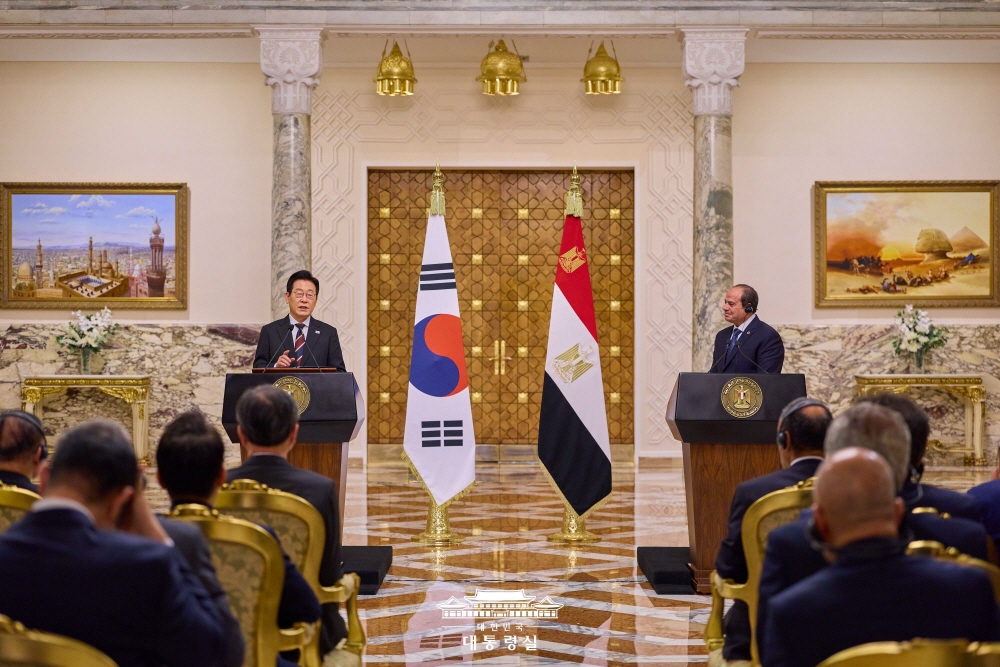
In April 2025, South Korea formalized diplomatic relations with Syria, aiming to expand its political influence in the Middle East. Subsequently, President Lee Jae-myung, only six months into his term, chose the Middle East as his second overseas destination for a state visit, following Japan and the United States. This early visit signals a clear reorientation of South Korea’s Middle East policy.
The shift aligns with the Lee administration’s broader foreign policy agenda, which seeks to establish South Korea as a “global leading nation” through “national interest-centered pragmatic diplomacy.” President Lee selected the United Arab Emirates, Egypt, and Türkiye as primary destinations.
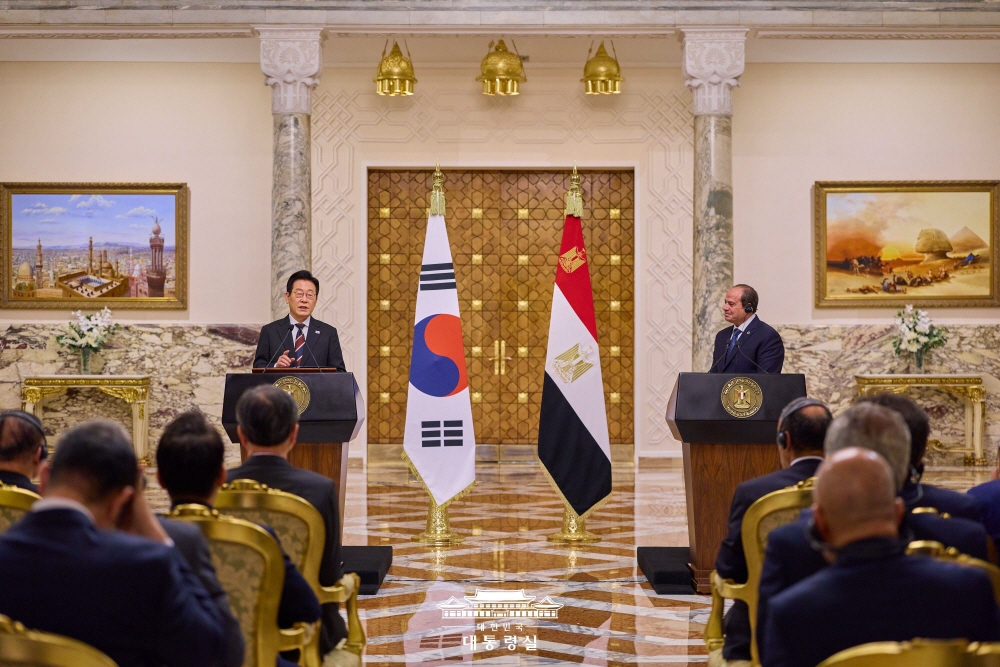
During these visits, agreements were reached to expand cooperation across multiple sectors, including defense, nuclear energy, culture, and artificial intelligence (AI), reflecting a pragmatic diplomatic approach. The most significant outcome was South Korea’s demonstration of a willingness to assume a proactive role in advancing regional peace. Historically, the Middle East has been a key energy supplier and investment destination for South Korea, but the country has largely remained passive in pursuing a political role. This tour marked a strategic shift, as President Lee articulated, for the first time, a comprehensive vision for the Middle East.
In a speech at Cairo University in Egypt, President Lee introduced the SHINE Initiative, an acronym for Stability, Harmony, Innovation, Network, and Education. The SHINE Initiative can be understood through three principal dimensions. First, it aims to promote peace on the Korean Peninsula and in the Middle East by emphasizing Stability and Harmony. South Korea pledged $10 million to the Egyptian Red Crescent Society to aid in the Gaza crisis and expressed its commitment to participate in Egypt’s Gaza reconstruction program.
The second dimension seeks to foster shared innovation and mutual prosperity. South Korea and Egypt agreed to advance the Korea-Egypt Comprehensive Economic Partnership Agreement (CEPA), strengthen collaboration in energy and construction, and expand cooperation in emerging technologies such as AI.
The third dimension seeks to broaden engagement beyond economic collaboration through the development of networks and educational exchanges, including expanding academic cooperation, enhancing institutional support, and promoting cultural exchanges such as K-Culture.
The SHINE Initiative, evoking the legacy of the Sunshine Policy of the Kim Dae-jung administration toward North Korea, signals South Korea’s commitment to enduring peace. In his Cairo University speech, President Lee referenced prior South Korean presidents, including Kim Dae-jung, who pioneered engagement with North Korea, and commended Egyptian President El-Sisi for his leadership in the recent Gaza ceasefire alongside President Trump.
The Lee administration emphasized its intention to conclude the era of confrontation on the Korean Peninsula, ushering in a period of peaceful coexistence and shared growth. The initiative underscores a broader vision: that peace and stability in the Middle East can serve as a foundation for long-term security and reconciliation on the Korean Peninsula. Like the Sunshine Policy, the SHINE Initiative prioritizes gradual change through dialogue, cooperation, and harmonization, extending this principle from the Middle East to East Asia.
President Lee’s announcement of the SHINE Initiative in Egypt was highly strategic. Egypt possesses a long history of civilization and controls the Suez Canal, a key global transit route. It was the first Arab nation to establish diplomatic relations with Israel, signaling pragmatic diplomacy.
Recently, Egyptian President El-Sisi, in coordination with President Trump, brokered a ceasefire between Israel and Hamas and advanced a peace vision for Gaza in Sharm El-Sheikh. Presenting an initiative emphasizing stability and prosperity for both the Korean Peninsula and the Middle East in Egypt, a symbol of regional peace, carries significant symbolic and strategic weight.
The Middle East remains a major global conflict zone, characterized by ongoing interstate wars and civil conflicts. The Gaza War, triggered by Hamas’s 2023 attack on Israel, escalated tensions into a broader confrontation between Israel and Iran, further intensified in July by U.S. military action against Iran, with implications for global security. These conflicts are not remote issues for Korea.
North Korea has historically engaged in military and weapons cooperation with Iran, supporting actors such as Hezbollah, Hamas, and Houthi rebels, and maintaining military ties with the Assad regime in Syria. Israel’s July strike on Iranian nuclear facilities carries important implications for the Korean Peninsula, likely reinforcing Iran’s determination to pursue nuclear capabilities.
Observing these developments, North Korea may interpret nuclear weapons as critical to its survival. Moreover, North Korea could adopt advanced conventional weapon systems, strategies, and tactics observed in the Middle East, intensifying its military capabilities. Thus, instability in the Middle East increases strategic uncertainty on the Korean Peninsula.
Emerging signs of shifts in the international order in the Middle East are evident. Early in his term, President Trump selected the Middle East as his first overseas destination, emphasizing maximum pressure on Iran while leaving space for negotiation. In October, he brokered a ceasefire between Israel and Hamas and facilitated the Gaza Peace Agreement for reconstruction efforts. By stabilizing the region, the U.S. intends to reshape the Middle East’s power dynamics while cultivating a peacemaker image.
If the Middle East stabilizes according to these intentions, U.S. attention may increasingly focus on Indo-Pacific security issues, including North Korea. At the recent APEC summit, President Trump expressed readiness to engage directly with North Korean leader Kim Jong-un, suggesting that progress in the Middle East could enhance prospects for U.S.-North Korea dialogue.
Stability in the Middle East encompasses more than the cessation of conflict. It intersects with U.S.-China competition, external interventions, denuclearization, terrorism, and energy security, often generating new challenges. Within this complex system, enhanced Middle East stability can catalyze positive changes across the broader international order.
The SHINE Initiative seeks not only to solidify Korea’s role as a partner for regional peace and prosperity but also to position South Korea as a proactive peace builder in the Middle East and beyond. By extending stability and development from the Middle East to the Korean Peninsula, the initiative represents Korea’s commitment to a global vision of enduring peace and shared prosperity.