

A Study on North Korea's Nuclear Economic Policy: Focusing on Correlation(3)
This research is a joint endeavor from the 2019 initiative aiming to lay the groundwork for reunification. This initiative was spearheaded by the SAND Research Institute in partnership with the Institute of Economic Research at Seoul National University. Within, we provide an up-to-date analysis examining the frequency, significance, co-occurrence, and implications of the terms "nuclear" and "economy" in various contexts.
(Continued from Issue No. 13, 14)
7. Analysis of the Relationship between “Nuclear”, “Economy”, and Events on the Korean Peninsula
1) regression analysis
A logistic regression analysis was employed to explore potential relationships between the prevalence of nuclear and economic related word groups in the entire document and events influencing peace on the Korean Peninsula—ranging from the destabilizing nuclear tests to the peace-fostering inter-Korean and North Korea-U.S. summits.
Firstly, the trend of the proportion of nuclear and economic related word groups in the total number of words from Table 5 was calculated and set as an independent variable. The simple frequency of appearance of the words “economy” and “nuclear” were also used as independent variables. Additionally, since a number of economic related word groups were included in the nuclear-related word groups, “pure nuclear related word groups” were derived by removing the economic related word groups from the nuclear related word groups, and this was used as an independent variable.
The quarterly trend of the appearance proportions of the two related word groups and the appearance proportion trend of the pure nuclear related word groups are as follows.
<Figure 4> Trend of Appearance Proportions of Nuclear and Economic Related Word Groups and Pure Nuclear Related Word Groups
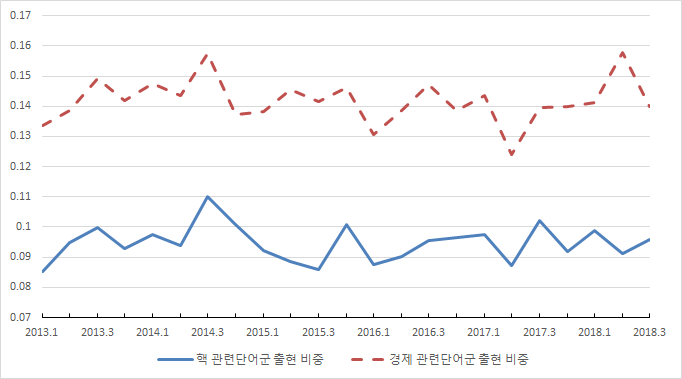
ㅡ Proportion of Occurrence of Nuclear-Related Word Group -- Proportion of Occurrence of Economic-Related Word Group
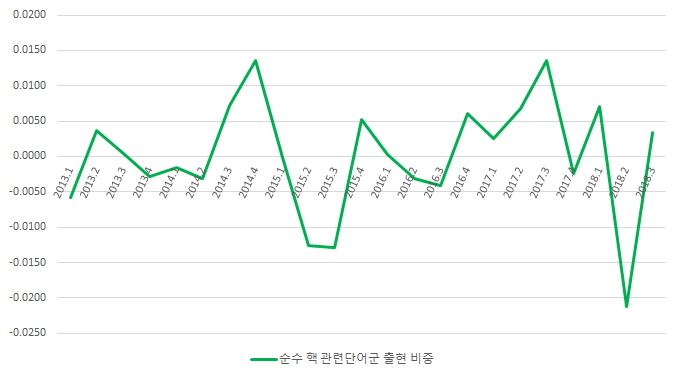
ㅡ Proportion of Pure Nuclear-Related Word Group Occurrence
Overall, the vocabulary related to economics consistently maintained a higher presence throughout the entire period in comparison to vocabulary related to nuclear topics.
Along with this, dummy variables for negative events affecting peace on the Korean Peninsula, such as North Korea's nuclear tests, and peaceful events such as high-level inter-Korean contacts, inter-Korean summits, high-level North Korea-U.S. contacts, and North Korea-U.S. summits were created and set as dependent variables.
For the negative event variable, a dummy variable was created with a value of 1 for quarters in which North Korea conducted nuclear tests or ballistic missile launches, and 0 for other quarters. For the positive event variable, a dummy variable was created with a value of 1 for quarters in which high-level meetings and summits between North and South Korea, and North Korea and the U.S. took place, and 0 for other quarters. The content of the positive and negative event variables derived based on the above criteria is as shown in Table 8 below.
Additionally, the study analyzed the impact of events that negatively influenced peace on the Korean Peninsula on the simple frequency of appearance of nuclear and economic words, the appearance proportion of related word groups, and the appearance proportion of pure nuclear related word groups in academic journals. It examined the impact of negative events, such as nuclear tests and ballistic missile launches, on the appearance of nuclear words and related words to investigate whether academic journals were attempting to justify these events after their occurrence.
<Table 8> Details of the Dependent Variable Construction
부정적 사건 변수 |
긍정적 사건 변수 |
|||
| 사건 Event |
변수값 Variable Value |
사건 | 사건 Event |
|
| 2013 1Q | 제3차 핵실험 Third Nuclear Test |
1 | 2013 1Q | 제3차 핵실험 Third Nuclear Test |
| 2013 2Q | 단거리 미사일 발사 Short-Range Missile Launch |
1 | 2013 2Q | 단거리 미사일 발사 Short-Range Missile Launch |
| 2013 3Q | - | 0 | 2013 3Q | - |
| 2013 4Q | - | 0 | 2013 4Q | - |
| 2014 1Q | - | 0 | 2014 1Q | - |
| 2014 2Q | 중거리 미사일 발사 Medium-Range Missile Launch |
1 | 2014 2Q | 중거리 미사일 발사 Medium-Range Missile Launch |
| 2014 3Q | - | 0 | 2014 3Q | - |
| 2014 4Q | - | 0 | 2014 4Q | - |
| 2015 1Q | 스커드 계열 미사일 발사 Scud Missile Series Launch |
1 | 2015 1Q | 스커드 계열 미사일 발사 Scud Missile Series Launch |
| 2015 2Q | KN 계열 미사일 발사 KN Series Missile Launch |
1 | 2015 2Q | KN 계열 미사일 발사 KN Series Missile Launch |
| 2015 3Q | - | 0 | 2015 3Q | - |
| 2015 4Q | - | 0 | 2015 4Q | - |
| 2016 1Q | 제4차 핵실험 Fourth Nuclear Test |
1 | 2016 1Q | 제4차 핵실험 Fourth Nuclear Test |
| 2016 2Q | 중거리 탄도미사일 발사 Medium-Range Ballistic Missile Launch |
1 | 2016 2Q | 중거리 탄도미사일 발사 Medium-Range Ballistic Missile Launch |
| 2016 3Q | 잠수함탄도미사일 발사 Submarine-Launched Ballistic Missile Launch |
1 | 2016 3Q | 잠수함탄도미사일 발사 Submarine-Launched Ballistic Missile Launch |
| 2016 4Q | 제5차 핵실험 Fifth Nuclear Test |
1 | 2016 4Q | 제5차 핵실험 Fifth Nuclear Test |
| 2017 1Q | 탄도 미사일 발사 Ballistic Missile Launch |
1 | 2017 1Q | 탄도 미사일 발사 Ballistic Missile Launch |
| 2017 2Q | 탄도 미사일 발사 Ballistic Missile Launch |
1 | 2017 2Q | 탄도 미사일 발사 Ballistic Missile Launch |
| 2017 3Q | 제6차 핵실험 Sixth Nuclear Test |
1 | 2017 3Q | 제6차 핵실험 Sixth Nuclear Test |
| 2017 4Q | 탄도 미사일 발사 Ballistic Missile Launch |
1 | 2017 4Q | 탄도 미사일 발사 Ballistic Missile Launch |
| 2018 1Q | - | 0 | 2018 1Q | - |
| 2018 2Q | - | 0 | 2018 2Q | - |
| 2018 3Q | - | 0 | 2018 3Q | - |
※ Source: Ministry of Unification website, specifically the <Major Chronology of Inter-Korean Relations> and <Inter-Korean Summit Information> sections.
Additionally, while there may be an impact occurring in the same quarter between the nuclear and economic related word groups, and the negative/positive events, that is, between the dependent and independent variables, considering that the impact may occur with a time lag, the lagged variables of the independent variables were created up to two quarters back, and the analysis was conducted.
2) Analysis Results
According to the results in <Table 9>, the model that set the simple word occurrence proportion as an independent variable (columns 1 and 4) does not show statistical significance for both negative and positive events.
The lagged variable of the pure nuclear-related word group occurrence proportion from the previous quarter shows a positive (+) influence at the 5% confidence level on negative events (column 3). However, its impact on positive events does not reach statistical significance (column 6). In other words, it is inferred that the higher the pure nuclear-related word group occurrence proportion in the previous quarter, the higher the probability of negative events such as nuclear tests and missile launches occurring in the current quarter.
The lagged variable of the economic-related word group occurrence proportion from the previous quarter shows a positive (+) influence at the 5% confidence level on positive events (column 5). It is inferred that the higher the economic-related word group occurrence proportion in the previous quarter, the higher the probability of positive events occurring in the current quarter.
While the simple frequency of occurrence of each nuclear and economic word does not influence positive/negative events, the lagged variables from the previous quarter show a significant impact on each event. The relationship between the lagged variables and the occurrence of events may not be logically explainable. There is also a possibility that this relationship occurred because of a tendency to detect the atmosphere of nuclear and missile tests or the atmosphere of talks in advance and respond to it beforehand. However, there is also a possibility that this is a mere statistical coincidence.
According to the results in <Table 10>, when a negative event occurs on the Korean Peninsula, the simple frequency of nuclear word occurrence in that quarter increases, and the occurrence of negative events two quarters prior also increases the simple frequency of nuclear word occurrence in that quarter. Additionally, it decreases the occurrence proportion of the economic-related word group during quarters when negative events occur.
3) Implications
The proportion of related word groups associated with "nuclear" and "economic" terms in academic journals seems to be intricately linked with positive and negative developments in peace across the Korean Peninsula.
Negative events on the Korean Peninsula increase the simple frequency of nuclear word occurrence, suggesting that justification of events such as nuclear tests and ballistic missile launches is somewhat taking place after those events.
On the other hand, when negative events occur, the appearance proportion of the economic-related word group decreases, suggesting that when events such as nuclear tests and ballistic missile launches occur, interest in the economic sector appears to be relatively low.
<Table 9> Time-Series Logit Regression Analysis Results
| 종속변수 Dependent Variable |
||||||
| 부정적 사건 Negative Event |
긍정적 사건 Positive Event |
|||||
| (1) | (2) | (3) | (4) | (5) | (6) | |
| “핵” 단순 출현빈도 Simple Frequency of “Nuclear” |
핵 관련단어군 비중 Proportion of Nuclear-Related Word Group |
순수 “핵” 관련단어군 비중 Proportion of Pure “Nuclear” Related Word Group |
“경제” 단순 출현빈도 Simple Frequency of “Economy” |
경제 관련단어군 비중 Proportion of Economy-Related Word Group |
순수 “핵” 관련단어군 비중 Proportion of Pure “Nuclear” Related Word Group |
|
핵 단어 출현 빈도t |
0.1231 (0.1440) |
|||||
핵 단어 출현 빈도t-1 |
0.1483 (0.1561) |
|||||
핵 단어 출현 빈도t-2 |
-0.0150 (0.1415) |
|||||
핵 관련단어군 비중t |
-152.5 (102.23) |
|||||
핵 관련단어군 비중t-1 |
-0.404 (84.11) |
|||||
핵 관련단어군 비중t-2 |
15.38 (63.82) |
|||||
순수 핵 관련단어군 비중t |
7.742 (72.85) |
-27.75 (102.54) |
||||
순수 핵 관련단어군 비중t-1 |
138.17* (61.24) |
-147.20 (75.38) |
||||
순수 핵 관련단어군 비중t-2 |
38.99 (68.55) |
-12.00 (76.30) |
||||
경제 단어 출현 빈도t |
0.0447 (0.0415) |
|||||
경제 단어 출현 빈도t-1 |
-0.0697 (0.0543) |
|||||
경제 단어 출현 빈도t-2 |
-0.0641 (0.0472) |
|||||
경제 관련단어군 비중t |
98.88 (86.22) |
|||||
경제 관련단어군 비중t-1 |
176.10* (70.07) |
|||||
경제 관련단어군 비중t-2 |
59.29 (69.22) |
|||||
| R-squared | 0.1349 | 0.1120 | 0.1665 | 0.1663 | 0.2298 | 0.1665 |
| 관측치 Observations |
21 | 21 | 21 | 21 | 21 | 21 |
※ Note: Figures in parentheses represent the Robust Standard Error. The (*) symbol indicates significance at the 5% confidence level, highlighted in bold. The results estimated for each independent variable at each time point t for each dependent variable also show no significant difference in significance or coefficients from the above results.
<Table 10> OLS Regression Analysis Results Table
| 종속변수 Dependent Variable |
|||||
| (1) | (2) | (3) | (4) | (5) | |
| “핵” 단순 출현빈도 Frequency of Simple Occurrence of "Nuclear" |
핵 관련단어군 비중 Proportion of Nuclear-Related Word Group |
순수 “핵” 관련단어군 비중 Proportion of Pure Nuclear-Related Word Group |
“경제” 단순 출현빈도 Frequency of Simple Occurrence of "Economy" |
“경제” 관련단어군 비중 Proportion of Economy-Related Word Group |
|
부정적 사건t |
2.800* (1.206) |
-0.0053 (0.0035) |
0.0006 (0.0037) |
6.180 (5.171) |
-0.0086* (0.0033) |
부정적 사건t-1 |
2.586 (1.437) |
0.0026 (0.0036) |
0.0006 (0.0052) |
4.866 (6.078) |
0.0034 (0.0036) |
부정적 사건t-2 |
4.300** (1.482) |
-0.0007 (0.0034) |
0.0020 (0.0048) |
5.880 (5.233) |
-0.0030 (0.0035) |
| R-squared | 0.5827 | 0.006 | 0.0091 | 0.2029 | 0.0070 |
| 관측치 Observations |
21 | 21 | 21 | 21 | 21 |
※ Note: Figures in parentheses represent the Robust Standard Error. The (*) symbol indicates significance at the 5% confidence level, and the (**) symbol indicates significance at the 1% confidence level, both highlighted in bold. The results estimated for each independent variable at each time point t for each dependent variable also show no significant difference in significance or coefficients from the above results.
8. Conclusion
According to the analysis through North Korean academic journals, nuclear and economy are perceived as independent concepts in terms of their intrinsic connection. They are connected only by common goals, and no internal correlation between the two is observed. However, the connection between nuclear and economy is seen in the hostile policies of U.S. imperialism, revealing the passive nature of the nuclear-economic parallel development policy.
In understanding the relationship between nuclear and economy, it is perceived that while the economy is complementary to nuclear, nuclear is not necessary for the economy, indicating a unilaterally complementary relationship. This implicitly reflects self-awareness that acknowledges the difficulty of securing legitimacy from the residents solely with nuclear capabilities.
The trend in the frequency of occurrences of the words "nuclear" and "economy" is similar, which can be interpreted as an indication of the North Korean regime's censorship on publications. Despite the disparity between the two words, it seems that the state policy of nuclear-economic parallel development has been instilled through censorship of academic journals.
In the period leading up to the first quarter, an increase in the prevalence of nuclear-related terms correlates with a higher likelihood of negative events on the Korean Peninsula, such as nuclear tests and missile launches. In contrast, a rise in the prevalence of economic-related terms correlates with an increased likelihood of peaceful events, like inter-Korean dialogues.
The occurrence of negative events in the Korean Peninsula increases the frequency of nuclear word occurrences while decreasing the proportion of economy-related words. This is believed to be for post-justification of nuclear and missile tests.