

North Korean Authorities Accuse Anti-Regime Movement, Involving Educators, Doctors, and Intellectuals, in Pursuit of Liberal Democracy Party…
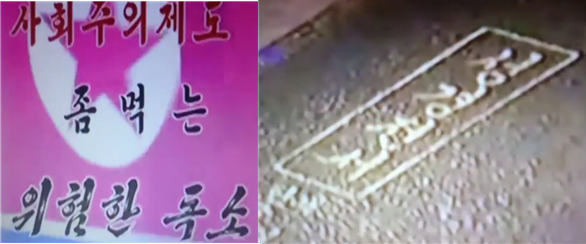
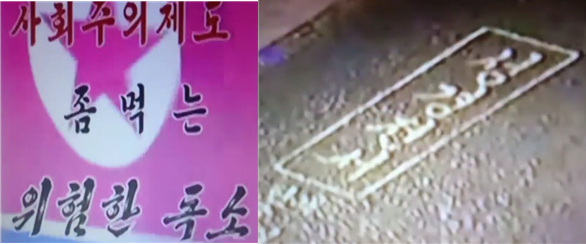
사회주의 제도 좀먹는 위험한 독소’라는 제하의 학습제강 영상자료에 성경전서를 퍼뜨린 사실도 성토하고 있다. (사진: SAND연구소가 입수한 영상자료 캡처)
North Korean organizations involved in anti-regime activities within North Korea have come to light through official North Korean documents. Recent video materials obtained by SAND from North Korean security authorities reveal that educators, doctors, and intellectuals in North Korea have recognized the irrationality and contradictions inherent in the North Korean regime through exposure to South Korean radio, movies, and TV shows. In response, they have spontaneously formed an anti-regime revolutionary organization, and astonishingly, some even claim to have established a political party with the vision of creating a liberal democracy system. The emergence of such organizations within North Korea, aiming to adopt South Korea's liberal democracy ideology and aspiring to transform their own society, is believed to be a first-time occurrence.
The materials recently acquired by SAND consist of videos created by North Koreans for internal educational purposes. These videos were carefully selected from crackdowns and arrests that occurred in Pyongyang and various provinces during the first half of the previous year, following North Korea's enactment of the Reactionary Ideology and Culture Rejection Law in December 2020. This law marked the beginning of an extensive nationwide campaign to suppress South Korean culture, with severe penalties, including the death penalty, imposed on those involved in distributing South Korean videos.
The video material provides detailed insights into anti-regime activities within North Korea, shedding light on key individuals involved. One prominent figure is Shin Tae-su, who worked as a middle school teacher in a county. His transformation from a typical educator to an anti-regime advocate began as he immersed himself in South Korean broadcasts and recordings. Ultimately, Shin declared the formation of an anti-regime political party, marking a pivotal moment in his life and in the broader landscape of North Korean dissent.
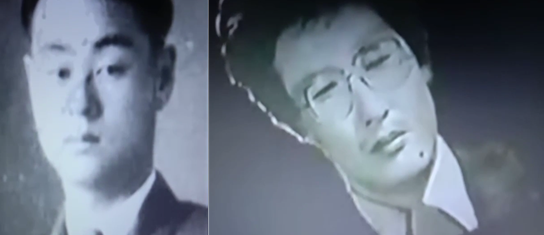
북한이 2022년 하반기에 조직별 학습제강인 영상자료에 등장하는 반체제 인물들. 왼쪽 신태수는 중앙대학 졸업, 학교교원으로 새로운 당을 창건, 새 정부를 세우기 위해 국가전복음모를 시도하여 적발, 오른쪽 병원의사로 재직하던 최모씨는 종교를 전도하면서 북한제도에 반기를 들었다는 죄명으로 처단(사진: 샌드연구소가 입수한 영상자료 캡처)
The video material states about Shin Tae-su, "The dissident Shin graduated from a central university with the Party's support and worked as a middle school teacher. However, he gradually became ideologically corrupted during the process of exposing himself to evil content such as South Korean TV programs. Eventually, he developed resentment towards our nation's system."
Furthermore, it was mentioned that "Shin always complained that the nation did not treat him well, and in the end, he claimed to have established a new party under the so-called liberal democracy system and formed a new government through the process of watching impure South Korean materials. He, along with more than ten dissidents he got to know through exposure to impure materials, conspired to overthrow our nation and went on a rampage, only to face the stern judgment of the nation."
This indicates that more than ten people, through exposure to South Korean cultural materials like TV shows, underwent ideological changes and formed a collective sympathy to engage in anti-regime activities. It illustrates how deeply South Korean cultural influence has penetrated North Korean society and the extent of its impact. The fact that they faced the stern judgment of the nation implies that they were either executed or sent to Political Prison Camps.
The video also reveals excerpts from a notebook containing the principles and regulations of the party he established, along with a partial list of its members. Article 1 of the party regulations stated, 'Our goal is to establish a new party under the liberal democracy system,' while Article 2 emphasized, 'Within our newly organized party, there will be no discrimination between upper and lower ranks.'
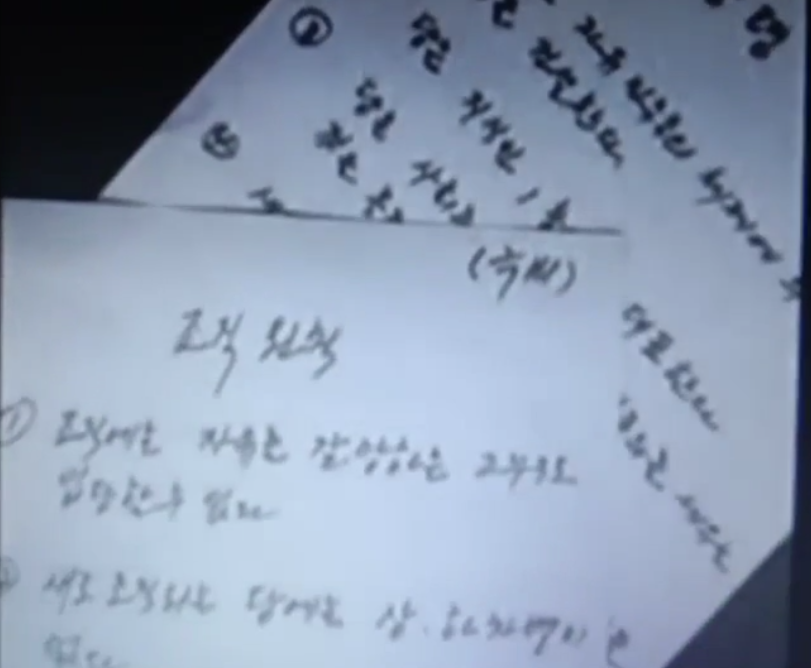
신태수가 작성한 새로운 당 강령과 조직원칙 (사진: SAND연구소 입수자료 캡처)
In the confidentially regulated party principles, Article 1 stated, 'Anyone who desired freedom can join our organization,' and Article 2 specified, 'Our party represents intellectuals, farmers, and others.' It is noteworthy that their organization, which aimed to build a liberal democratic political party in North Korea, prioritized the representation of intellectuals and farmers, rather than the core class of the Workers' Party of Korea (WPK). They sought to incorporate the intellectual class, known for rational and reasoned thinking, as well as the disgruntled peasant masses, who were bound by hunger and feudalistic servitude under the cooperative farm system, into the vanguard of the revolution to achieve fundamental regime transformation in North Korean society."
Ri Young-chol, Cha Ryong-sun, Park Sang-geun, and more were on the list, and North Korea's public disclosure of these names of individuals involved in anti-regime activities serves as a stark warning, not just to those named but also to their families, effectively marking them all as dissidents.
The video discusses a North Korean doctor who turned to religion after reading the Bible. Exposure to South Korean videos triggered significant ideological shifts, ultimately leading him to participate in anti-regime activities. Additionally, the video accuses individuals of accepting money in exchange for sharing military secrets, educational materials, and sensitive military information with South Korean authorities. It also unveils how party members monitored Kim Jong-un's movements through surveillance and eavesdropped on military facilities.
The video material reports, "These dissidents conspired not only against our system but also to harm their own leader, devising counter-revolutionary plans. However, they were apprehended and arrested following reports from our loyal people." The video depicts party members as "alarming foes of the revolution, enticed by impure propaganda, and engaged in actions against our leader."
Additionally, the video condemns South Korean broadcasts and videos as "malicious counter-revolutionary toxins that penetrate the hearts of our people and erode the absolute authority of our leader”.
In the 1980s, there were individuals in South Korea known as the Juche Faction. They were deeply committed to Kim Il-sung's Juche ideology, considering it their guiding principle and the basis for their actions. They played a prominent role in stirring up mass anti-American protests and advocating for North Korea's "National Liberation People's Democracy Revolution (NLPDR)." In fact, the Juche faction managed to exert significant influence over the student activist movement during the late 1980s and early 1990s and even made inroads into South Korean politics.
However, today, we are witnessing a new phenomenon: the emergence of revolutionary parties in North Korea working towards achieving liberal democracy. Moreover, more people are being exposed to South Korean cultural materials, such as TV shows, which signifies a significant development.
If North Korea clings to the Juche ideology and its regime system, even as it faces international criticism, these new vanguards will seek fundamental changes.
North Korea's enactment of the "Reactionary Ideology and Culture Rejection Law" in December 2020, which includes the death penalty for distributing South Korean content, underscores the significant influence of South Korean content within North Korea, as the regime perceives it as a substantial threat.
Despite the tight control exerted by North Korean authorities, it appears that South Korean content, continue to gain traction within North Korea. A survey conducted by the Unification Media Center in October of the previous year revealed an increasing demand for South Korean content among North Korean youth, despite the reinforced penalties for consuming such materials.
Although anti-regime organizations in North Korea face dissolution and heightened suppression by the authorities, as long as the Kim family regime remains in power and restricts human freedoms, the struggle of North Korean revolutionary forces striving for a liberal democratic system akin to South Korea is likely to persist in the future.
<To be continued in the next newsletter>