

Groupism

It is an ideology actively utilized as a means of consolidating the system, emphasizing the way of life that all residents must sacrifice and submit themselves for the organization and the group, and that society and the group are more important and should take precedence over the individual.
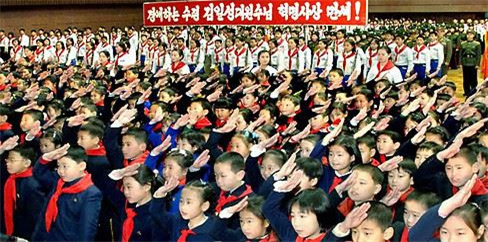
Throughout North Korea, one can see the collectivist slogan, "one for all, all for one." In North Korea, a person is regarded not as an individual but as a member of society and the group, and the extent to which one dedicates themselves to society and the group serves as a measure of value and a principle of action. Therefore, individualism is thoroughly excluded, and only a collectivist view of life is paradoxically preached as the true creed that communists should possess. Additionally, North Korea has been raising the consciousness of its residents by connecting the collectivist view of life to the so-called "theory of socio-political life," stating that the socio-political life of the group is more precious than the physical life of the individual.

North Korea's Korean Central Television is promoting the slogan "one for all, all for one" through video editing materials. (Source: Korean Central Television)
Accordingly, all political and social systems in North Korea are based on collectivism, and the group method is applied to every nook and cranny of individual and social life. After a day's work, North Korean residents participate in a "Life Review Session," which is one form of collectivist lifestyle. Agriculture through cooperative farms, competitive labor movements, mass rallies, etc., are also typical phenomena caused by collectivism. In learning activities, the methods of "collective learning" and "collective discussion" are implemented, emphasizing "collective guidance".
North Korea claims that collective guidance is "the most scientific method of leadership that can eliminate individual subjectivity and arbitrariness in the activities of the party committee." In literary and artistic creation, collectivism is reflected in the method of "collective work." Since the 1960s, "leader image works" have been mass-produced as idolized literary works, and various types of collective works are being created. The greatness of the leader is justified by the logic that it cannot be created by the power of a single individual, and therefore the strength and talent of multiple creators must be gathered.
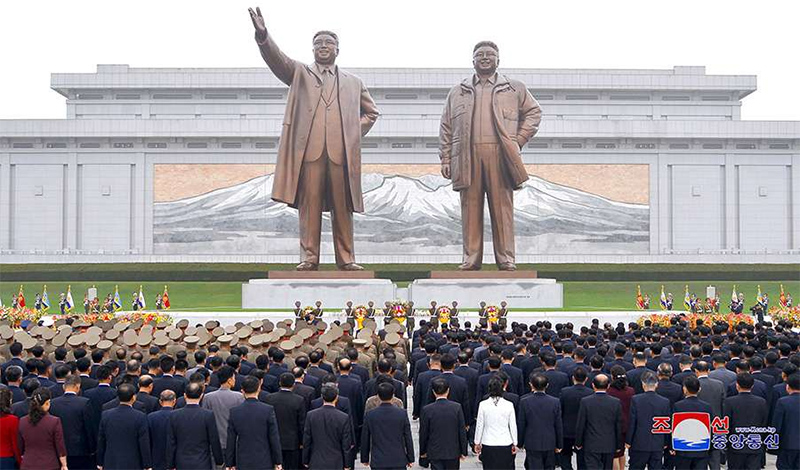
Statues of Kim Il-sung and Kim Jong-il established on Mansudae Hill in Pyongyang City / Photo by Korean Central News Agency
North Korea's collectivism has thus been deeply ingrained in social structure and residents' consciousness, functioning as a mechanism to maintain the regime. However, North Korean society is also changing over time, just as North Korea itself has said it is a single living entity, and accordingly, the principles of collectivism are being eroded. The national distribution system has disappeared due to continuous economic difficulties, and private economic activities through the Jangmadang (marketplace) economy are increasing, as residents need to solve their own food, clothing, and shelter issues. Furthermore, the influx of external information is spreading individualism among North Korean residents, showing a tendency to weaken the existing ideology-centric and collectivist consciousness.
-
PREV [SAND Research Report]
-
NEXT [North Korean culture]