


The Peaceful Unification Advisory Council's Proposal for President Yoon on Preparedness for North Korean Nuclear Attacks
- Our military should conduct "counterattack exercises" even in areas affected by destruction and contamination following North Korea's nuclear attack.
- Civilian education should promote the perception of survivability in nuclear attacks and reduce nuclear fears through "nuclear strike evacuation drills."
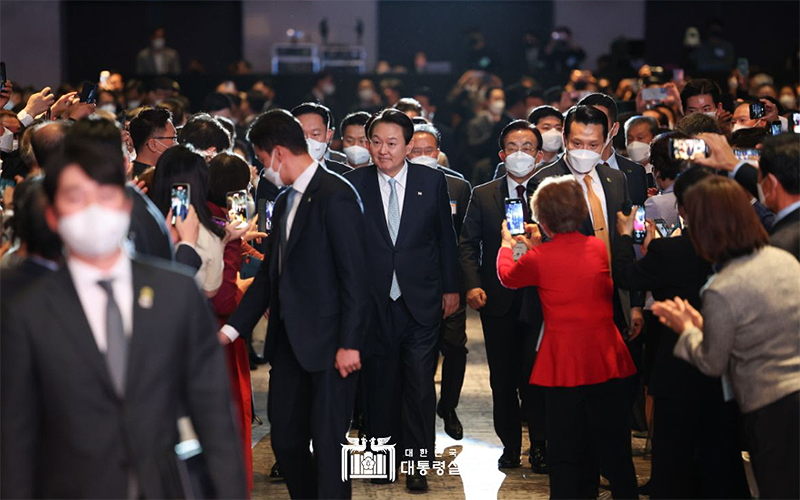
Amidst the growing threat of North Korea's nuclear weapons, the Peaceful Unification Advisory Council, a presidential advisory body, has recently unveiled its "1st Policy Proposal for 2023." This comprehensive proposal incorporates the deliberations of its divisions, feedback from advisory members and public opinion surveys, and provides crucial policy proposals to President Yoon Suk-yeol. It strongly emphasizes the need for the South Korean military to conduct training exercises that would enable counteroffensive operations even in areas devastated or contaminated by a North Korean nuclear attack. Furthermore, the council highlights the importance of educating civilians through various means, instilling in them the belief that survival is possible in the face of a nuclear attack, and ultimately working towards reducing nuclear fears.
The Peaceful Unification Advisory Council is a constitutional institution established to advise the President on all matters related to achieving democratic peace and unification on the Korean Peninsula. Under the leadership of President Yoon Suk-yeol, the council comprises appointed the Executive Vice-Chairperson and a Secretary General who guide its operations.
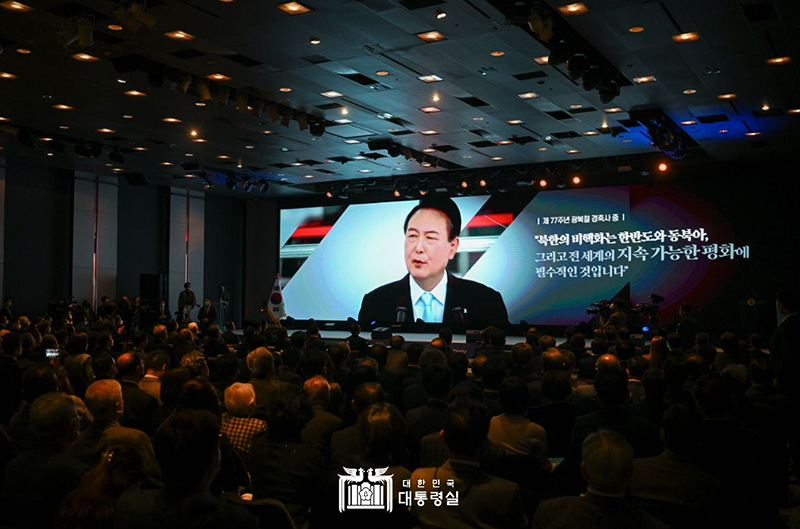
President Yoon Suk-yeol, Chairperson of the Peaceful Unification Advisory Council, providing words of encouragement during a dialogue with overseas advisory members at Grand Walkerhill Seoul in Gwangjin-gu, Seoul on November 29, 2022. – the Presidential Office
The Council, in its policy proposals, has underscored the imperative of addressing the North Korean nuclear threat by adopting a multifaceted approach. One key aspect involves diversifying the timing of joint military exercises between South Korea and the United States to effectively respond to the evolving situation. By adjusting the schedule of these exercises, the aim is to alleviate the burden on the ROK-US Combined Forces Command while simultaneously exerting pressure on the North Korean military, keeping them on their toes. Additionally, the council has proposed resuming training activities in the DMZ, an area where such exercises had been halted since signing of the 2018 inter-Korean military agreement. This measure is intended to reestablish a military presence and exert strategic pressure on North Korea, compelling them to expend energy and resources.
The policy proposal also emphasizes the importance of enhancing the South Korean military's operational readiness and preparedness in the event of a nuclear attack. The council advocates for strengthening defensive capabilities and resilience, enabling counteroffensive operations even in areas affected by destruction or contamination caused by a potential North Korean nuclear strike. To bolster preparedness against such threats, the proposal includes the prompt acquisition and widespread deployment of radiation detectors and protective suits across the military, ensuring cost-effective measures are implemented.

Conceptual Diagram of Transportable Combined Heat and Power Generation System
(Source: 2023 1st Policy Proposal Compilation by The Peaceful Unification Advisory Council)
For the general public, it was suggested that diverse methods should be implemented to raise the "nuclear IQ", so that they have the perception that survival is possible in a nuclear attack, rather than resorting to unconditional evacuation. It was emphasized that through such education, scientific understanding of the effects of nuclear incidents should be promoted, overcoming fears and encouraging voluntary participation in evacuation drills. In particular, it was highlighted that the fatality rate from radiation fallout in a nuclear attack exceeds 70%, but citizens should be educated about the fact that fallout can be overcome by adhering to the "7-10 Rule." The "7-10 Rule" hypothesizes that if individuals safely take shelter for approximately 49 hours (7*7 hours, approximately 2 days) after 7 hours have passed since the nuclear explosion, their chances of survival will be significantly higher.
To enhance civilian nuclear preparedness, it was suggested that existing civil defense shelters be equipped with post-evacuation guidance materials and essential survival items, with budgetary support. Additionally, in the design of new constructions such as underground malls and parking lots, provisions should be made for them to serve as civil defense shelters. The importance of providing incentives, such as tax benefits, was also emphasized. Furthermore, it was suggested that measures should be institutionalized to reduce the risk of fire during a nuclear attack and mitigate damage caused by glass fragments, such as actively using flame-retardant materials and attaching films to windows in underground facilities.
The Council proposed concrete countermeasures in preparation for a North Korean nuclear attack, as the threat posed by North Korea's nuclear capabilities has become imminent. North Korea has been conducting ongoing provocations by continuously launching various types of missiles since the beginning of this year. These include the launch of the Hwasong-15 intercontinental ballistic missile (ICBM) on February 18, the Super-large Multiple Launch Rocket System on February 20, the Hwasal-2 cruise missile on February 23, the simultaneous launch of six Close Range Ballistic Missiles (CRBM) targeting South Korea and Japan on March 9, and the sequential launch of two KN-23 missiles, their version of the Iskander missile, on March 2. Additionally, North Korea conducted tests involving the detonation of a model tactical nuclear warhead-equipped short-range ballistic missile in mid-air on March 18-19.
In particular, as stated by Kim Jong-un himself, it indicates that North Korea has successfully developed a nuclear command and control system. This system allows them to conduct extensive training exercises, covering the transmission of nuclear attack orders, integration of nuclear weapons with various delivery systems, and launch procedures under different scenarios. Moreover, on March 28, North Korea publicly revealed the existence of tactical nuclear warheads designed for eight different types of weapons, including ballistic missiles, cruise missiles, artillery, and nuclear torpedoes. These weapons systems are primarily intended for targeting South Korea. Despite facing significant international sanctions, North Korea remains steadfast in its pursuit of advancing its nuclear capabilities. They firmly believe that nuclear development and military strength are essential for maintaining the stability and longevity of the Kim Jong-un regime.
Given the ongoing escalation of North Korea's nuclear capabilities and military provocations, as well as the strengthening cooperation among nuclear-armed countries in the region (North Korea, China, and Russia), the presented strategies aim to provide practical and concrete solutions to overwhelm the chain of nuclear threats posed by these countries.
The Council also revealed a medium-term strategy for North Korean denuclearization, aiming to solidify President Yoon's "Audacious Initiative." As a tailored approach to address North Korea's concerns regarding food shortages, medicine shortages, and energy deficiencies, they proposed the "DMZ Farm & Pharm" plan. This plan involves the creation of a mobile "combined heat and power generation system for chemical waste disposal," which can provide aid in the form of food, medicine, and fuel while North Korea disposes of its chemical weapons. Initially, the device will be installed and operated in the southern part of the DMZ, and once North Korea accepts the proposal, it can be immediately relocated to the northern part. After the disposal of chemical weapons, the device can be repurposed as a power generator and smart farm heat supply device. North Korea would receive the mobile combined heat and power generation system as compensation for disposing of chemical weapons.
Considering North Korea's perception that economic reform and denuclearization jeopardize the regime's survival, it has been emphasized to limit the use of the "combined heat and power generation system" to the DMZ area in order to build trust without threatening the regime. This proposal is based on the understanding that the value of chemical weapons decreases after the development of tactical nuclear weapons (TNW), making it difficult for North Korea to manage the disposal of chemical weapons. Therefore, a phased disposal process under the pretext of environmental cooperation in the contact zone appears to be a feasible option.
-
PREV [Feature Article]
-
NEXT [Analysis]