

The Competitiveness of South Korea’s Aerospace Industry in Light of Nuri’s Fifth Launch
- From Demonstrating Indigenous Technological Capabilities to Private-Sector-Led Space Development and Advanced Satellite Constellations -

Jong-am Kim
Professor
Department of Aerospace Engineering
Seoul National University
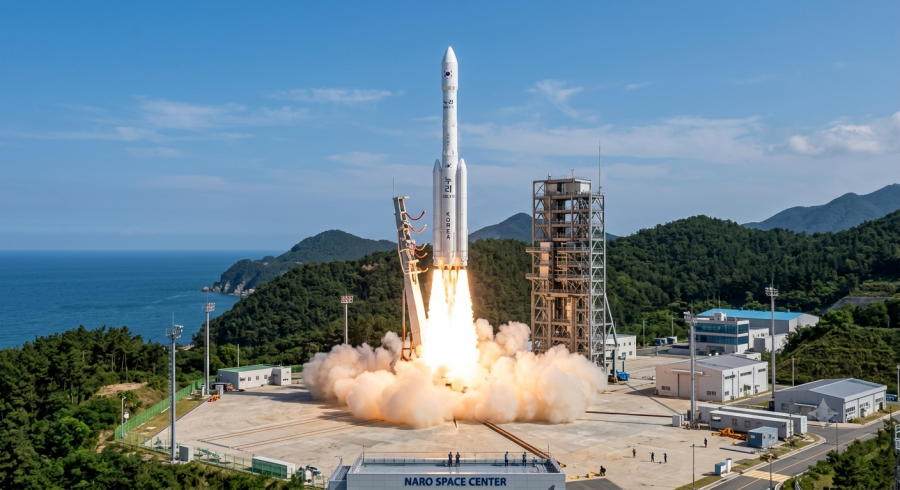
At 12:25 p.m. on October 7, 2026, South Korea’s domestically developed space launch vehicle, Nuri (KSLV-II), lifted off from Launch Pad No. 2 at the Naro Space Center in Goheung, South Jeolla Province. Unlike the second, third, and fourth launches, which were delayed or rescheduled due to strong winds, communications issues, or sensor signal verification, the fifth launch proceeded exactly as planned, without a minute’s delay—a first in Nuri’s launch history [1].
After approximately 19 minutes and 45 seconds of autonomous flight, Nuri reached a sun-synchronous orbit (SSO) at an altitude of approximately 570 kilometers and sequentially deployed its five primary payloads, comprising a constellation of microsatellites, as well as secondary CubeSat payloads. The mission marked Nuri’s fourth consecutive successful launch since its second flight, bringing its cumulative launch success rate to 80 percent [2].
In the space launch industry, a single successful launch establishes technological feasibility, whereas repeated successes demonstrate operational reliability and the maturity of the underlying industrial capabilities. Particularly significant was Nuri’s precise deployment of multiple operational satellites into orbit during a single mission, alongside the expanded role of a private company in critical launch operations. Taken together, these achievements mark a major milestone in South Korea’s transition from government-led aerospace research and development toward a commercially competitive, private-sector-led space economy. They also signal the growing maturity of South Korea’s aerospace industry to the international community.
Technological and Industrial Significance of Nuri’s Fifth Launch
The most significant technological achievement of Nuri’s fifth launch was the successful deployment of a five-satellite constellation as its primary payload, marking a first for South Korea’s space program. The launch vehicle carried a total of 15 satellites: five NEONSAT-2 through NEONSAT-6 microsatellites, developed under the overall supervision of the Satellite Technology Research Center at the Korea Advanced Institute of Science and Technology (KAIST), as primary payloads, and 10 CubeSats developed by private companies, universities, and research institutions as secondary payloads.
The primary and secondary satellite payloads weighed approximately 500 kilograms and 96 kilograms, respectively. Including the satellite deployment mechanisms and adapters, the total payload assembly weighed 1,071 kilograms, exceeding the approximately 960 kilograms of satellite payload carried during the fourth launch [1].
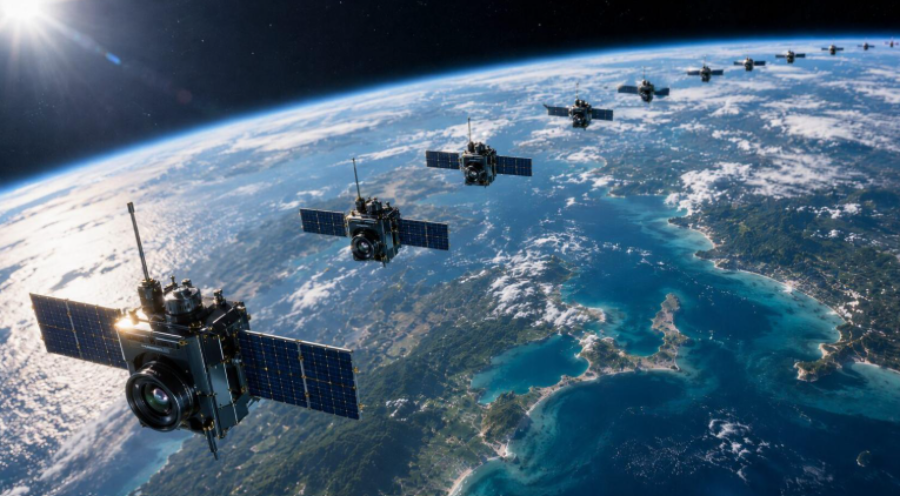
Successfully deploying a satellite constellation requires capabilities that extend well beyond reaching the designated orbital altitude. It also demands precise control over separation-induced shocks, potential interference among satellites, deployment directions, and the timing intervals between successive satellite separations.
To meet these requirements, Nuri incorporated a newly developed low-shock separation mechanism for its primary payloads, along with dedicated adapters for the secondary payloads [3]. In terms of communications, two-way contact was successfully established with all five constellation satellites [4], while communications with the CubeSats were established considerably more quickly than during the fourth launch [5].
Building on the success of the fourth mission, the fifth launch further demonstrated that Nuri’s competitiveness should be assessed not merely in terms of successful flight performance, but also in its ability to deliver multiple satellites accurately and reliably into their intended orbits.
From an industrial perspective, the expanding role of private companies in Nuri missions is equally significant. As the system integrator for the Nuri launch vehicle, Hanwha Aerospace assumed responsibility for manufacturing and final assembly. Compared with the fourth launch, the company substantially expanded its involvement in launch operations during the fifth mission, operating 20 of the 22 consoles at the Launch Control Center (LCC) [1].
This development represents an important step toward establishing commercially competitive, private-sector-led launch operations for Nuri following the completion of the launch vehicle advancement program. It also demonstrates the practical outcomes of transferring technologies originally developed by government research institutions to a private-sector system integrator. For Nuri’s sixth launch, Hanwha Aerospace plans to assume operational responsibility for nearly all LCC consoles.
At the same time, the fifth launch highlighted several challenges that must be addressed before Nuri can become a fully competitive commercial launch service. Of the 15 satellites carried aboard the launch vehicle, all five primary payloads and nine of the 10 secondary payloads were successfully deployed. However, one secondary satellite, PerSat-02, developed by Quaternion Co., Ltd., failed to separate from the launch vehicle.
This outcome highlights the importance of ensuring the reliability of satellite separation mechanisms and payload integration systems, particularly for missions involving multiple satellites with different technical specifications. Cost competitiveness presents another pressing challenge. In the global commercial launch market, reusable launch vehicle technologies are increasingly reshaping cost structures and market expectations. In response to this trend, South Korea is pursuing first-stage reusability for its next-generation launch vehicle, a separate program from Nuri [6].
Ultimately, the fifth launch demonstrated South Korea’s growing capabilities in multi-satellite deployment and private-sector launch operations, while also underscoring the need to translate these technological and industrial achievements into reliable, cost-effective, and internationally competitive commercial launch services.
The Nuri Program and the Development of Indigenous Launch Vehicle Technologies and Industrial Competitiveness
International technology transfers in the space launch sector are subject to stringent controls under frameworks such as the Missile Technology Control Regime (MTCR). Consequently, countries seeking independent access to space must develop critical launch vehicle technologies largely on the basis of their own scientific expertise and industrial capabilities, particularly in precision manufacturing, mechanical engineering, and electronics. Since 2010, South Korea has systematically built up its indigenous technological capabilities, including through the development of a liquid oxygen–kerosene rocket engine in the 75-metric-ton-force class.
Major accomplishments include the domestic development of turbopumps, combustion chambers, and cryogenic valves capable of operating under extreme temperature conditions, from approximately −183°C for liquid oxygen to nearly 3,300°C in the combustion chamber. Another significant achievement of South Korea’s independent research and engineering efforts was overcoming combustion instability, one of the most challenging technical problems in liquid-propellant rocket engine development.
Furthermore, South Korea successfully clustered four 75-metric-ton-force-class engines to generate a combined thrust of approximately 300 metric tons-force. This achievement required the development and integration of several critical technologies, including synchronized engine ignition, asymmetric thrust management, and thrust vector control through engine gimbaling. Since its second launch, Nuri has completed four consecutive successful flights, demonstrating consistent trajectory control and increasingly precise orbital insertion. During its fifth mission, Nuri accurately delivered its satellite payloads into their target orbit at an altitude of approximately 576 kilometers. These results provide strong evidence that South Korea’s propulsion systems and guidance, navigation, and control (GNC) technologies have achieved a substantial level of operational maturity and reliability.
In materials engineering and manufacturing, South Korea has employed friction stir welding (FSW) and metal spinning to manufacture large aluminum-alloy propellant tanks measuring 3.5 meters in diameter, with wall thicknesses of only a few millimeters. These advanced manufacturing techniques have helped reduce structural weight while preserving the strength and integrity required for launch operations. Particularly noteworthy is South Korea’s development of an integrated domestic industrial infrastructure and supply chain covering the entire launch vehicle development cycle—from system design and component manufacturing to final assembly, combustion testing, environmental qualification, launch pad construction, and launch operations.
More than 95 percent of the systems at the Second Launch Pad were developed and built using domestic technologies. Meanwhile, approximately 300 companies, including Hanwha Aerospace, Korea Aerospace Industries, and HD Hyundai Heavy Industries, participate in South Korea’s broader space industry ecosystem. Through the Nuri program, culminating in its fifth launch, South Korea has further strengthened its independent access to space, including its ability to launch operational satellites weighing more than one metric ton in accordance with its own strategic and operational requirements. Equally important, the program has helped establish a domestic aerospace industrial base and supply chain, strengthening national technological autonomy and enhancing resilience to disruptions in global supply chains.
Launch Vehicle Reliability and Prospects for Further Technological Advancement Through Repeated Nuri Missions
In the space launch industry, where hundreds of thousands of components must function together with exceptional precision, customers place a high premium on demonstrated flight heritage and operational reliability. With the successful completion of its third, fourth, and fifth missions, Nuri has achieved four consecutive successful launches, raising its cumulative launch success rate to 80 percent. The fifth mission’s on-schedule liftoff further demonstrated the growing maturity of launch operations, including vehicle erection, launch pad preparations, system verification, and automated launch sequences.
These achievements mark meaningful progress toward the reliability standards expected in the international commercial launch market, where success rates of 90 percent or higher serve as an important benchmark. Nevertheless, sustaining and improving this performance will require further operational experience, rigorous quality assurance, and systematic efforts to address remaining technical vulnerabilities. Looking ahead, the Korea Aerospace Administration (KASA) plans to conduct at least six additional Nuri launches by 2032, beginning with the sixth mission in 2027. In parallel, it aims to establish a regular, private-sector-led launch schedule of two to three missions per year.
In particular, the sixth launch is expected to mark the full-scale implementation of a private-sector-led production system. Under this arrangement, individual launch vehicle stages will be assembled at Hanwha Aerospace’s launch vehicle manufacturing facility in Suncheon, South Jeolla Province, and then transported by sea to the Naro Space Center.
The technological capabilities and operational experience accumulated through successive Nuri missions are expected to provide a critical foundation for South Korea’s next generation of space launch systems. First, the KASA plans to develop orbital transfer vehicles and engine reignition technologies, paving the way for higher-value launch and in-space transportation services. These capabilities would enable satellites to be delivered to a wider range of orbital altitudes and inclinations, extending mission options beyond conventional low Earth orbit deployments. In parallel, South Korea is pursuing a reusable next-generation launch vehicle powered by liquid methane, with the aim of overcoming the economic and operational limitations of Nuri’s expendable architecture.
To this end, the KASA has finalized a next-generation launch vehicle development program with a total budget of 2.2921 trillion Korean won. The program will focus on developing a reusable first-stage launch vehicle powered by an 80-metric-ton-force-class liquid methane engine, a propulsion system designed to support repeated use. By incorporating advanced atmospheric reentry, precision landing, and recovery technologies, the next-generation launch vehicle is expected to reduce launch costs and strengthen South Korea’s competitiveness in the global commercial space market. It will also establish a critical technological foundation for more ambitious deep-space exploration missions, including the planned launch of an independently developed lunar lander in 2032.
[References]
[1] Korea Aerospace Administration (KASA), “Nuri Rocket Fifth Launch Press Kit,” September 15, 2026.
[2] Yonhap News Agency, “Nuri’s Fifth Launch Succeeds, Marking First Simultaneous Deployment of Five Microsatellites (Second Comprehensive Report),” Sang-hyun Park, Seung-han Cho, and Seon-mi Shin, October 7, 2026.
[3] YTN Science, “Nuri’s Fifth Launch Succeeds; Communications Established with All Five Microsatellites in the Constellation,” A-young Jang, October 8, 2026.
[4] Korea Aerospace Administration (KASA), press release, “Initial Communications Successfully Established with All Five Mass-Produced Microsatellites in the Constellation,” October 7, 2026.
[5] Korea Aerospace Administration (KASA), Press Release, “Communications Successfully Established with All Nine Secondary Payload Satellites from Nuri’s Fifth Launch,” October 13, 2026.
[6] Korea Aerospace Research Institute (KARI), “Next-Generation Launch Vehicle,” KARI Official Website.
-
PREV [Thematic Analysis] Inter-Korean Sports Exchanges
-
NEXT 다음 글이 없습니다.