


Russia's Military Support for North Korea: A Clear Breach of UN Security Council Resolutions

Shin Un
Former Ambassador of the Republic of Korea
On November 21st, North Korea launched its reconnaissance satellite, 'Malligyong-1.' This event, analyzed by the South Korean government and various experts, shows technological progress compared to earlier launches. Notably, there is compelling evidence pointing to Russian technical support in this endeavor.
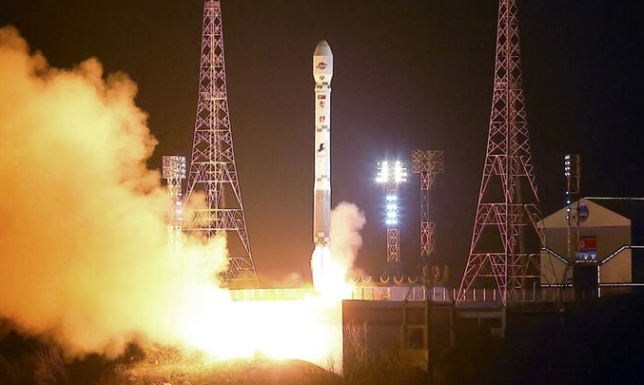
On November 21st, North Korea launched the 'Malligyong' satellite on the 'Chollima-1' rocket at Sohae Satellite Launching Station in Cholsan County, North Phyongan Province. Photo by Korean Central Television
Russia seems to have shared satellite launch expertise with Kim Jong-un, who had previously suffered embarrassment from two failed satellite launches. A Russian-looking technical expert was observed at the site, and the South Korean military and the National Intelligence Service (NIS) are now raising suspicions of Russian involvement in the recent launch.
This support from Russia likely stems from the September summit between Vladimir Putin and Kim Jong-un. North Korea attempted to launch reconnaissance satellites in May and August of the same year, both of which ended in failure. Kim Jong-un, driven by a need to demonstrate success to “his people”, was left with no choice but to seek external assistance. The success of South Korea's Nuri rocket launch in May might have further motivated this decision.
Faced with technological shortcomings, North Korea was driven to seek help, with China and Russia being the most viable supporters in advanced precision weaponry and space launch vehicles.
China, while crucial in supplying North Korea with basic necessities, has been cautious about aiding North Korea’s nuclear ambitions. Thus, North Korea likely turned to Russia as its only viable alternative.
Indeed, Putin could be facing a pressing situation, with an urgent need for a continuous supply of ammunition due to the prolonged conflict in Ukraine. Given the necessity to alleviate diplomatic isolation in the face of a united front presented by the United States and the European Union, partnering with North Korea might not be an unfavorable choice for Russia.
With a shared understanding, Kim Jong-un visited Russia and engaged in talks with Putin at the Vostochny Cosmodrome on September 13th, 2023. During this meeting, he successfully secured Russia's commitment to cooperate in advanced science and technology transfer. It's plausible that Kim Jong-un found it enticing to demonstrate tangible achievements, leading to the successful launch of a reconnaissance satellite.
From Putin's viewpoint, given North Korea's economic hardships due to Western sanctions and international isolation, it may hold significant value as a tactical cooperation partner.
While North Korea's weapon systems, excluding nuclear and missiles, are generally considered primitive by weapons experts, it's worth noting that they possess a significant quantity of conventional ammunitions. These rudimentary munitions have been utilized in actual combat by groups like Hamas and Yemen's Houthi rebels.
Russia's technical support for North Korea's reconnaissance satellite launch directly challenges the rule-based international order by undermining consensus-backed United Nations Security Council resolutions (from Resolution 1695 in 2006 to Resolution 2397 in 2027) supported by Russia as a permanent Security Council member.
Additionally, it further exacerbates tensions in an already heightened international security environment due to the Ukraine-Russia conflict and the Israel-Hamas conflicts.
While the means to directly pressure Russia and North Korea are limited, there are feasible dual-track approaches to consider:
a. Collaborating with like-minded countries and urging Russia to fulfill its responsibilities and obligations in international forums as one of the P5 members.
b. Acknowledging potential risks, conveying a warning message through backchannel talks with Russia, emphasizing that their continued support for North Korea's reconnaissance satellite technology and procurement of munitions from North Korea could lead to other countries providing direct military support to Ukraine.
c. Utilizing unofficial channels for Korea-Russia Dialogue to express concerns about the deteriorating relations between South Korea and Russia.
Furthermore, it is crucial to consider the possibility of leveraging China's influence. This can be achieved in the following ways:
a. While China has publicly maintained a hands-off attitude regarding the deepening North Korea-Russia relationship, it's possible that China may not be pleased with the growing ties between North Korea and Russia. Therefore, actively engaging with China's stance could be explored as a means of applying pressure on both Russia and North Korea.
b. Given the frequent use of the term "New Cold War" in recent discussions about the triangular relations between North Korea, China, and Russia, it is important to exercise caution in emphasizing this term to avoid strengthening the bonds among these three countries.
c. Considering the notable efforts towards compromise between the United States and China during the summit between Joe Biden and Xi Jinping on November 15th in San Francisco, it is imperative to seek ways to encourage China's positive influence through cooperation with the United States. Additionally, early efforts should be made to convene a summit among the leaders of South Korea, China, and Japan.
-
PREV [Current Affairs Analysis]
-
NEXT [Opinion]