

North Korea's Response to the Israel-Hamas Conflict and Its Implications Analyzed Through Discourses

JIN Euilim
Researcher, Korean Institute for Defense Analysis
(Former) 2nd Secretary, R.O.K. Ministry of Foreign Affairs

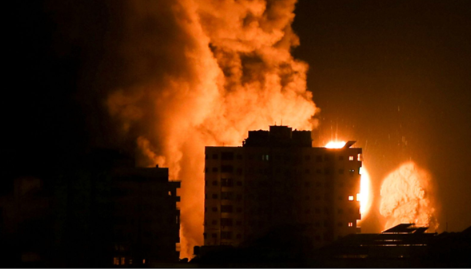
Heavy bombing has continued in Gaza in the early hours of the morning as Israeli warplanes unleashed a series of airstrikes across several locations.
1. Introduction
For the past two months, the Israel-Hamas armed conflict has been unfolding. As concerns about the involvement of Middle Eastern countries persist and international issues like the Ukraine-Russia front remain at the forefront, the international community has found itself uneasy regarding North Korea's position in this volatile situation. North Korea has been closely monitoring the developments since the early stages of the Israel-Hamas conflict and has articulated its stance through a series of key speeches. From major figures' discourse to editorials, commentaries, and articles, North Korean media have conveyed the intentions of the North Korean government, both directly and indirectly. It is imperative that we pay attention to these discourses and commentaries. After conducting a search of North Korean media content related to the Israel-Hamas conflict from October 7th to November 22nd, we discovered a total of 326 articles.
2. North Korea's Implicit Thoughts in Their Speeches
Among these articles, five materials stand out as representing the viewpoint of the North Korean government. On October 23rd, North Korea released a commentary titled "The Main Culprit of the Middle East Situation Is the United States" through the Korean Central News Agency (KCNA). While there have been statements from international issue pundits following the conflict, this commentary can be considered the first significant media commentary on the matter. On October 23rd, immediately after the United Nations Security Council (UNSC) meeting resulted in a failed resolution, a speech was delivered in the name of Jo Chol-su, the head of the International Organizations Department of the Ministry of Foreign Affairs. In this speech, North Korea criticized the rejection of the resolution held on October 18th, which aimed at providing humanitarian aid for Gaza. It particularly emphasized the double standards of the United States, which advocate Israel's right to self-defense. Three days later, on October 26th, a spokesperson from the Ministry of Foreign Affairs criticized the actions of the United States in an interview with the press. On November 3rd, a spokesperson from the Commission of Jurists of North Korea, expressed the position that "the United States' unilateral policy toward Israel and reckless military support constitute war crimes and crimes against humanity that lead to mass killings of innocent Arabs." Although this statement did not originate from the Ministry of Foreign Affairs or KCNA commentary, it appears there was an intention to assess the Western countries' response to the current conflict from a legal perspective. Finally, on November 14th, a dialogue with the media was issued in the name of the head of the International Organizations Department of the Ministry of Foreign Affairs, bearing the title "G7 Is the Destroyer of World Peace and Stability." Given that the G7 joint statement addressed the Ukraine war, Israel-Hamas conflict, and the Taiwan Strait crisis while also emphasizing the need for the international community to jointly address the threat posed by North Korea, this dialogue can be seen as a rebuttal to those mentions.
3. Implications
While the main points vary across each major speech and commentary, several key implications emerge. Firstly, North Korea seeks to emphasize to the international community that the responsibility for this conflict rests with Israel and its supporter, the United States. In particular, North Korea condemns Israel for heinous crimes against humanity, specifically referencing the bombing of Gaza Strip's hospital, while criticizing the United States for endorsing these actions. This suggests that North Korea intends for other countries to scrutinize and question the United States' qualifications as a Permanent Member of the United Nations Security Council and also implies that they want to hold G7 countries that support these actions accountable.
Secondly, North Korea appears to utilize the clear double standards evident in the United States' exercise of its veto power in UNSC resolutions as a basis for criticizing U.S. policy toward North Korea. North Korea points out that the United States, along with its ally Israel, characterizes Israel's actions as "exercising the right to self-defense" while labeling even minimal harm to neighboring countries as a "threat." This underscores North Korea's intention to emphasize the legitimacy of its own policies.
Thirdly, North Korea consistently critiques the actions of the United States and its allied nations by citing violations of International Humanitarian Law and International Human Rights Law in the context of this conflict. This serves to highlight the paradox where countries that have accused North Korea, Syria, and Russia of violating international law are now taking actions that closely resemble violations in support of their own allies.
In conclusion, North Korea, through its repeated mention of double standards and the perceived lack of legitimacy in the United States and other countries with similar stances in this conflict, aims to validate its own policies while asserting that international sanctions and pressure from the global community are ineffective.