

What Motivated North Korea to Present Multiple Candidates in the Recent Local Council Elections?

Kim Hyung-seok
Professor of Daejin University
Former Vice Minister of Unification
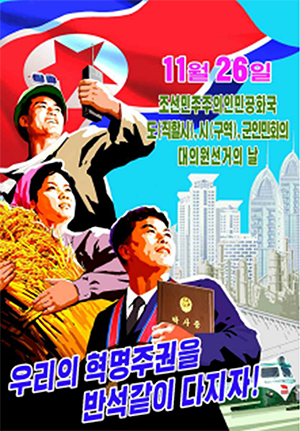
During North Korea's provincial, city, and county People's Assembly Elections on November 26, 2023, a promotional message encouraged, "Let's strengthen our revolutionary sovereignty!" (Photo: Rodong Sinmun)
North Korea held local people's assembly elections for a four-year term on November 26, boasting a 99.63% voter turnout with over 28,000 delegates. Unlike previous practices, North Korea experimented with a limited multi-candidate system in select constituencies, allowing pre-election meetings to nominate and choose from multiple candidates. It's important to note that North Korea's election system significantly differs from democratic nations. Typically, voters are asked to vote either in agreement or disagreement for a single candidate, limiting democratic representation. This has sparked different interpretations of the situation.
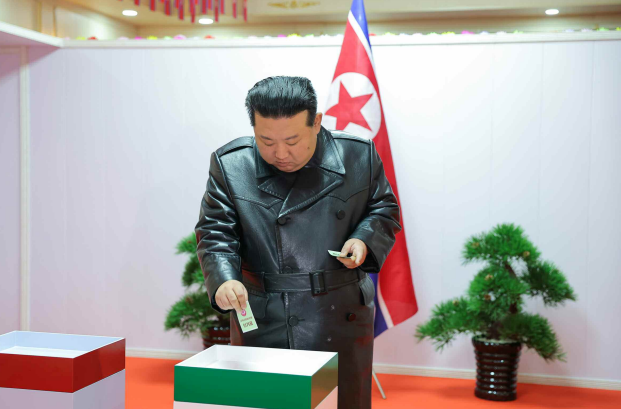
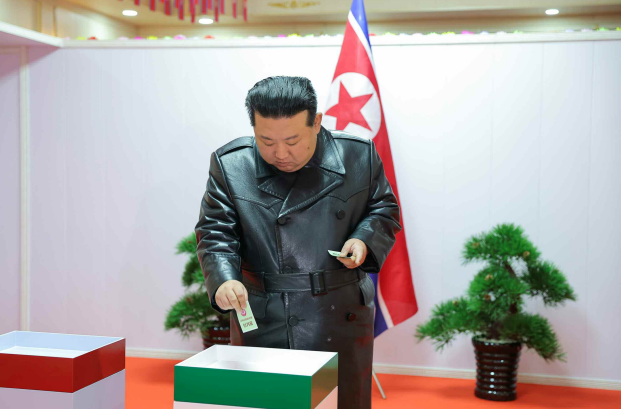
On November 26, Kim Jong-un participated in the Local Council Election to cast his vote at the 26th precinct of the 55th electoral district in South Hamgyong Province. (Photo: Rodong Sinmun)
Critics argue that despite its name as the 'Democratic People's Republic of Korea (DPRK),' North Korea's elections prioritize maintaining totalitarian control over promoting real democracy. While the introduction of multiple candidates in some constituencies for pre-election meetings might seem like a small step towards democracy, it falls short of a truly free and fair electoral process. Actual elections still feature single-candidate contests with votes cast as "approval" or "disapproval," lacking the personal freedom and secrecy of true democratic elections. The limited adoption of the multi-candidate system is confined to the local election pre-election stage and may not signal North Korea's response to international concerns or engagement with the global community.
Some suggest that North Korea's introduction of a multi-candidate system in certain constituencies aims to address the grievances of residents struggling with the dire economic situation and boost morale. The international community imposed sanctions on North Korean livelihood-related sectors after its fourth nuclear test in 2016, affecting areas like coal, iron ore, and labor exports. North Korea's economy has since declined, worsened by self-imposed border closures during the 2019 COVID-19 pandemic. As of 2023, North Korea's economy is estimated to be only about one-tenth of its pre-2016 levels. To spur economic growth, North Korea has adopted "The Five-Year Plans for social and economic development initiatives," underscoring its determination with slogans like "independence." Despite these efforts, North Korea continues to face persistent economic decline, with projects like the "Pyongyang General Hospital" remaining uncompleted. In 2023, North Korea's food situation is reportedly challenging, even though grain production is a top priority in its economic plan. Chronic energy shortages and material deficiencies necessary for industrial growth persist. While North Korea aims for economic growth under the banner of "independence," significant results have yet to materialize. Moreover, the authorities' inability to maintain a normal distribution system has caused a decline in the "jangmadang" (North Korea's market), and intensified control over scarce resources further exacerbates the situation.
In these circumstances, the daily lives of North Korean residents are growing increasingly challenging, leading to a buildup of grievances among the populace. It remains uncertain whether providing limited opportunities for North Korean residents to participate in the temporary candidate selection process for local people's assembly elections will effectively address the issues stemming from their daily hardships. North Korean citizens may not perceive the introduction of the multi-candidate system as a significant positive change, especially considering that the final candidates are still chosen using the approval and disapproval voting method, and pre-election multiple candidates are chosen by the ruling party. Moreover, even if North Korean authorities present this change as a response to the concerns of North Korean residents, there is a concern that individuals may perceive it as a potential risk, fearing that they could be labeled as dissidents and subjected to repercussions within North Korea's strict authoritarian environment.
So, what were the intentions of North Korean authorities in introducing the multi-candidate system? North Korean authorities provide the following explanation for its purpose: "Representatives recognized as those who seek one more beneficial and excellent thing for the country and the people will be elected." This explanation implies that the introduction of the multi-candidate system is not simply a reactive measure to address the grievances of North Korean residents or to counter criticisms of North Korea's pseudo-democratic system. Instead, it can be viewed as an endeavor to select individuals who can effectively fulfill their roles, particularly in regions where incumbent local assembly members have failed to adequately lead regional economic recovery. In essence, instead of ensuring the free choice of North Korean residents, this change appears to be geared towards promoting competition among individuals serving as regional authorities. The competition aims to motivate more capable individuals to take the lead in regional economic recovery, aligning with broader efforts to rejuvenate North Korea's economy. In August, Kim Jong-un visited a flood-damaged tideland in South Phyongan, where he strongly criticized officials, including Prime Minister Kim Tok-hun, labeling their performance as "irresponsible" and accusing them of "ruining national economic projects." This indicates that Kim Jong-un recognized the inadequacies in official duties and the need for improvements in related systems. The adoption of the 'Bluff Prevention Law' in 2022 is another example of a measure implemented in response to this need.
Since Kim Jong-un assumed North Korea's top leadership position in December 2011, he aimed to build a "strong socialist state" encompassing political, military, and economic strength. Currently, while North Korea has achieved political and military strength, its economic prowess remains unrealized. In 2018, Kim Jong-un shifted focus towards economic construction, but growth has been hampered by maintaining a "strategic position" as a nuclear-armed state, leading to international confrontation. The international community is unwilling to provide unconditional support amidst North Korea's nuclear weapons and military threats.
As North Korea continues to demonstrate its formidable military capabilities, the international community is intensifying efforts to restrain and impose sanctions on the nation. North Korea finds itself in a dilemma where its pursuit of military strength compounds its economic challenges. Regrettably, North Korean authorities have yet to fully grasp the gravity of this dilemma. Instead, they remain focused on independence and a "frontal breakthrough" to overcome economic difficulties. They intend to bolster North Korea's economic recovery by enhancing state control over limited resources, with the Cabinet serving as the economic command center.
To address the void in North Korea's struggling economy, the nation has embarked on a strategy of "North Korean-style openness." This entails re-establishing trade with China and recently cooperating with Russia, despite its involvement in the Ukraine conflict, to secure essential materials. North Korea is seeking external support from China and Russia, traditionally seen as friendly nations, to facilitate its economic recovery. Nonetheless, due to conflicts with the international community, particularly the United States, and internal challenges faced by China and Russia, it remains uncertain whether these countries will provide North Korea with the desired level of support. Ultimately, North Korea may have no option but to seek cooperation and assistance from the international community, including the United States and South Korea, in order to ensure regime survival.
North Korea's recent launch of the Manrikyong-1, Intercontinental Ballistic Missile (ICBM) and its demonstration of enhanced military capabilities pose a conundrum, offering no support to North Korea's struggling economy. As military prowess grows, the daily lives of North Koreans become increasingly difficult. Unfortunately, while North Korean citizens feel this hardship firsthand, Kim Jong-un lags in recognizing it. It is essential for Kim to acknowledge the undeniable truth that nuclear weapons cannot sustain a nation. We hope he will embrace the path of ‘unconditional dialogue, as proposed by South Korea and the United States, coupled with denuclearization, to pave the way for peace on the Korean Peninsula and mutual prosperity between North and South Korea.
-
PREV [Opinion]
-
NEXT [Current Affairs Analysis]