

The Intricate Position of China in the Israel-Hamas Conflict

Han Seong-hyun
Ph.D. Candidate, Sungkyunkwan University
Former Second Secretary, Republic of Korea Ministry of Foreign Affairs
1. Introduction
On October 7th, Hamas, a militant Palestinian faction, unexpectedly attacked Israel, causing numerous civilian casualties and kidnapping several individuals to undisclosed locations in Gaza. In response, Israel intensified its military operations, including extensive bombings in Gaza, and recently, the conflict escalated to a 'new level' with the deployment of ground troops in the region. Iran has warned Israel, stating that they've "crossed a critical threshold" and that "further escalation of the war is inevitable" due to civilian casualties in Gaza. In the midst of the chaotic situation in the Middle East, the world is closely watching China's actions.
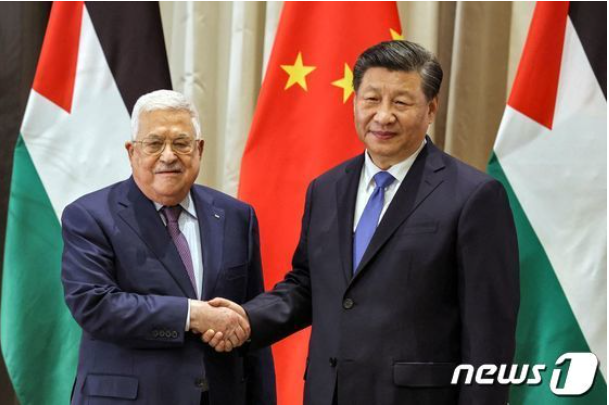
Chinese President Xi Jinping shaking hands with Mahmoud Abbas, leader of the Palestinian National Authority, in Riyadh, Saudi Arabia. (Photo: Palestinian National Authority, Dec 9, 2023, AFP=News1)
2. China’s Strategic Play in a U.S.-Centric World
Since embarking on its economic and political transformation in the late 1970s, China has rapidly increased its national power. Under President Xi Jinping’s leadership, and fueled by its newfound economic and military might, China is seeking to redefine the international order traditionally dominated by the United States. China has embarked on major military reforms to modernize its armed forces and has sought to exert greater control over its adjacent waters. It has also cast its gaze westwards, aligning with developing countries to counter U.S. influence in the Asia-Pacific region. China has invested nearly $1 trillion in infrastructure projects spanning the Silk Road, gaining both political and economic support. Initiatives like the ‘Global Development Initiative (GDI)’ and ‘Global Security Initiative (GSI)’ represent bold attempts to forge ties with anti-American entities, albeit their somewhat limited tangible content.
The Middle East, sitting on One Belt and One Road, is of strategic importance for China, not just for securing vital energy resources, but also as a base of support in its geopolitical tussle with the United States. As of 2021, China’s trade with the Gulf Cooperation Council (GCC) nations and Iran quadruples that of the U.S., amounting to $248 billion. Additionally, over half of China's energy imports come from the Middle East. Despite facing global scrutiny for alleged human rights violations, China has managed to secure unwavering support from Middle Eastern countries. In October of this year, these nations backed China’s re-election to the United Nations Human Rights Council (UNHRC), leading China to tout its human rights record and challenge Western standards on the issue. China swiftly moved in to fill the strategic void left by the U.S. withdrawal from the Middle East, rapidly adjusting to the changing geopolitical landscape. When the Taliban took control of Kabul in Afghanistan back in 2021, China wasted no time in recognizing the interim Taliban government. In 2022, during Foreign Minister Wang Yi’s visit, discussions were held to explore potential support measures for the new regime. This year marked a significant shift as China took on a mediator role, successfully facilitating the normalization of diplomatic relations between Saudi Arabia and Iran in March. The negotiation table saw Iran and Saudi Arabia, the predominant nations of Shia and Sunni Islam respectively, coming together to reaffirm their commitment to mutual sovereignty and non-interference in each other’s internal affairs. They also agreed to reestablish previously concluded agreements related to security cooperation, as well as economic, trade, and investment. August saw China's influence extending to the economic sphere, as it played a crucial role in integrating four Middle Eastern countries—Egypt, Iran, Saudi Arabia, and the United Arab Emirates—into the BRICs group of emerging economies.
In the meantime, the United States responded by forming the I2U2 Group, also known as the 'Middle East Quad,' in partnership with India, Israel, and the United Arab Emirates. However, this initiative has yet to yield any substantial outcomes. China’s assertive moves and successful mediations underscore its growing confidence and strategic positioning in the Middle East.
3. China's 'Major Power' Leadership Challenged by the Israel-Hamas Conflict
In the midst of ongoing tensions, the conflict between Israel and Hamas has thrown China into a conundrum, presenting a complex mix of challenges and opportunities. China, which has cultivated good relations with both Israel and Palestine, found itself in a tricky position, eventually adopting a balanced stance a day after the conflict erupted. Emphasizing its commitment to 'fairness and justice,' China proposed the 'two-state solution' as a foundational resolution to the crisis. However, the reality on the ground is more complex, with Hamas's fundamental opposition to the existence of Israel complicating the situation. Furthermore, the absence of direct statements from Chinese President Xi Jinping concerning the Middle East situation indicates that China is carefully considering ‘its position’ it aligns with in this complex conflict.
Indeed, China's recent approach to major conflicts is not a new phenomenon, as evidenced by its responses to North Korea's military provocations on the Korean Peninsula and Russia's 'special military operation' in Ukraine in February of the previous year. Although China advocated for nations to exercise restraint and expressed their concerns, its use of vague and ambiguous language did not meet the expectations for China to establish itself as a 'leading country.' China's passive diplomacy, which leans towards vague language instead of openly condemning the use of force, clearly diverges from the expected role of a 'leading country' in the international order. Consequently, it has left those who had hoped for China to assume a leadership role disappointed.
By adopting this approach, China managed to maintain a facade of neutrality. While being a country that is inevitably drawn into geopolitical conflicts, it likely intended to appear as a 'peace-loving third party.' This strategy was intended to set China apart from the United States, which is unavoidably seen as a 'war enthusiast' due to its involvement in various conflicts.
However, this approach has raised doubts about China's capabilities in managing international crises.
The world is closely monitoring whether China can effectively mediate in the Israel-Hamas conflict, and potentially challenge the traditional leadership role of the United States. China is expected to carefully assess the benefits, drawbacks, and risks associated with this conflict and consider two potential courses of action after this evaluation.
And these are two potential paths China might take in this situation:
The first involves China bolstering its regional presence by consistently conveying messages related to this conflict through bilateral or multilateral diplomatic channels, instead of primarily pursuing formal diplomatic agreements. While this approach may not result in significant immediate gains for China, it can, at the very least, create diplomatic opportunities with regional powers like Iran, Saudi Arabia, and others, using 'conflict resolution' as a diplomatic pretext. This approach will further solidify China's influence in the region.
The second option involves China positioning itself as a 'conflict resolution mediator,' drawing on its prior mediation efforts between Saudi Arabia and Iran. By actively mediating between Israel and Hamas, China has the potential to achieve diplomatic success. However, given the extensive casualties, abduction issues, and the humanitarian crisis in Gaza, mediating a resolution between the two parties is an exceedingly challenging task. A failure in mediation would not only be a setback but could also damage perceptions of China's leadership capabilities. Conversely, a successful mediation could lead to a reshaping of the regional order, with China at its center.
Despite the potential benefits of the second option, China is more likely to opt for the first, prioritizing the protection of its interests in the Middle East while managing other pressing issues, such as the Taiwan situation and the need to bolster its domestic economy. Furthermore, China lacks the political, military, and financial resources to deeply involve itself in addressing Middle East security issues. Hence, it's likely that China will take a cautious approach, refraining from deep involvement in the Russia-Ukraine and Israel-Hamas conflicts, and instead focusing on asserting its own position. If feasible, they may attempt to frame this war as a 'struggle for justice,' rallying anti-Israel and anti-American sentiments in the Middle East, effectively countering the United States, Israel's primary supporter. In practice, their primary objective may be to prevent the situation in the Eastern Mediterranean, which could disrupt their uninterrupted oil imports, from escalating into the Persian Gulf. Ultimately, it seems that China could indirectly influence the regional situation through key Arab nations like Iran and Saudi Arabia.
4. Conclusion
Fortunately, neither the United States nor China desires an escalation of the current conflict, hinting at the possibility of cooperative engagement in the region. To mitigate further loss of innocent lives, an urgent U.S.-China summit is necessary to establish a common ground for resolution. The United States, in particular, needs a clear post-conflict vision to retain its influence in the Middle East. As China rises as a potential leader in the region, offering new visions to developing countries, the U.S. struggles to present a coherent governance strategy beyond its containment of China. Without a sense of urgency and a clear vision, the U.S. risks ceding regional leadership to China in the near future.