

My Moment of Desperation and the Desire to Demolish Pyongyang with a Tank
Lim Kang-jin
Former Regimental Commander
I am a college alumnus of the artillery department of Kim Il Sung National Defense University, alongside North Korean leader Kim Jong-un. To my knowledge, Kim Jong-un's older brother, Kim Jong-chol, also attended the university around the same time. Yes, I went to school with the sons of North Korea's Kim family.

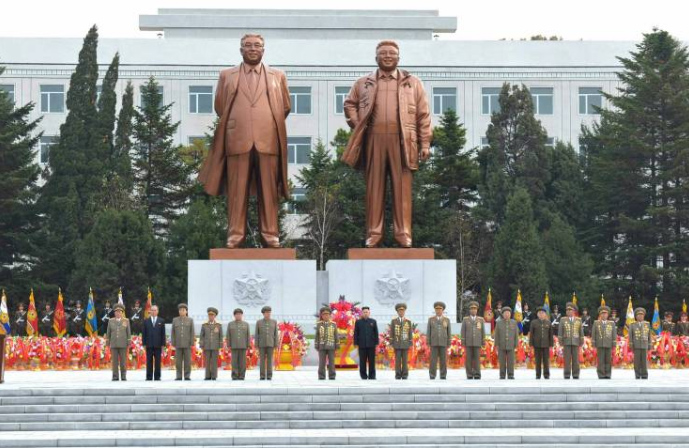
Kim Jong-un visiting Kim Il Sung National Defense University in 2012. (Photo: Rodong Sinmun)
Located in the Mangyongdae District of Pyongyang City, the university I attended is a prestigious military institution tasked with training the upper echelons of the North Korean armed forces. First established on October 28, 1952, as an advanced military academy, it was later renamed to pay tribute to Kim Il-sung, the founder of North Korea. A statue of Kim Il-sung stands prominently on the campus, a constant reminder of his legacy.
The academic programs at the university are divided into a regular 3-4 year curriculum and a short-term 1-year course. The main program educates active-duty military officers from the rank of captain to lieutenant colonel. The duration of education spans three years for infantry, reconnaissance, and artillery, and four years for communications, engineering, and chemical warfare. High-ranking officers between the ranks of lieutenant colonel and colonel are required to complete a one-year postgraduate research program.
In 1997, while serving as a battalion commander in the North Korean artillery unit, I was recommended to enroll in the artillery department of Kim Il Sung National Defense University, where I studied for the next three years until 2000.
Kim Jong-un’s publicly disclosed curriculum vitae states that he graduated from Kim Il Sung National Defense University, where he majored in the same field as me from 2002 to 2006, albeit in a ‘special class’.
In 1998, during my second year, I heard that Kim Jong-il’s son had enrolled in our university. The department head at the time, a one-star general in the army, revealed to me and other students that “we are providing special military education twice a month to the son of our leader, Kim Jong-il.” According to him, a ‘special class’ of 32 students was created specifically for the education of Kim Jong-il’s children, and professors from various military fields were assigned to teach them.
Kim Jong-il’s decision to send his two sons to Kim Il Sung National Defense University, instead of Kim Il Sung University, was likely a strategic move to secure their grip on the military power for succession.
The entire university was abuzz with the news that Kim Jong-il’s son was among us, sparking speculations that he might be the chosen successor. One day, the department head addressed us, saying, “You should feel honored and proud to be studying alongside the son of our leader.”
In truth, I did not even know the name of Kim Jong-il’s son at the time. It was only after my defection to South Korea that I gathered various pieces of information and realized that the person who had attended the university with me was Kim Jong-un's elder brother, Kim Jong-chol. Kim Jong-chol, who had been studying in Bern, Switzerland, suddenly returned to North Korea just before his graduation in 1998 and enrolled in Kim Il Sung National Defense University.
Kim Jong-chol, who was initially considered the likely successor until the early 2000s, fell out of favor in the succession race following the death of their mother, Ko Yong-hui. Eventually, it was Kim Jong-un who ascended to power in North Korea.
Unaware that it was Kim Jong-chol at the time, I took great pride in having attended university with the son of Kim Jong-il.
After graduating in October 2000, I was promoted from captain to lieutenant colonel and appointed as the regimental artillery commander in the 9th Corps 266th Division of the North Korean military. Just two months later, in December, I was further promoted to a rank between lieutenant colonel and colonel, taking on the role of regimental commander in the 262nd Division’s artillery regiment. At the age of 36, I became the youngest regimental commander, and I was determined to climb even higher, aspiring to become a division commander and eventually a corps commander. I was exhilarated at the thought of a bright future unfolding before me.
I was born in February 1965 in Sariwon City, North Hwanghae Province, as the fifth child among six siblings. After graduating from high school in 1981, I enlisted in the North Korean military. I received my basic military training at the 208th Tank Training Base in Kaechon City, South Phyongan Province. After a year of training, I was assigned as a tank driver in the 5th Corps of the North Korean military.
In October 1985, I graduated from the Kim Chol-ju Artillery Comprehensive Military Officer School (a two-year program) and was appointed as an artillery platoon leader (second lieutenant) in a unit under the 5th Corps. In March 1991, I was promoted to a rank between first lieutenant and captain and appointed as a company commander.
In February 1993, I was promoted to major and appointed as a battalion commander. After graduating from Kim Il Sung National Defense University in 2000, I had risen to the rank of regimental commander, 19 years after joining the military.
However, my life as a regimental commander, which I had expected to be glorious, turned out to be challenging from the start. Upon being assigned to the 262nd Division’s artillery regiment of the 9th Corps stationed in North Hamgyong Province, I found the unit in deplorable condition. The troops were starving due to a constant shortage of food, and their uniforms, not replaced for over two years, were completely worn out. This resulted in a severe lack of energy among the soldiers.
There were frequent power outages at the regimental headquarters, and at times, we couldn’t move our vehicles due to a lack of fuel (gasoline and diesel). We had no choice but to rely on charcoal cars (vehicles powered by methane gas produced from burning wood) as an alternative. Even when military supplies were delivered, higher units like corps and divisions would take their share first, leaving lower units like ours in a constant state of shortage.
Inevitably, we had to resort to some creative solutions to keep the unit running. We started by using the fuel stored in the combat vehicles like tanks and armored fighting vehicles. However, that still wasn’t enough to solve our fuel shortage, so we had to think outside the box. Soldiers dealing with the fuel problem were granted special leave, and we even went as far as renting out military vehicles, including the regiment commander’s car, to local merchants and charging them for it. Military vehicles had the advantage of being able to bypass police security checks, making them attractive for merchants transporting smuggled goods. The money we made from this was used for unit operations, but it eventually led to serious complications.
When Kim Jong-un was named the successor in 2009, it marked the beginning of a comprehensive inspection of the North Korean military. By July 2010, a censorship team from the Organization and Guidance Department of the Workers’ Party of Korea had descended upon my regiment. They were there to evaluate our combat readiness and to audit our books, but they also conducted extensive inquiries into the regiment’s leadership and other related individuals. Unfortunately, my driver got caught up in their investigation, accused of corruption. He had been transporting smuggled Chinese goods, among which were CDs containing South Korean and American TV shows and movies. He ended up in prison, and as his commanding officer, I was forcibly discharged from the military.
I had spent my whole life serving my country, and to see all my efforts to keep my unit afloat criminalized and to be forced out of the military felt incredibly unjust. I remember lying awake at night, filled with rage, thinking, ‘I could drive a tank directly into Pyongyang and lay waste to it.’ But thoughts of my wife and two children kept me from acting on those impulses.
After my defection to South Korea, one of the questions I got asked the most was, “Why don’t North Korean people do coups in the North Korean military?” My response was always, “Even if you’re high up in the ranks, you can’t just move troops around on your own. A coup in the North Korean military is structurally impossible.
Following my forced discharge in 2011, I found myself working as an equipment manager at the Musan mine in North Hamgyong Province. The challenges there weren’t all that different from those in the military. Most of the production lines were at a standstill due to a lack of fuel, and we were in a dire situation where we would have starved if not for flour shipments from China. With the situation at home growing increasingly desperate, my daughter decided to defect to China, and I haven’t heard from her since.
Her defection hit me hard. It was a crushing blow at a time when I was already disillusioned with my country and the regime I had spent my life protecting. I could no longer bear the thought of a future in North Korea. So, in October 2013, my family and I made the decision to defect. Thanks to the help of some relatives who had defected before us, we were able to safely make it to China, and from there, we traveled through Laos and Thailand, finally arriving in South Korea in November.
South Korea, a nation I once perceived as an adversary due to lifelong indoctrination in the North, has surprisingly turned out to be a source of genuine joy and happiness. Here, freedom is valued, and hard work is rewarded, no matter the circumstances. Choosing to defect was the best decision I've ever made. But looking at South Korean soldiers, I can’t help but feel envious. In North Korea, soldiers spend a decade battling hunger in the military, only to be forcibly assigned to coal mines or rural areas once they’re discharged. It’s a stark contrast and one that breaks my heart. I hope that one day, the people of North Korea will be able to realize and enjoy the freedom and happiness that South Korea has to offer.
-
PREV [Defectors' Podium]
-
NEXT [Opinion]