


A Comparative Study of the Cult of Personality Policies of Kim Il-sung and Kim Jong-il

Jeong min sub
Korea Army Reaearch for Future & Innovation Center,
Research Officer, Korea
I. Introduction
This study aims to examine how North Korea has implemented cult of personality policies towards its Supreme Leaders to maintain its regime and system, and how this has influenced North Korea internally. Understanding the cult of personality towards the Supreme Leader is crucial in comprehending North Korean society as it plays a pivotal role in sustaining the hereditary rule of Kim Il-sung, Kim Jong-il, and Kim Jong-un over three generations, thus upholding the North Korean regime. The theoretical framework for this study combines the political power theories of Charles Edward Merriam, Miranda and Credenda. While previous studies on North Korea's cult of personality have been more critical and fact-based, this study aims to provide a more scholarly examination by applying Merriam's Miranda and Credenda theories.
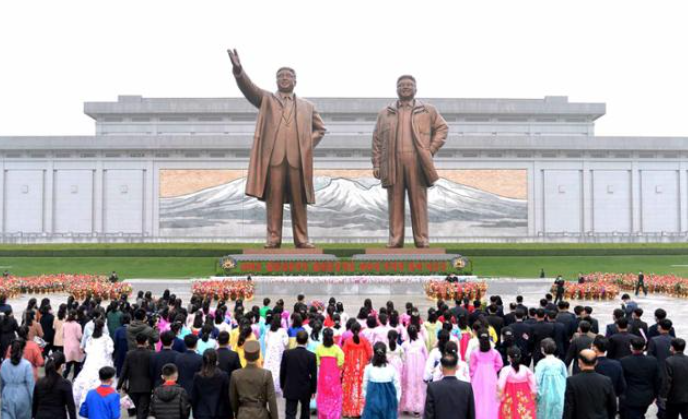
Portraits of Kim Il-sung and Kim Jong-il Displayed Together at Kim Il Sung Square in Pyongyang. ( Photo by Newsis)
II. The Relationship Between Political Power and the Cult of Personality: A Theoretical Perspective
The cult of personality refers to a state where truth is obscured due to certain obstacles, and an individual is exaggerated to the point of being placed in a divine position, with its extreme form being deification (Cho Yong-kwan, 2002). The legitimacy of a state's ruling system is achieved when citizens voluntarily acknowledge and accept it. Therefore, the cult of personality policy towards leaders becomes an effective means of governance, as it can induce obedience from a human group to the leader's specific commands. By excessively elevating the leader's abilities to superhuman levels and fostering reverence and worship, leaders gain authority by demanding loyalty from their subjects and even sacrificing them for their own benefit. In terms of governance, leaders strategically utilize the cult of personality policy to maintain and secure political power, including succession.
Merriam divides the methods of acquiring political power into two categories: "Miranda," which involves receiving praise from others, and "Credenda," which involves gaining trust from others. Firstly, "Miranda" is based on the premise that power is maintained through trust and admiration from others, representing a just power that upholds justice. This power is deeply rooted in emotions, feelings, morals, wisdom, and higher levels of cultural cohesion. If sincere admiration and loyalty are maintained, this power will undoubtedly captivate the senses, including sight and hearing, and garner support. This paper presents an analytical framework based on Merriam's "Miranda" and "Credenda" theories.
III. Comparative Analysis of the Cult of Personality Policies of Kim Il-sung and Kim Jong-il
1. Kim Il-sung's Cult of Personality Policy
Kim Il-sung's cult of personality closely resembles Merriam's Miranda and Credenda theories, but it is more creative and developed in its form, effectively utilized for the maintenance, strengthening, and succession of political power. Kim Il-sung's cult of personality in North Korea began with the establishment of one-man rule and the elevation of his status as a leader, followed by the fabrication of a narrative that portrayed Kim Il-sung as a great successor to revolutionary traditions.
Kim Il-sung's cult of personality is characterized by its focus on Miranda aspects. He established national holidays such as his birthday, Party Foundation Day, and Korean People's Army Foundation Day, and created various forms of commemorative events, including military parades, mass rallies, and central reporting meetings, to promote his achievements and the legitimacy of his rule. Additionally, he constructed iconic cult of personality buildings like the Kumsusan Palace of the Sun, the Juche Tower, the Taesongsan Revolutionary Martyrs' Cemetery, and the April 25 Cultural Hall.
Furthermore, Kim Il-sung's adulation songs were widely disseminated, leading them to be sung at schools and social organizations, both before and after work, gradually elevating the deification of Kim Il-sung. In the case of Korean revolutionary operas, a fusion of song and dance, these performances toured various regions, naturally promoting Kim Il-sung's anti-Japanese struggle and emphasizing patriotism, urging unwavering loyalty to Kim Il-sung. Additionally, one of the most prominent symbolic manipulations pursued by Kim Il-sung during the early years of his rule involved portraits and badges. By hanging Kim Il-sung's portraits in homes and having people wear badges adorned with his image, they were indoctrinated to believe that life outside the veneration of Kim Il-sung was unimaginable. Statues and commemorative monuments were erected grandiosely and sacredly in various locations, ensuring that even during everyday occasions such as Kim Il-sung's birthday, national holidays, and even weddings, people paid homage to him. North Korea used symbols such as slogans, historic revolutionary sites, the Kim Il-sung cult, and extreme reverence as tools to educate and maintain the regime, making indoctrination and propaganda essential for its enduring system.
Historical and anecdotal narratives about Kim Il-sung were crafted with more creativity and originality than Merriam's theories suggested. Experts manipulated Kim Il-sung's history to portray him as a hero of the anti-Japanese struggle and a hero of the Korean War. Kim Il-sung's cult of personality was disseminated through publications such as the "Immortal Chronicles," which detailed his anti-Japanese exploits, and through readings in schools and organizations. The cult was further propagated through the Kim Il-sung Youth League, which instilled the belief that Kim Il-sung was the national hero who liberated Korea from Japanese rule.
2. Kim Jong-il's Cult of Personality Policy
Kim Jong-il, as a second-generation leader who came to power through succession, faced an urgent need to establish a solid foundation for governance, unlike his father Kim Il-sung. Consequently, during the early stages of his regime, Kim Jong-il placed significant emphasis on the Credenda aspect of cult of personality policies to secure the legitimacy of his rule.
Through a meticulous implementation of Credenda aspects like the succession doctrine, the ideology of Juche, our style of socialism, and benevolent politics, Kim Jong-il appealed to the rationality of the residents, thus substantiating his claim as a political leader. However, the local leadership's primary objective was to construct an image of dedication, leading people to believe that Kim Jong-il tirelessly worked to improve their quality of life, ultimately compelling them to revere and praise him, just as they did with Kim Il-sung.
Kim Jong-il, after consolidating his political power, adopted Miranda-inspired cult of personality policies. He established a system for promoting his achievements and the legitimacy of his ruling party through various commemorative events like his birthday celebrations and military parades. Additionally, he guided the construction of monuments and even developed architectural theories to ensure their effective use by the populace. In the realm of music and dance, he created theories and organized annual performances like the Arirang Mass Games to foster loyalty and generate foreign currency. Additionally, he paid more attention to music and dance, developing new theories in music and dance arts, and actively utilized mass performances like the Arirang Mass Games to foster loyalty and generate foreign currency.
3. Comparative Analysis of Kim Il-sung and Kim Jong-il's Cult of Personality Policies: Commonalities and Differences
The commonalities between Kim Il-sung and Kim Jong-il's cult of personality policies include:
- The complementary use of Miranda and Credenda-based cult of personality policies, depending on the socio-political context, the legitimacy of authority, and the degree of authority;
- A focus on Credenda-oriented cult of personality policies when facing domestic or external crises or when the legitimacy and authority of rule were challenged;
- Active promotion of successor cult of personality when preparing for leadership succession;
- Institutionalization of cult of personality policies, including dedicated organizations, structures, and budgets;
- The operation of North Korea as a closed society to enhance the effectiveness of cult of personality policies.
Differences between Kim Il-sung and Kim Jong-il's cult of personality policies include:
- Kim Il-sung primarily used Miranda-oriented cult of personality policies during the early stages of his rule, while Kim Jong-il initially relied on Credenda-oriented policies to establish his power base;
- Kim Il-sung actively supported the cult of personality of his successor, Kim Jong-il, while Kim Jong-il used it to elevate himself and reduce his father's presence;
- Kim Jong-il theorized, systematized, and institutionalized cult of personality policies to a greater extent than Kim Il-sung.
IV. Conclusion
Considering the complex nature of humanity, encompassing reason and emotion, North Korea has heavily invested in the cult of personality. This study carries weight in its examination of North Korea's cult of personality policies through the lens of political authority and governance. These policies within North Korea are designed to uphold political authority, encompassing its establishment, fortification, and succession, achieved by evoking the rational and emotional facets of the subordinates, compelling them to venerate and idolize their rulers. The political figures at the helm of North Korea, namely Kim Il-sung and Kim Jong-il, are scrutinized for their adept application and utilization of the concepts of Miranda and Credenda in the pursuit, consolidation, and transmission of political power. Ultimately, North Korea's cult of personality can be characterized as a mode of governance that molds its populace into compliant individuals who unquestioningly adhere to the Supreme Leader's directives, obstructing their ability to accurately grasp reality, leveraging the inherent structural characteristics of human rationality and emotion. It can be described as a mechanism of political authority that steers North Korean residents in accordance with the desires of Kim Il-sung and Kim Jong-il.
In conclusion, Merriam's Miranda and Credenda theories, initially crafted for application within democratic contexts, have found relevance in prominent socialist states like North Korea during the reigns of Kim Il-sung and Kim Jong-il. Thus, these theories hold value as tools for the study and analysis of cult of personality policies. Consequently, a systematic examination of Kim Jong-un's cult of personality policies in North Korea may offer valuable insights into the country's future direction.
Reference
1. Robert C. Tucker, Politics as Leadership, translated by Ahn Sung-suk (Seoul: Kachi, 1983), p. 18-23.
2. Cho Yong-gwan, "A Study on the Historical and Cultural Preconditions of North Korean Regime Peculiarity," North Korean Studies Review, Vol. 6, No. 2 (2002), p. 153.
3. Seo Jae-jin, A New Analysis of the Formation and Evolution of the Juche Idea (Seoul: Korea Institute for National Unification, KINU, 2001), p. 109.
-
PREV [Defectors' Podium]
-
NEXT [Feature Article]