

The Formalization of North Korean Leadership:
Unveiling its Contemporary Significance

Jeong min sub
Korea Army Reaearch for Future & Innovation Center,
Research Officer, Korea
⦁ First-generation Leader: The Formalization of Kim Il-sung's Leadership
⦁ Second-generation Leader: The Fabrication of the Baekdu Mountain Legend by Kim Jong-il
⦁ Modern Significance: The Future of the Third-generation Leader, Kim Jong-un
For decades, there have been persistent predictions of North Korea's impending collapse and disappearance. The longevity of these forecasts raises the question of whether there is more to the regime's resilience than mere coincidence. Despite facing significant economic and regime challenges, North Korea has managed to endure. What could be the underlying reason behind the success of its unique three-generation leadership lineage? The answer lies in the systematic and organized formalization of North Korean political leaders, a phenomenon known as the 'supreme dignity.' This article delves into the fundamental aspects of North Korea's leader formalization policy and explores its potential implications for the future.
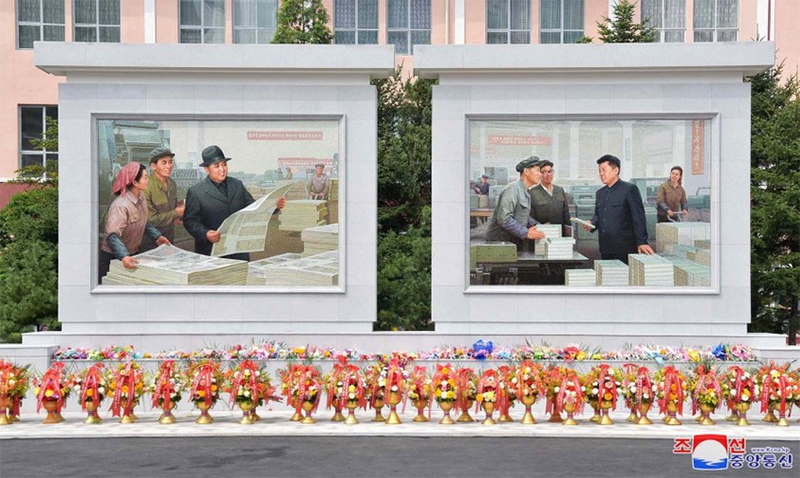
북한 지역들에 김일성과 김정일의 영상을 형상화한 모자이크벽화를 선전하고 있다.(사진/조선중앙통신)
First-generation Leader: The Formalization of Kim Il-sung's Leadership
The cultural and artistic policies directed towards formalizing Kim Il-sung's image had a clear objective: to establish his legitimacy as a leader and foster unwavering loyalty among the people.
During the 1960s, as Kim Il-sung solidified his position as the sole leader, the efforts to formalize his personality cult gained momentum. The formalization process aimed not only to garner support for Kim Il-sung's regime during its establishment but also to firmly embed the idealized image of the leader, as advocated in the Juche idea, which served as North Korea's central ideology of governance. To achieve this, Kim Il-sung outlined five principles for cultivating a personality cult, to be integrated into socialist literature, arts, and the daily lives of the residents.
One of the principles emphasized by Kim Il-sung is the deep embodiment of Suryong's ('Great Leader') greatness in the formalization process. The leader's personality should be portrayed as that of a remarkable human being, a revolutionary figure, with a focus on highlighting their exceptional qualities and traits to establish a revolutionary leadership model among the people. To achieve this, it is crucial to accentuate the leader's visionary capabilities as an outstanding theoretician, capable of showcasing their greatness as a thinker and a renovator of ideology and outdated intellect. The formalization should depict the leader as a skilled organizer of the masses, a political leader adept at presenting slogans of the struggle and guiding methods of leadership, and a strategist skilled at mobilizing the people in an organized manner. In essence, the leader serves as an artistic exemplar in the art of leadership.
Secondly, the formalization process also sought to highlight Suryong's human qualities, placing significant emphasis on his boundless humility, simplicity, infinite kindness, generosity, and noble revolutionary camaraderie. The primary focus was on portraying him as a compassionate and caring parental figure, fostering a deep and profound connection with the people.
Thirdly, Suryong's relationship with the party and the masses should be emphasized for the formalization. The portrayals underscore his ties with the party and the people, showcasing his active involvement in the lives of citizens as a social and political entity. Specific anecdotes and stories are used to illustrate his local leadership and guidance.
Fourthly, it is essential to deeply and comprehensively portray the greatness of Suryong. Drawing inspiration from the Immortal History, which highlights the greatness of Kim Il-sung, the relevance of themes and events becomes crucial. Historical upheavals and progressive creations should elevate the revolutionary history in terms of political ideology and artistry. The leader's revolutionary journey should be depicted as the history of an outstanding leader and a remarkable human being, employing biographical and episodic forms to thoroughly embody their life story.
Fifthly, the portrayal should be firmly grounded in actual historical facts. Key to achieving this lies in individualizing the characters according to humanistic demands, while avoiding embellishments and ensuring consistency with Suryong's ('Great Leader') revolutionary history, the party's history, and the history of the revolution. Continuously delving into history and literature will elevate their historical and literary value. Suryong's history and immortal achievements should be portrayed as exemplary traits, providing an invaluable source of learning and inspiration for the people to follow their leader.
Second-generation Leader: The Fabrication of the Baekdu Mountain Legend by Kim Jong-il
In contrast to the first-generation leader Kim Il-sung, who established his political power independently, Kim Jong-il inherited leadership from his predecessor, which somewhat diminished the significance of his legitimacy compared to Kim Il-sung. Nevertheless, Kim Jong-il successfully seized and maintained political power, making him a relatively successful leader who later passed it on to the third-generation leader, Kim Jong-un.
The inception of Kim Jong-il's personality cult policy revolved around the fabrication of his birthplace as Baekdu Mountain, orchestrated by his father, Kim Il-sung. This move aimed to establish the legitimacy of the Paektu bloodline and create a foundation for his leadership.
Unlike other socialist countries that idolize solely the leader, North Korea practices a lineage-based personality cult, encompassing the father, grandfather, and great-grandfather. Kim Jong-il's idolization began when he was designated as the heir in 1972, leading to the creation of various legends and anecdotes that deified him.
One of the prominent legends related to Kim Jong-il's birth fabrication is the "Kwangmyŏngsŏng program" associated with Baekdu Mountain. According to this legend, on February 16, a white crane appeared from the heavens above Baekdu Mountain, heralding the birth of an extraordinary leader who would rule the world like the mighty mountain. It is said that when Kim Jong-il was born, thunder and lightning reverberated, ice cracked with an enigmatic sound, and a brilliant double rainbow adorned the sky. Further claims suggest that at the age of 4, Kim Jong-il's actions influenced the weather, as heavy rain poured on Japan when he pointed at it on a map, and the sea turned into a jade octopus while the Simsan Valley transformed into a paradise.
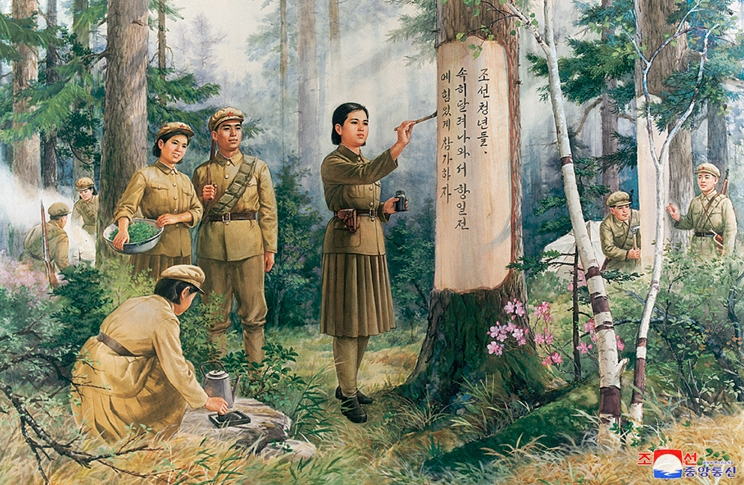
김정일의 생모 김정숙이 청봉숙영지의 나무에 글을 쓰고 있다. (사진/조선중앙통신)
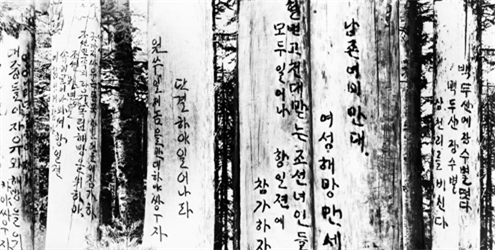
1980년대에 나무들이 발견됐다고 주장하고 있으나 내부자들의 증언에 따르면 수령형상 신화를 위해 급조했다고 한다. (사진/조선중앙통신)
During the 6th Party Congress of 1980, when Kim Jong-il was officially introduced as the successor, the legend of his birth in Baekdu Mountain began to spread, gaining momentum from 1984. Subsequently, in 1987, Baekdu Mountain was publicly declared as his birthplace, leading to the discovery of slogan trees praising Kim Jong-il, Kim Jong-suk, and Kim Il-sung. Nationwide, these anti-Japanese guerrilla fighters became symbolic tools to emphasize the legitimacy of Kim Jong-il's succession, with approximately 200 literatures within these trees praising the Kim Jong-il succession system. Among the phrases used were ones such as "Oh, Korea, announcing the birth of Baekdu Mountain" and "The National Sun, General Kim Il-sung, and the shining Baekdu brightness (Kwangmyŏngsŏng) carrying on his light."
In September 1991, a collection of legends about Kim Jong-il, known as the "Kwangmyŏngsŏng program," was published and distributed among residents to reinforce his personality cult. This collection included 30 legends, showcasing instances like Kim Jong-il visiting Chŏngjin City and purportedly turning the Japanese map black upon seeing a globe used by Japanese people, leading to Japan being covered by black clouds and light rain. The idolization of Kim Jong-il commenced alongside the process of his power succession, and an essential aspect is that his father, Kim Il-sung, directly designed and participated in the formalization of Kim Jong-il's image.
Modern Significance: The Future of the Third-generation Leader, Kim Jong-un
After the regime's establishment, Kim Jong-un reportedly invested around 500 million dollars (approximately 53 billion KRW) in formalizing the images of his father and grandfather. This extensive endeavor included the installation of 3,200 Eternal Life Towers, 400 mosaic murals, a 23-meter tall statue at Mansudae, and the development of facilities to improve residents' lives, all part of his achievements to promote. Four characteristics summarize the formalization of Kim Jong-un's personality cult.
Firstly, he emphasized local leadership to highlight his leadership skills. Implementing initiatives like "increasing local visits" and "publicizing the first train," Kim Jong-un sought to portray an image of constant care for the people.
Secondly, in the formalization of his personality cult, Kim Jong-un employed titles and fabricated anecdotes. Bestowed with designations like "Brilliant Comrade" and "Respected Kim Jong-un," the anecdotes attributed to him ranged from shooting a gun with precision at age three, to spearheading a missile program, and strategizing for nuclear confrontation with powerful nations during his student days. These narratives aimed to cement his position within the regime.
Thirdly, he focused on education and learning for the youth to formalize his personality cult. Strengthening school education through measures like "Revising the Ten Principles of the One-Ideology System in 2013," producing films about Kim Jong-un's achievements, issuing stamps, and introducing a subject on his revolutionary history were undertaken to prevent potential challenges from future generations and enhance ideological education among the youth.
Fourthly, Kim Jong-un produced symbols of the previous leaders to carry out the formalization of his personality cult. Creating a new statue of his grandfather, Kim Il-sung, and installing it at the Victorious Fatherland Liberation War Museum, he aimed to highlight the younger days of Kim Il-sung to garner loyalty and support from the people.
Following in the footsteps of his father and grandfather, Kim Jong-un persists in employing the strategy of formalizing his personality cult to solidify his power and regime. Given the challenges he faces in attaining the same charisma and legitimate authority as his predecessors, Kim Jong-un is anticipated to actively pursue a systematic personality cult policy to sustain his political influence in the times to come.