

Reflecting on South Korea's Peace and Security
on the 50th Anniversary of Yuk Young-soo's Death

Shin Gak-soo
Former Vice Minister of Foreign Affairs and Trade,
Former South Korean Ambassador to Japan
This year commemorates half a century since Yuk Young-soo, the wife of President Park Chung-hee, was fatally shot by Zainichi Korean Moon Se-gwang during the National Liberation Day ceremony on August 15, 1974. This tragic event, which occurred when I was a college sophomore, remains a vivid memory due to the significant impact it had. Despite its importance, it is a largely forgotten event, especially among those under 50.
Like many high-profile assassinations, Moon's act is surrounded by conspiracy theories. According to the South Korean government's official account, Moon Se-gwang, born in Osaka with roots in Gyeongnam, joined the Korean Residents Union in Japan before being recruited by the General Association of Korean Residents in Japan in 1972. He became actively involved in the rescue committee following Kim Dae-jung's abduction in 1973. In September of that year, Kim Ho-ryong of Chongryon's Ikuno branch recruited him, and by May 1974, he had received ideological training aboard the North Korean ship Mangyongbong-92 in Osaka, where he was indoctrinated to assassinate President Park Chung-hee.
With help from his Japanese girlfriend, he obtained a Japanese passport in October and received 500,000 yen from North Korea's South Liaison Department in November to execute his plan.
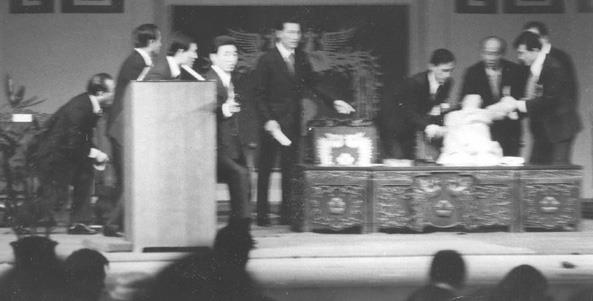
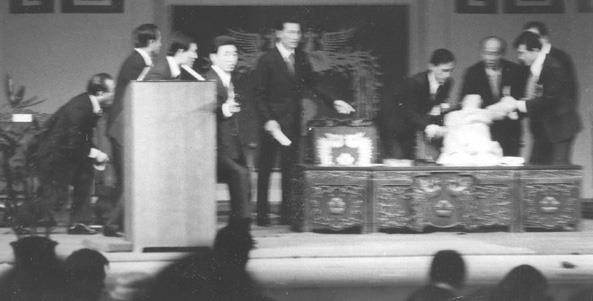
On August 15, 1974, during the Liberation Day ceremony at the Sejong Center in Gwanghwamun, Seoul,
Mrs. Yuk Young-soo was shot by Mun Se-gwang, a member of Chongryon. / Future Korea Party
In July 1974, Moon Se-gwang stole two 38 caliber revolvers and ammunition from an Osaka police station. On August 6, he smuggled the weapons into South Korea through Gimpo Airport by concealing them in a portable radio. The morning newspaper confirmed President Park's attendance at the National Liberation Day ceremony, prompting Moon to move from the Chosun Hotel to the venue. With inadequate security, he easily entered and, during President Park's speech, attempted to shoot him but missed, hitting Yuk Young-soo instead. She was rushed to the hospital but did not survive.
Moon Se-gwang was swiftly apprehended at the scene and admitted to the assassination during questioning by the Central Intelligence Agency's investigation team. He faced six charges, including murder with the intent to incite insurrection and breaches of the National Security Act. He was sentenced to death by the Seoul Central District Court on October 19, affirmed by the Seoul High Court on November 20, and upheld by the Supreme Court on December 17. His execution was carried out at the Seoul Detention Center on December 20.
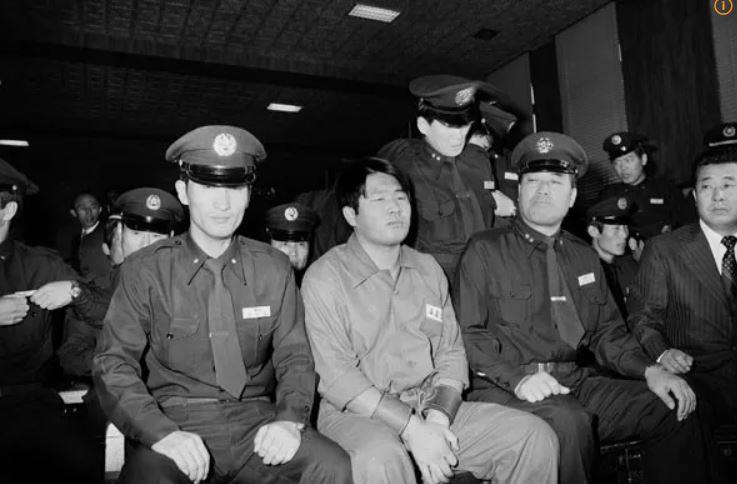
Moon Se-kwang, the assassin of First Lady Yuk Young-soo, during his trial on July 14, 1974. He was executed by
hanging at the Seoul Detention Center on December 20, 1974, four months after the incident. / Namu Wiki
The assassination attempt on President Park and the death of the first lady was a profound terrorist act with wide-ranging implications. Domestically, it had a significant impact, and internationally, it involved both North Korea and Japan, heightening tensions.
At the time, the Cold War between the US and the Soviet Union was ongoing, and the economic burden of the Vietnam War prompted the U.S. to take measures to alleviate these pressures. The U.S. economy's share of global GDP had fallen from 35% to 27% over two decades. In August 1971, President Nixon ended gold convertibility and adopted a floating exchange rate system to address trade deficits and the declining dollar value, an event known as the Nixon Shock, which destabilized the Bretton Woods system. This was followed by the Paris Peace Accords in January 1973, leading to the U.S. military withdrawal. Meanwhile, the U.S. and the Soviet Union signed multiple arms reduction treaties and expanded trade in the late 1960s, maintaining a partial détente until the Soviet invasion of Afghanistan in 1979.
One of the most impactful events for East Asia was President Nixon's visit to China in February 1972. This strategic move aimed at hastening the end of the Vietnam War and leveraging the Sino-Soviet ideological rift caused a significant psychological impact on U.S. allies in Asia, including South Korea and Japan.
Startled by this unilateral U.S. action, Japan quickly arranged for Prime Minister Kakuei Tanaka to visit China, leading to the establishment of diplomatic relations in September 1972. Having rebuilt its post-war economy and emerged as the world's second-largest economy in 1967, Japan was rushing to expand into Southeast Asia. The international political landscape of the 1970s differed markedly from the Korean War era of the 1950s and the Vietnam War of the 1960s.
For South Korea, the escalating military threat from North Korea was particularly concerning, especially as the Nixon administration reduced its engagement in Asia, including withdrawing one United States Forces Korea (USFK) from South Korea in 1971. North Korea continued its provocations, including the armed infiltration in Uljin-Samcheok (1968), the capture of the U.S. naval intelligence ship Pueblo (1968), and the shootdown of the U.S. reconnaissance aircraft EC-121 (1969). Notably, the Blue House raid on January 21, 1968, was a direct terrorist act targeting President Park Chung-hee.
The Moon Se-gwang incident, under these circumstances, intensified tensions in Northeast Asia. The use of a stolen Japanese police revolver and the involvement of a Zainichi Korean with a Japanese passport under Chongryon's directives led the South Korean government to demand that Japan take responsibility, investigate accomplices, and regulate Chongryon.
However, Japan's refusal to cooperate and conflicting investigation outcomes created significant discord. This reluctance stemmed from lingering tensions over Kim Dae-jung's kidnapping in August 1973, ongoing repatriation of Koreans residing in Japan to North Korea, and Japan's need to maintain ties with North Korea. Declassified South Korean diplomatic documents from 2005 reveal that South Korea even considered cutting diplomatic ties with Japan and sought U.S. pressure on Japan. The U.S. recommended a diplomatic resolution to avoid disrupting South Korea's defense. Ultimately, the investigation into accomplices was inconclusive, and Chongryon's regulation was only verbally addressed by former Foreign Minister Shiina Etsusaburo during his visit to South Korea, resolved through a memo exchange.
Despite these challenges, resolving the Moon Se-gwang incident helped mend strained South Korea-Japan relations after Kim Dae-jung's kidnapping. Overcoming two major crises within a decade of establishing diplomatic ties facilitated further progress. Improved relations were crucial when the Carter administration planned to withdraw USFK from South Korea in 1978, with Japan's opposition playing a key role in maintaining security on the Korean Peninsula and in Northeast Asia.
In the early 1970s, inter-Korean relations saw a brief thaw due to the détente between the U.S. and the Soviet Union, U.S.-China rapprochement, and efforts to end the Vietnam War. The July 4 South-North Joint Statement in 1972 marked the first South-North talks since the division, agreeing on unification principles. However, relations soon cooled again after North Korea halted talks in August 1973, citing South Korea's June 23 declaration.
The Moon Se-gwang incident happened in this context, with Kim Il-sung denying North Korean involvement, similar to other provocations. It was also reported that Kim Il-sung suggested to the new Soviet ambassador Gleb Krilov that Kim Dae-jung supporters were behind the incident.
North Korea has made three assassination attempts on South Korean presidents, the Moon Se-gwang incident, and the Rangoon bombing. The nature of North Korean provocations has evolved, but they remain audacious enough to target the head of state directly. Considering that North Korea is promoting a hostile two-state theory with South Korea, we must remain vigilant against future provocations, especially unexpected ones.
The Moon Se-gwang incident had significant political repercussions domestically, resulting in the dismissal of Park Jong-gyu, Chief of Presidential Security, Seoul Mayor Yang Taek-sik, Interior Minister Hong Sung-chul, and Justice Minister Lee Bong-sung. The new Chief of Presidential Security, Cha Ji-chul, established security support units within the military and police and overstepped his authority, causing national confusion. The death of Yuk Young-soo, who was a supportive figure to President Park Chung-hee and cherished by the public, cast a significant shadow over Park Chung-hee's leadership.
The authoritarian Yushin regime faced escalating democratization movements and increased repression, leading to instability and international pressure. This culminated in the Bu-Ma uprising and the October 26 incident, which ended Park Chung-hee's regime and the Yushin system. Although the Moon Se-gwang incident may not have directly caused these political shifts, it undeniably had a significant impact on modern Korean history.
Over the past 50 years, both Korea and the world have undergone substantial changes. However, the Korean Peninsula remains tense due to North Korea's advanced nuclear capabilities and its hostile two-state theory. The journey toward peace and stability on the peninsula is still long. While managing inter-Korean relations in the long term is essential, we must always be prepared for unexpected provocations from North Korea, especially terrorism.
Achieving peace on the Korean Peninsula requires not only dialogue but also effective deterrence and defense. The Moon Se-gwang incident, occurring during frequent North Korean provocations, could have been prevented with adequate vigilance. The harsh lesson from 50 years ago, resulting from a critical security lapse, should remind us to leave no gaps in our national security and public safety.
-
PREV [Defectors' Podium]
-
NEXT [Defectors' Podium]