

-North Korea Confirms Hypersonic Missile Test as Kim Jong-un Observes with Daughter Ju-ae
-Kim Jong-un Orders “Thorough Suppression” of Reactionary Ideology and Culture, Calls for Greater Use of Modern Information and Technology
-Chinese Ambassador to North Korea Visits Jilin Province, Emphasizes “Economic and Trade Cooperation with North Korea”

Kim Myong-sung
Secretary General of the SAND Institute
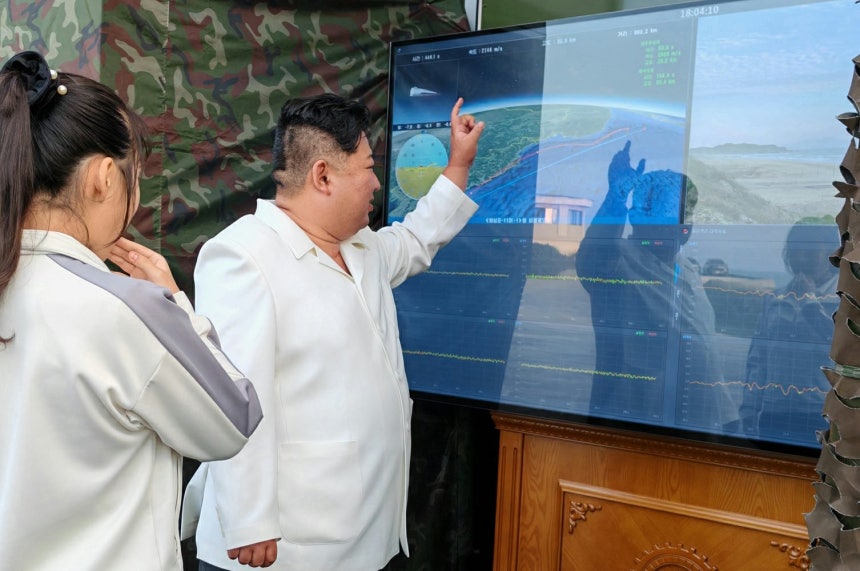
North Korea Confirms Hypersonic Missile Test as Kim Jong-un Observes with Daughter Ju-ae
North Korea officially confirmed two days later that it had launched two short-range ballistic missiles on September 20, describing the launch as a “successful test of a new type of weapon.” Analysts assessed that the launch may have involved a hypersonic missile.
On September 22, the Korean Central News Agency (KCNA) reported that State Affairs Commission Chairman Kim Jong-un and his daughter, Ju-ae, had attended a test in which “the Missile Bureau successfully conducted a test of a new weapon on the 20th, which holds significant meaning for the advancement of weapons-system technology.” KCNA added that the test “had no negative impact whatsoever on the security of neighboring countries.”
According to the Republic of Korea Joint Chiefs of Staff (JCS), North Korea launched two short-range ballistic missiles (SRBMs) in relatively rapid succession from the Wonsan area toward the East Sea on the afternoon of the 20th. The missiles flew approximately 450 kilometers and more than 600 kilometers, respectively, with the two launches occurring approximately three hours apart.
Although North Korea’s official report did not provide detailed technical specifications, the phrase “flight trajectory of Hwasongpho-11Ma-1” was visible on a monitor viewed by Kim Jong-un and Ju-ae in photographs released by North Korean state media. Experts have speculated that the designation may refer to an improved or successor variant of the Hwasongpho-11 series, a hypersonic short-range ballistic missile previously unveiled by North Korea.
North Korea claimed that it had successfully secured the technology for a “hypersonic” short-range ballistic missile (SRBM). In a report published on September 22, Rodong Sinmun, the official newspaper of the Workers’ Party of Korea, described the SRBM test conducted two days earlier as “a test of a new type of weapon of great significance for the advancement of weapons-system technology.”
Some analysts suggest that North Korea’s decision to disclose the launch, as well as the timing and extent of its public coverage, was linked to major international political events, including the opening of the UN General Assembly. One interpretation is that Pyongyang sought to demonstrate its military capabilities ahead of U.S. President Donald Trump’s address to the UN General Assembly while avoiding unnecessary escalation of tensions with the international community.
Kim Jong-un Orders “Thorough Suppression” of Reactionary Ideology and Culture, Calls for Greater Use of Modern Information and Technology
Kim Jong-un, Chairman of the State Affairs Commission of North Korea, has instructed officials in the Workers’ Party’s propaganda apparatus to make greater use of modern information and technological tools to prevent the influx of foreign ideology and culture. As North Korea continues its extensive efforts to block the flow of external content, including South Korean films, television dramas, and news, Kim has called for an “ideological struggle” that incorporates advanced technologies. Analysts assess that the directive may reflect the regime’s recognition that traditional propaganda and censorship measures alone may be insufficient to contain the spread of external information within North Korean society.
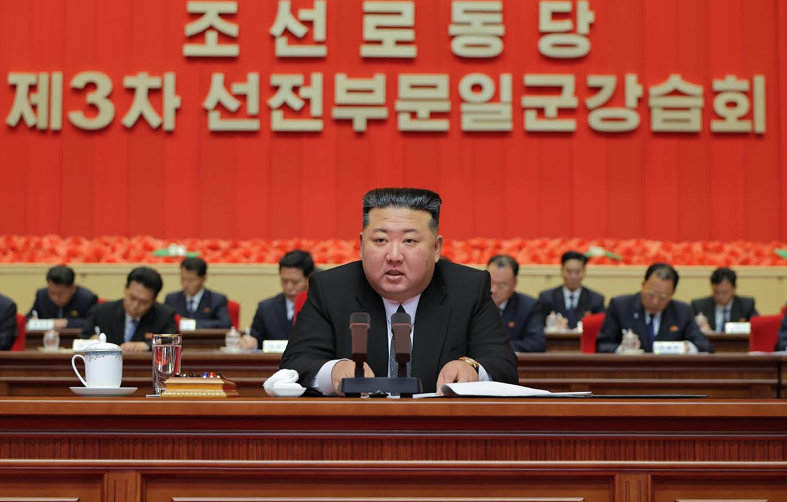
Rodong Sinmun, the official newspaper of the Workers’ Party of Korea, and KCNA reported on September 22 that Kim Jong-un attended and delivered a speech at the closing ceremony of the Third Training Session for Propaganda Department Cadres, which was held the previous day in Pyongyang. The four-day training session began on the 18th, with Kim also attending and delivering a speech at the opening ceremony. This marks the first time North Korea has publicly disclosed the contents of Kim’s remarks at a training session for propaganda officials.
Emphasizing the need to modernize propaganda work, Kim Jong-un said, “Our forms and methods of propaganda and education must constantly evolve in line with the progress of the times.” He added, “We must also focus on utilizing modern information and technological tools to enhance the speed and effectiveness of propaganda and educational work and to thoroughly suppress the spread of reactionary ideology and culture.”
North Korea’s decision to publicly release Kim Jong-un’s directive calling for the active use of modern information and technological tools to block “reactionary ideology and culture” is noteworthy. The North Korean authorities have long strengthened censorship and punishment of citizens in an effort to prevent the inflow of foreign cultural content, including South Korean films, television dramas, and music. Kim’s directive suggests that the regime may now be seeking to supplement these existing measures with new forms of information technology–based monitoring and control.
Kim Jong-un also criticized simplistic and repetitive approaches to propaganda. He stated, “If the laws governing the recognition of objects and phenomena and the principles of life are excluded from propaganda work, and information is instead instilled in a formulaic and mechanical manner, the truth may actually be distorted and misrepresented, leading only to skepticism and resistance.”
He continued, “Ideological education must not only be logical but also firmly grounded in reality,” and instructed propaganda officials to develop new methods capable of resonating with the thoughts and emotions of the population. At the opening ceremony, Kim similarly emphasized that “today’s ideological struggle must be an innovative, creative, and offensive ideological struggle that leads the times.”
In particular, Kim assessed that “the pace of change in the objective environment is faster than the pace at which the means and methods of ideological work are changing.” His remarks may indicate an internal perception that the Workers Party’s propaganda apparatus is struggling to keep pace with rapid changes in information access and living conditions within North Korean society.
Kim Jong-un also issued a strong warning against corruption and bureaucratism among propaganda officials. He warned, “Even if a bolt of lightning were to strike your head or a knife were held to your throat, you must not compromise with negative phenomena that violate the Party’s ideology and socialist principles,” urging officials to refrain from abuses of power, bureaucratic practices, and the illicit accumulation of wealth.
He also emphasized the role of the Workers’ Party’s Propaganda and Agitation Department. Kim stated that “revolutionary measures” must be taken to strengthen the political and theoretical education and practical capabilities of the propaganda sector, adding that the Central Party’s Propaganda and Agitation Department must serve as the starting point for this effort. The directive appears intended to reinforce the department’s central role and institutional capacity in overseeing the Workers Party’s ideological work.
During the training session, participants discussed measures to enhance the effectiveness of ideological and political work aimed at consolidating the Worker Party and society around Kim Jong-un’s revolutionary ideology, as well as ways to improve propaganda and agitation in implementing the decisions of the 9th Party Congress. Participants also adopted a pledge of allegiance to Kim Jong-un.
This was the third training session for North Korean propaganda officials since the first such session was held in 2022. Unlike the previous two sessions, Kim Jong-un attended both the opening and closing ceremonies this time, underscoring the importance he attaches to the propaganda sector. Observers assess that, as North Korea increasingly views the influx of foreign information and culture as a potential threat to regime stability, the regime may be seeking to move beyond its traditional reliance on ideological education and punitive measures toward a broader model of propaganda and social control that makes greater use of information technology.
Chinese Ambassador to North Korea Visits Jilin Province, Emphasizes “Economic and Trade Cooperation with North Korea”
China’s ambassador to North Korea visited Jilin Province, which borders North Korea, and emphasized the importance of economic and trade cooperation with Pyongyang. The visit has drawn particular attention amid speculation that the New Yalu River Bridge could soon become operational.
According to the Chinese Embassy in North Korea and Yanbian Daily on September 22, Chinese Ambassador to North Korea Wang Yajun visited Yanji, in Jilin Province’s Yanbian Korean Autonomous Prefecture, the previous day and met with Hu Zafu, Party Secretary of Yanbian.
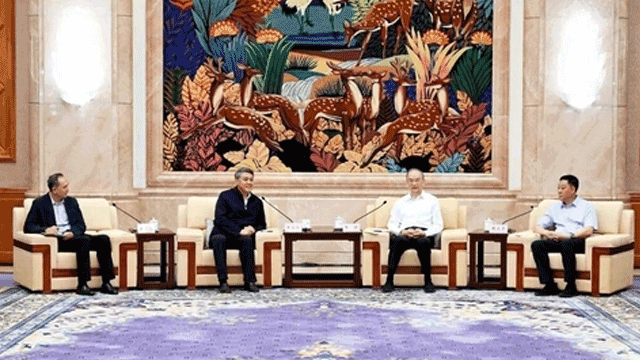
Ambassador Wang stated, “Yanbian’s unique geographical location enables it to play an important role in exchanges and cooperation between China and North Korea.” He added, “We will actively promote exchanges and cooperation between Yanbian Korean Autonomous Prefecture and North Korea in areas including the economy, trade, and culture, thereby contributing more effectively to the broader framework of national diplomacy and supporting the high-quality economic and social development of Yanbian.”
Hu noted that Chinese President Xi Jinping’s visit to North Korea last June provided an opportunity to deepen exchanges and cooperation between the two countries. He pledged, “We will fully leverage our geographic proximity and cultural ties to steadily advance economic and trade cooperation and cultural exchanges with North Korea, thereby making a greater contribution to the country’s overall diplomatic efforts through concrete actions.”
He added, “I hope that the embassy will continue to pay close attention to and support Yanbian, serving as an even more effective bridge and link by providing greater guidance, assistance, and support in areas such as expanding economic and trade exchanges and promoting people-to-people exchanges.”
On September 19, Ambassador Wang also met in Changchun with Huang Chang, Party Secretary of Jilin Province, and Hu Weiting, Deputy Party Secretary and Governor of Jilin Province.
During the meeting, Ambassador Wang said, “China-DPRK relations are currently at a new historical juncture and facing new opportunities for development,” adding, “Jilin Province shares a border with the DPRK and has deep historical ties and a strong foundation for cooperation.”
He also expressed his embassy’s intention to actively support efforts to deepen exchanges, diplomatic engagement, and economic and trade cooperation between Jilin Province and North Korea.
Huang stated, “Jilin is firmly seizing this important opportunity to strengthen friendly exchanges with North Korea and steadily advance practical cooperation, thereby contributing through concrete actions to the country’s broader diplomatic efforts.” He also requested the embassy’s support for Jilin Province’s efforts to expand cooperation with North Korea.
The visit is drawing attention amid speculation that the New Yalu River Bridge, linking Sinuiju in North Korea with Dandong in China’s Liaoning Province, could soon open.
The four-lane, two-way bridge was completed in 2014. However, its opening has been delayed for 12 years because North Korea had not completed the necessary customs facilities and related infrastructure.
China completed its customs facilities in 2016, but North Korea did not construct the corresponding customs facilities and connecting roads until recently. North Korea is now reported to have completed work on customs and immigration facilities and related infrastructure. Some observers speculate that the bridge could open on October 6, coinciding with the 77th anniversary of the establishment of diplomatic relations between North Korea and China.