

Trends in North Korea (April 2026)
- The Parallel Development of Military Technology and Selective Governance Strategies -

Seung hyun Lee
Ph.D in Public Administration
Research Fellow, SAND Institute
North Korean developments in April 2026 reflect a complex pattern of regime management, characterized by the simultaneous pursuit of military technological advancement, internal cohesion, and the maintenance of economic foundations, as policy implementation accelerated following the Ninth Congress of the Korea Workers’ Party (KWP).
Notably, although the frequency of Chairman Kim Jong-un’s public appearances declined in April compared to the previous month, the emphasis on military affairs was maintained and, in some respects, strengthened. This trend does not indicate a simple reduction in activity but rather a shift toward a more selective governance model that prioritizes strategic impact over the volume of public engagements.
First, in the military domain, North Korea conducted a series of intensive tests of multi-layered weapons systems beginning in early April. According to North Korean state media, from April 6 to 8, the country carried out consecutive tests of electromagnetic weapon systems, carbon-fiber dummy projectile dispersal mechanisms, mobile short-range air defense missile systems, and tactical ballistic missile warheads.
This sequence represents a departure from the relatively limited scope of past ballistic missile launches and is assessed as an effort to simultaneously enhance electronic warfare capabilities, air defense systems, and wide-area strike capabilities required for modern warfare. In particular, electromagnetic weapons and carbon-fiber projectiles constitute asymmetric capabilities designed to disrupt or paralyze an adversary’s communications networks and power infrastructure, indicating a growing sophistication in North Korea’s military strategy.
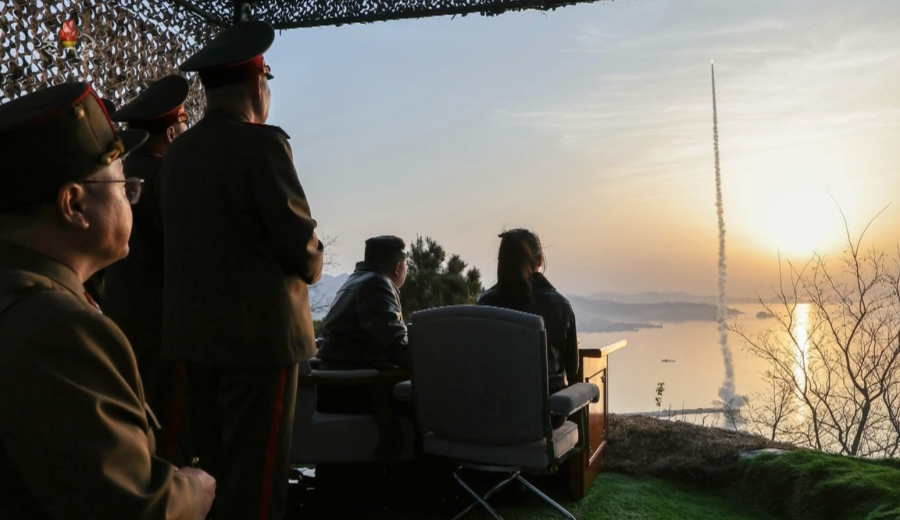
In mid-April, Kim Jong-un personally observed a weapons systems test aboard the destroyer Choe Hyon-class vessel and subsequently oversaw an artillery firing competition among artillery units to mark Kim Il-sung’s birth (the Day of the Sun). These activities illustrate North Korea’s parallel pursuit of naval capability expansion and modernization of conventional firepower.
If on-site guidance at a major shipyard in March and the public unveiling of a strategic nuclear submarine symbolically demonstrated Pyongyang’s commitment to strengthening naval capabilities, the April observation of the destroyer’s weapons test can be interpreted as a follow-up step linking these ambitions to operational deployment. Furthermore, Kim’s characterization of artillery capabilities as “the most important factor determining the outcome of war” suggests that North Korea is drawing strategic lessons from the prominent role of long-range artillery in the Russia–Ukraine war.
This prioritization of military affairs is also reflected in the pattern of Kim’s public activities. In March 2026, he conducted a total of nine public engagements, reflecting a relatively balanced distribution: four military-related events, one political event, and four economic and social activities.
In contrast, in April, although the total number of public appearances declined to approximately six, military-related activities remained at four, while economic and social engagements fell to just one. In other words, while overall activity declined, the proportion of military-related engagements increased significantly. This shift is interpreted as evidence that he has strategically concentrated attention on the military sector following the articulation of policy priorities through on-site guidance at economic and industrial facilities immediately after the March KWP Congress.
In the political domain, large-scale nationwide commemorative events were organized to mark the 114th Day of the Sun. Activities such as visits to the Kumsusan Palace of the Sun, celebratory gatherings involving youth and labor organizations, artistic performances, and sporting events demonstrate the regime’s continued reliance on leader-centric political rituals and institutionalized mechanisms for reproducing legitimacy. Notably, the simultaneous conduct of military drills and commemorative events suggests a dual objective: reinforcing internal cohesion while signaling external confidence in military capabilities.
In the economic sector, although Kim’s direct on-site guidance activities declined, North Korean state media continued to emphasize the priority of foundational industries, describing the metallurgical sector as the “eldest son industry.” At the same time, media reporting highlighted ongoing efforts to expand the production base, including flood control measures, the construction of greenhouse agricultural facilities and power plants, and land reclamation projects.
These developments do not necessarily indicate an improvement in economic conditions; rather, they suggest continued economic management through the concentration of limited resources on strategic industries and food production infrastructure. Accordingly, the reduction in Kim’s public economic engagements is better understood not as a weakening of economic governance, but as a transition to an implementation phase led primarily by Cabinet institutions and Party organizations.
Taken together, developments in April 2026 indicate that North Korea pursued both regime stability and external deterrence through the simultaneous operation of three core pillars: military technological advancement, internal political cohesion, and the maintenance of economic foundations.
From the perspective of international politics, this approach can be characterized as a combination of a “managed tension strategy” and a “selective governance strategy.” Rather than engaging in large-scale provocations, North Korea appears to be sustaining a calibrated level of tension through weapons testing and military exercises, while consolidating domestic control through commemorative politics and economic mobilization.
Looking ahead to May and beyond, North Korea is likely to pursue a combined approach that includes assessing agricultural productivity, generating localized economic outputs, and conducting low-intensity military demonstrations in response to shifts in the external security environment. In particular, factors such as ROK–U.S. joint military exercises, the trajectory of U.S.–China strategic competition, and the depth of North Korea–Russia cooperation are expected to serve as key variables shaping the scale and intensity of North Korea’s future military activities.
-
PREV [North Korea Inside]
-
NEXT [North Korea Inside]