

North Korean Trends
February 2026
- Power Realignment and Governance Stabilization
Ahead of the Ninth Party Congress -

Seung-hyun Lee
Ph.D in Public Administration
Research Fellow, SAND Institute
In February 2026, North Korea presented an outward appearance of relative stability. Beneath this surface, however, the regime appeared to be engaged in sustained political calibration and institutional preparation ahead of the Ninth Congress of the Workers’ Party of Korea (WPK). Patterns in Kim Jong-un’s public activities, the formal elevation of Kim Yo-jong, and the regime’s approach to military messaging and social control suggest deliberate strategy of power realignment and governance consolidation in the lead-up to the Congress.
Leadership Activity and Governance Priorities
Kim Jong-un conducted 11 publicly reported activities in February, representing an increase from the previous month. The substantive focus of these engagements, however, diverged from prior patterns. While routine military inspections and oversight of strategic weapons programs continued, the regime refrained from high-visibility provocations or major weapons tests targeting external audiences. Instead, greater emphasis was placed on Party organizational management, cadre supervision, and the reinforcement of ideological guidance.
This shift suggests that, in the run-up to the Ninth Party Congress, leadership priorities have moved away from performance-based signaling—such as demonstrations of military capability—and toward internal stabilization and system management.
Kim repeatedly framed the upcoming Party Congress not as a ceremonial political event, but as an inflection point for recalibrating the regime’s operational direction. His engagement in cadre consultations, ideological study sessions, and guidance to Party departments responsible for organization and propaganda appears designed to lay the institutional groundwork for potential post-Congress policy adjustments or personnel changes.
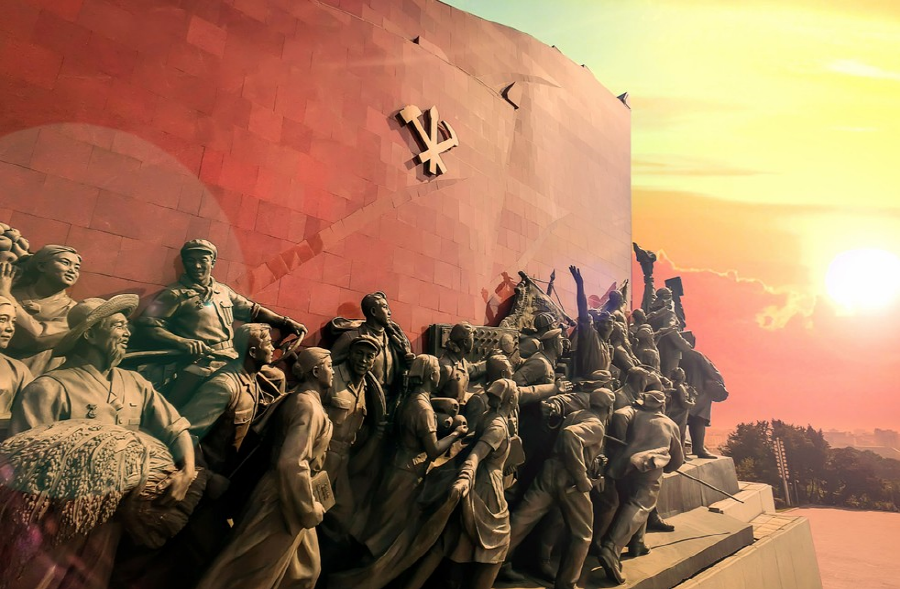
Political Mobilization and Ideological Emphasis
Throughout February, state media messaging centered overwhelmingly on preparations for the Ninth Party Congress. Official rhetoric emphasized themes such as “all-Party advance” and unity-driven transformation. Notably, coverage prioritized ideological discipline, organizational cohesion, and loyalty over economic performance or foreign policy accomplishments.
This messaging pattern likely reflects both structural constraints and political calculation. In the absence of demonstrable economic gains, the regime appears to have reverted to a traditional mobilization model—reinforcing internal cohesion through ideological consolidation rather than material achievement. Such an approach is consistent with past pre-Congress periods, during which political unity and discipline were foregrounded to ensure elite alignment.
Institutional Consolidation and Kim Yo-jong’s Appointment
One of the most consequential developments in February was the formal confirmation of Kim Yo-jong as Director of the General Administration Department of the WPK Central Committee. The department plays a central role in managing Party administration, finances, logistics, and internal coordination. Control of this portfolio confers significant influence over the Party’s operational infrastructure.
Kim Yo-jong’s appointment appears to signal further concentration of functional authority within the Kim family. While she has long exercised political influence, her assumption of a key administrative post suggests a deeper institutionalization of her role. More broadly, it indicates that Kim Jong-un is reinforcing regime durability by consolidating control over core Party mechanisms within trusted familial networks.
Military Posture and Managed Tension
In the military domain, North Korea maintained what can be characterized as a posture of managed tension. Publicized activities included inspections of strategic readiness, observation of tactical drills, and guidance visits to defense-industrial facilities. These actions appeared oriented toward verifying operational capability rather than signaling escalatory intent.
Although official statements condemned ROK–U.S. joint exercises and alleged South Korean drone incursions, Kim Jong-un himself largely refrained from direct rhetorical escalation. Instead, messaging was delegated to the Ministry of National Defense, the Ministry of Foreign Affairs, and Kim Yo-jong. This division of labor is consistent with North Korea’s established crisis management approach—maintaining deterrent signaling while preserving strategic flexibility and avoiding premature escalation.
The drone intrusion narrative, in particular, was framed around themes of sovereignty violation and the right of self-defense. Domestically, this messaging likely served to reinforce regime legitimacy and national cohesion ahead of the Party Congress by positioning the leadership as the defender of territorial integrity.
Socioeconomic Messaging and Mobilization
In the socioeconomic sphere, state messaging intensified around the theme of greeting the Party Congress with “achievements.” Reports on expanded Cabinet meetings and field inspections emphasized implementation of the annual economic plan and fulfillment of production targets. However, there was no acknowledgment of material shortages or structural economic constraints.
This asymmetry suggests that political mobilization synchronized with the Party calendar is currently being prioritized over substantive economic reform. Similarly, social-sector coverage emphasized ideological study, organizational life, and unity rather than improvements in household welfare. Such patterns are characteristic of the internal consolidation phase that often precedes major Party gatherings.
Kim Ju-ae’s continued public appearances, particularly at military-related events, also carry symbolic significance. Nevertheless, no formal title or institutional role has been conferred upon her. Her exposure is better understood as gradual narrative positioning aimed at long-term regime continuity rather than evidence of an imminent succession framework.
Assessment
Overall, February 2026 appears to have functioned as a preparatory phase ahead of the Ninth Party Congress. The regime avoided major external provocations while concentrating on internal alignment, personnel positioning, and ideological reinforcement. Kim Jong-un’s public engagements emphasized system management and the projection of symbolic authority, while the formalization of Kim Yo-jong’s administrative role points to continued consolidation within the ruling family.
Taken together, these developments suggest that the leadership sought to stabilize elite cohesion, secure military loyalty, and mobilize societal support in advance of potential post-Congress policy recalibration. Political and military activity in the months following the Congress may therefore reflect the outward manifestation of this internal restructuring process.
In this context, February can be characterized less as a period of inertia and more as a deliberate phase of controlled stabilization—a transitional moment preceding potential strategic shifts in North Korea’s domestic governance and external posture.
-
PREV [North Korea Inside]
-
NEXT [NK Focus]