


Analysis and Outlook on the Meaning of “Kim Jong-un’s Korea”

Lee Soo-seok
Professor (Special Appointment), Graduate School of Global Peace and Unification,
Kookmin University
The Emergence of “Kim Jong-un’s Korea”
Kim Jong-un ascended to power abruptly following the sudden death of his father, Kim Jong-il, in December 2011. From the outset, he engaged in symbolic politics designed to evoke nostalgia for his grandfather’s era, emulating Kim Il-sung’s image and style while carefully orchestrating continuity and renewal. Simultaneously, he dismantled the songun (“military-first”) policy that defined his father’s rule and convened two Party Congresses—an institutional practice entirely absent under Kim Jong-il.
From the mid-2010s, Kim Jong-un began to promote new ideological motifs such as “improving the people’s livelihood” and “love for the next generation,” signaling a generational transition. He gradually reduced direct references to Kim Il-sung and Kim Jong-il, except through the official doctrine of “Kimilsung-Kimjongilism,” thereby constructing a distinct political identity encapsulated in the notion of “Kim Jong-un’s Korea.”
At the Eighth Party Congress in 2021, the North Korean leadership formally declared the dawn of the Kim Jong-un era. Since then, the term “Kim Jong-un’s Korea” has appeared with increasing frequency in official discourse. Portraits of Kim Il-sung and Kim Jong-il have been partially withdrawn from public events, and nostalgia-driven imagery associated with the Kim Il-sung period has been noticeably curtailed.
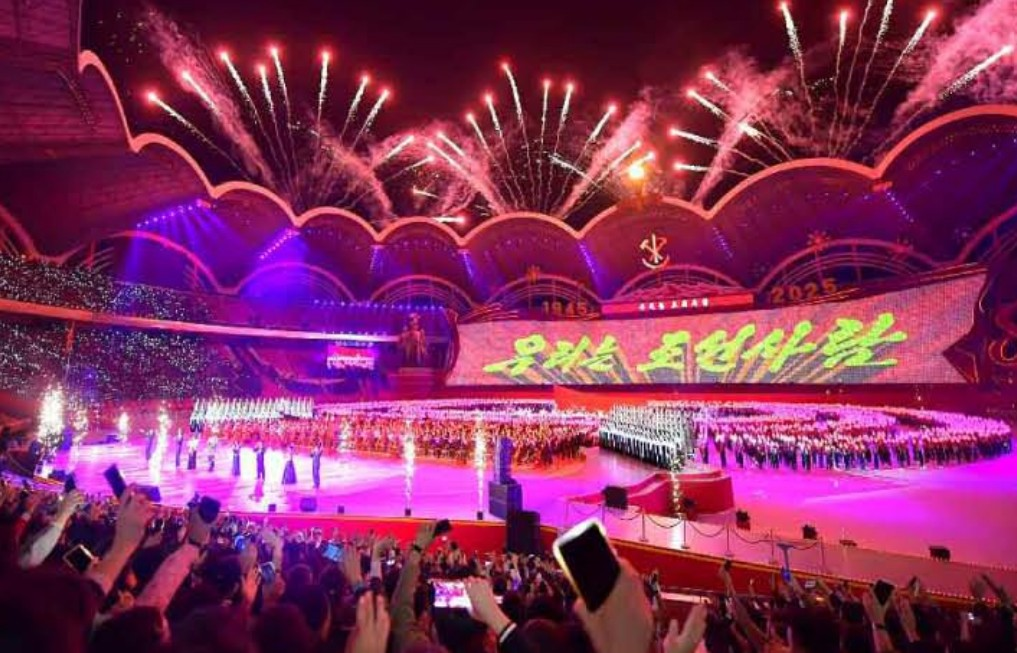
A striking example of this transformation was the mass gymnastics and artistic performance held in Pyongyang on October 9–10, 2025, which vividly illustrated the central themes of Kim Jong-un’s Korea. The production placed Kim Jong-un at its symbolic and aesthetic center, culminating in the grand finale proclaiming, “May Kim Jong-un’s Korea prosper forever.”
This performance underscored a definitive transition from “Kim Il-sung and Kim Jong-il’s Korea” to “Kim Jong-un’s Korea,” reflecting Kim’s determination to transcend the shadow of his predecessors and construct an autonomous political order bearing his own imprint.
The Meaning of “Kim Jong-un’s Korea”
The concept of “Kim Jong-un’s Korea” carries several layers of significance.
First, it signifies a projection of confidence—both domestic and international. Since consolidating power through systematic purges of elites linked to the Kim Jong-il era, Kim Jong-un has established unchallenged authority as supreme leader. Having secured his political foundation, he now feels less compelled to rely on the inherited legitimacy of his predecessors.
Initially, efforts to institutionalize “Kim Jong-un’s Korea” faced serious obstacles. The collapse of the economy and the social disruptions caused by the COVID-19 pandemic generated widespread discontent. This instability prompted a temporary reversion to ideological symbols of the Kim Il-sung era in the early 2020s. However, the recent large-scale leadership reshuffle and the regime’s renewed propaganda focus signal Pyongyang’s confidence that the Kim Il-sung–Kim Jong-il era has conclusively ended and the Kim Jong-un era has fully begun.
Second, Kim Jong-un’s Korea seeks to portray Kim as a benevolent and compassionate ruler. The discourse on “people-first politics” and improved livelihoods is rooted in economic stabilization—arguably the most tangible expression of leadership competence. In this narrative, Kim Jong-un presents himself as a paternal figure dedicated to enhancing the welfare of the masses. This political ethos is formally linked to Kimilsung-Kimjongilism, reinterpreted through the principle of “placing the people at the center.”
Third, Kim Jong-un’s Korea asserts the regime’s status as a nuclear-armed state. Through nuclear and missile tests, publicized visits to weapons facilities, and rhetorical reaffirmation of nuclear deterrence, Kim underscores his leadership’s technological and strategic accomplishments. Confidence in the completion of the country’s nuclear forces has emboldened Kim to promote an image of Kim Jong-un’s Korea as a proud and self-reliant nuclear power. This self-perception also reinforces the regime’s “two states theory,” which defines South Korea as a hostile, separate entity—no longer an object of national unification but a rival state.
Fourth, Kim Jong-un’s Korea provides an ideological and institutional foundation for legitimizing a potential fourth-generation succession. North Korea today functions not as a communist polity but as a dynastic state governed by the Kim family. The political architecture of Kim Jong-un’s Korea appears designed to pave the way for hereditary continuity—possibly through his daughter, Kim Ju-ae. Whether she will indeed emerge as the fourth-generation successor remains uncertain, but the regime’s consistent promotion of her public image suggests deliberate preparation for dynastic perpetuation.
Prospects for “Kim Jong-un’s Korea”
Looking ahead, the evolution of Kim Jong-un’s Korea will hinge on the consolidation of a political discourse that detaches itself from the aura of previous leaders. Just as Kim Il-sung was mythologized through constructs such as the “Sun Nation” and “the People of the Sun,” North Korea will likely intensify its idolization campaigns to institutionalize Kim Jong-un Thought and the Kim Jong-un Nation.
Future ideological narratives are expected to focus less on inherited legitimacy and more on intergenerational loyalty and succession, thereby normalizing the idea of a fourth-generation transfer of power. The state-controlled media will continue to proliferate editorials, essays, and artistic works celebrating Kim Jong-un’s Korea, reinforcing ideological cohesion and cultivating public devotion.
At the same time, Kim Jong-un’s Korea is inseparable from its nuclear posture. The regime’s domestic legitimacy and diplomatic strategy will remain anchored in its identity as a nuclear weapons state. Pyongyang will likely continue to pursue assertive, transactional diplomacy with Washington while simultaneously seeking to restore and deepen ties with Beijing and Moscow in order to mitigate the impact of international sanctions and secure economic and political support.
In this context, the Ninth Party Congress, scheduled for 2026, is expected to serve as a major political stage for the full-scale articulation and glorification of Kim Jong-un’s Korea. This event will likely mark a new phase in the institutionalization of Kim’s personalist rule and the consolidation of a post-Kim Jong-il North Korean political identity.
-
PREV [North Korea Inside]
-
NEXT [North Korea Inside]