

North Korea Inside
· North Korea Urgently Mobilizes Nuclear Weapons Research and Production Personnel, Accelerates Nuclear Material Production and Force Deployment
· Families of North Korean Soldiers Killed in Russia Reportedly Disappear Following Grievance Complaints
· Kim Jong-un as “Good Cop”? North Korea Orders Return of Forcibly Collected Funds
· Rodong Sinmun Highlights North Korea-China Relations Amid Limited Diplomatic Outcomes
Kim Myong-sung
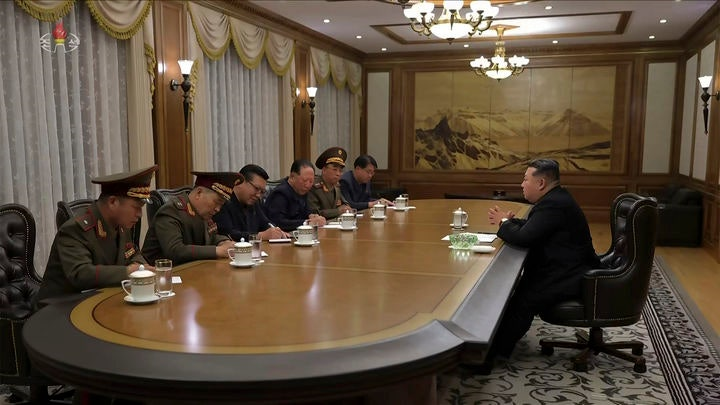
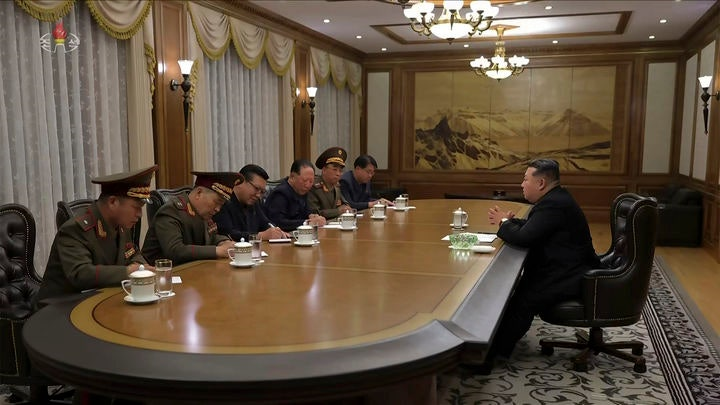
Kim Jong Un, Chairman of the State Affairs Commission of North Korea, met with scientists and technicians
in nuclear-related fields, including the Nuclear Weapons Research Institute, on the 26th and guided an important meeting
concerning nuclear material production and nuclear weapons production, according to a report by
Korean Central Television on the 27th. 2025.09.28./Photo=Korean Central Television capture
According to a Pyongyang-based source familiar with the situation, on August 28 the regime convened an all-hands meeting at the Nuclear Weapons Research Institute, bringing together researchers, engineers, and scientists. At this event, Chairman Kim’s letter was read aloud, commending the personnel’s contributions as “the solid foundation guaranteeing the nation’s security,” and simultaneously assigning new “combat tasks” for the months ahead.
The letter stressed that “raising the qualitative and quantitative levels of nuclear forces to new heights is not merely a technical choice but the most just path to safeguard Korea’s destiny,” underscoring Kim’s long-standing narrative that national stability rests on nuclear deterrence.
This message echoed Kim’s remarks of August 26, when he told nuclear scientists that “ensuring stability through strength, with nuclear forces at its core, is our absolute and unchanging position.”
The Party Committee overseeing the Institute outlined two immediate priorities: a rapid increase in fissile material production and an accelerated timetable for both tactical and strategic nuclear force deployment.
Following the announcement, the committee declared an “emergency training period” (late September through early December), requiring all departments to combine technical practice with ideological study sessions. Researchers were ordered to submit documented plans for implementation and report progress on a weekly basis.
The institute’s atmosphere has reportedly shifted to what sources described as a “wartime footing.” Personnel are now operating under extraordinary pressure, with expectations of round-the-clock work until year-end.
The Party Committee is said to be applying intense oversight, including direct evaluations during quarterly reviews, in order to test loyalty, strengthen ideological resolve, and accelerate progress in nuclear weapons research and production.
Recent reports indicate that families of North Korean soldiers killed in the Russia-Ukraine conflict have reportedly vanished without a trace shortly after lodging grievances with authorities. These incidents occurred in the aftermath of the second commendation ceremony honoring fallen personnel. Estimates suggest that approximately 2,000 North Korean soldiers deployed to the Russia-Ukraine war have died, with over 4,000 sustaining injuries.
North Korean authorities reportedly conferred the title of “Hero of the Republic” on some deceased soldiers and pledged special treatment for their families. However, simultaneously, authorities appear to have imposed strict controls over expressions of dissatisfaction or grievance.
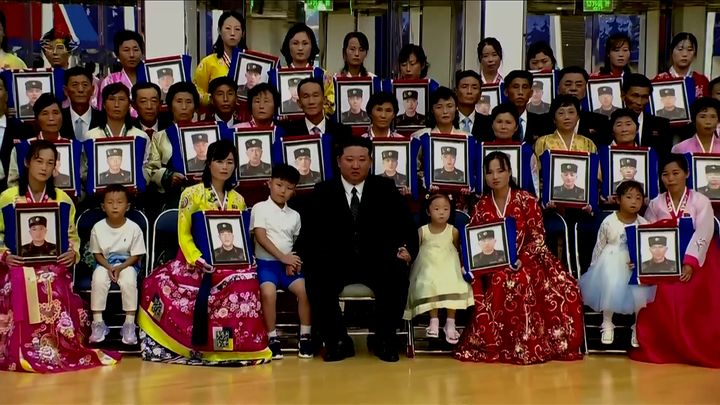
Kim Jong Un, Chairman of the State Affairs Commission of North Korea, met with the bereaved families of martyrs who
made outstanding contributions in overseas military operations at the Mulan Pavilion in Pyongyang on the 29th to offer
condolences, according to a report by Korean Central Television. 2025.08.30. /Photo=Korean Central Television capture
A source in Yanggang Province reported on September 24 that a family in Pochon County, including the father in his 50s, disappeared shortly after returning from the commendation ceremony for their eldest son, who had been posthumously recognized as a Republic Hero. Residents and local officials described the disappearance as sudden and deeply unsettling for the community.
The son, a member of the North Korean Army’s Storm Corps, was killed in action on the Ukrainian battlefield. The father, a work team leader at Gasan Farm, reportedly expressed outrage during a viewing of a commemorative documentary, criticizing the regime for sending his son to die abroad and rejecting relocation to Pyongyang as compensation. Witnesses reported that he vented his anger publicly, an act interpreted by authorities as slander against the Party and the state.
According to sources, the State Security Department subsequently conducted a nighttime raid on the family’s residence, removing the family without explanation while leaving household belongings behind. Local residents were reportedly ordered to clean up the property and received warnings against commenting on the incident.
The following day, in a gathering with residents and local officials, the State Security Department conducted coercive ideological instruction, framing the father’s actions as a severe affront to the Party and the state and asserting that the son’s heroic status did not mitigate the perceived offense.
Observers report that this incident has generated widespread fear among residents. As one source noted, “In a situation where even the family of a recognized hero can disappear overnight, public expression of dissatisfaction is effectively suppressed,” highlighting the climate of intimidation and control within North Korean society.
Kim Jong-un as “Good Cop”? North Korea Orders Return of Forcibly Collected Funds
Recent reports indicate that Kim Jong-un, Chairman of North Korea’s State Affairs Commission, has publicly criticized the regime’s forced fundraising practices and directed that improperly collected funds be returned to residents. Observers interpret this move as a political maneuver aimed at alleviating public discontent and mitigating the risk of unrest amid growing economic hardship and state exactions.
According to Rodong Sinmun (September 24), Chairman Kim reprimanded officials during a site inspection of the Pyongyang General Hospital, a project initiated five years ago but completed only seven months later. He criticized unauthorized design changes and the creation of ad hoc fundraising committees, describing these practices as “serious political issues” that violated state financial discipline. Reports indicate that full refunds were made to victims of illegal fundraising in December of the previous year.
Chairman Kim has also curtailed fundraising campaigns aimed at supporting families of soldiers deployed to Russia. In his policy address at the 13th session of the 14th Supreme People’s Assembly on September 21, he stated, “Supporting bereaved families is the state’s responsibility,” and ordered the return of donations to their original owners. While North Korean authorities claim that contributions were voluntary, sources familiar with the country describe the campaigns as effectively coercive.
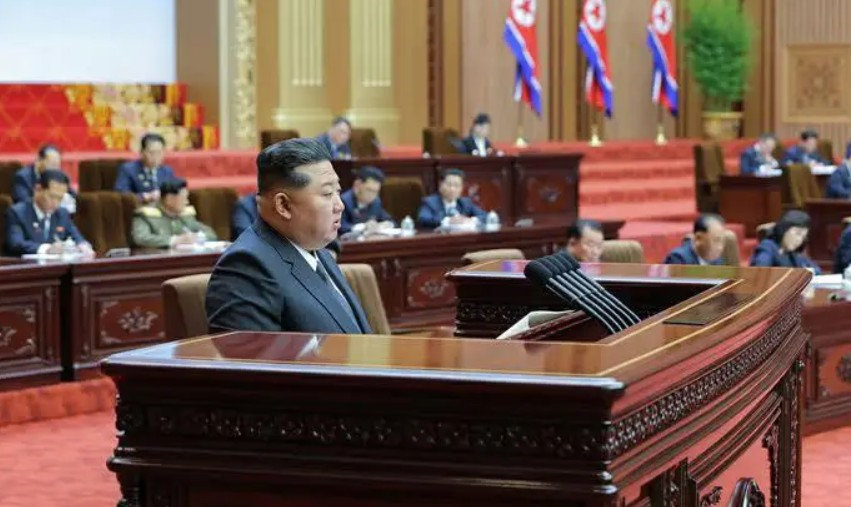
Kim Jong Un, Chairman of the State Affairs Commission of North Korea a speech at the 13th session of the 14th Supreme People's
Assembly held at the Mansudae Assembly Hall in Pyongyang on September 20-21. 2025.09.23/Photo: Korean Central Television
In agriculture, Chairman Kim emphasized a “farmers first” approach. He instructed officials not to withhold farm workers’ distribution shares or mismanage grain to meet state quotas, emphasizing that the rights and welfare of workers, as well as public sentiment, should take precedence over raw production figures. Analysts interpret this as an implicit acknowledgment of the dire conditions faced by rural populations, many of whom are reportedly on the brink of starvation.
Indeed, media outlets focused on North Korea report recent incidents of newborn abandonment due to economic hardship in South Hwanghae and South Hamgyong Provinces. Residents are said to be pleading that, “After paying what we owe to the state, we have nothing left and only accumulate debt,” reflecting widespread economic distress.
Observers note that Chairman Kim’s actions appear linked to broader structural pressures within North Korea. Since assuming power, Kim has simultaneously advanced large-scale construction projects—housing, industrial facilities, and infrastructure restoration—while relying heavily on residents’ contributions of funds and materials. This approach has reportedly generated widespread discontent and resentment.
Rodong Sinmun commentary on September 25 highlighted the perceived stakes, stating, “The moment the Party loses the people’s trust, its very existence becomes a thing of the past in history books,” and warned that coercion alone cannot secure public support. Officials were cautioned that authoritarian tendencies could undermine the Party’s popular foundation.
However, experts remain skeptical about the potential for lasting structural change. An official from a state-run research institute stated, “Chairman Kim Jong-un’s recent measures constitute political theater designed to placate public dissatisfaction and reinforce loyalty to the regime. Given the dependence of state construction projects on residents’ contributions, the likelihood of substantive change remains low.”
Rodong Sinmun Highlights North Korea-China Relations Amid Limited Diplomatic Outcomes
On October 1, North Korea’s state media published four China-related articles in a single day, emphasizing the “friendly relations” between Pyongyang and Beijing. While the coverage underscores the public display of diplomatic closeness, analysis suggests that substantive diplomatic achievements remain limited.
According to Rodong Sinmun, Chairman Kim Jong-un sent a congratulatory message to Chinese President Xi Jinping on the occasion of the 76th anniversary of the founding of the People’s Republic of China, reaffirming that “no matter how the international situation changes, we will deepen and develop North Korea-China friendship.” The same day, the newspaper reported that Foreign Minister Choe Son Hui returned to Pyongyang following a three-night, four-day visit to China.
Additional coverage highlighted a banquet hosted by the Korean Foreign Cultural Exchange Association and the Korea-China Friendship Association, which reportedly invited Chinese Embassy officials, as well as China’s launch of a small satellite from the Taiyuan Satellite Launch Center, showcasing Chinese technological achievements.
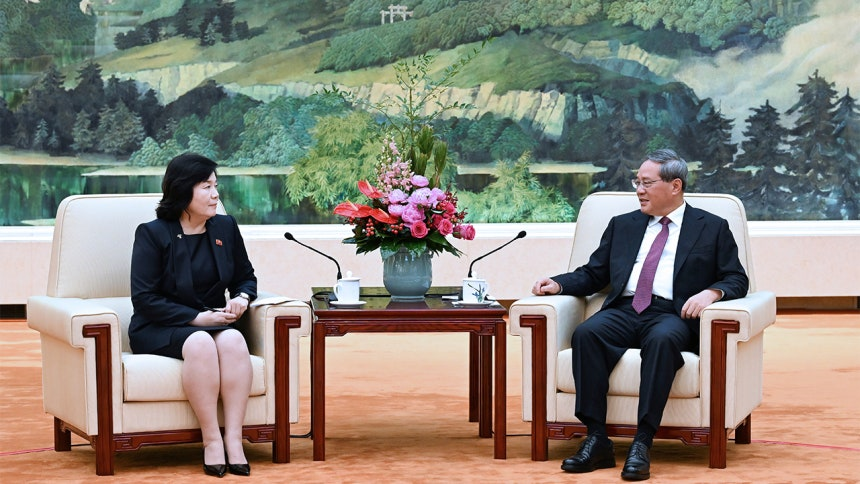
Choe Son Hui, North Korean Foreign Minister, met with Chinese Premier Li Qiang at the Great Hall of the People
in Beijing, China, on September 29./2025.09.30/Photo: Korean Central News Agency
Despite the concentrated media coverage, analysts note limited concrete outcomes. Although Foreign Minister Choe met with Premier Li Qiang and Foreign Minister Wang Yi, a proposed meeting with President Xi Jinping did not materialize. Chinese state media reported that Choe expressed support for Xi’s vision of a “community with a shared future for mankind” and other global initiatives; these references were omitted in North Korean reports.
Similarly, North Korean outlets did not mention discussions on China’s core interests regarding Taiwan, Xinjiang, or Tibet. This divergence highlights differences in communication strategy and possibly reflects North Korea’s intent to maintain flexibility in U.S.-DPRK engagement even while cooperating with China.
Observers also noted the presence of China’s Vice Foreign Minister responsible for border and maritime affairs at meetings with North Korean officials, suggesting discussions may have included issues related to East Sea access. While a summit-level meeting with Xi did not occur, North Korea emphasized “strengthened high-level exchanges” with Premier Li and through Foreign Ministry discussions, signaling the regime’s interest in maintaining visibility and signaling intent to Beijing.
Shortly after Choe’s return, satellite imagery and flight tracking data indicate that a large Chinese cargo aircraft landed in Pyongyang, offloaded multiple trucks of materials, and departed within four hours. While the exact contents remain unconfirmed, analysts suggest these may constitute either civilian commemorative goods or, less likely, specialized supplies, noting historical precedent for gift shipments coinciding with political anniversaries.
Finally, the Korean Central News Agency reported that Foreign Minister Choe sent a congratulatory message to Chinese Foreign Minister Wang Yi on the occasion of China’s National Day, emphasizing the “important mission” of diplomatic sectors in advancing traditional DPRK-China friendship in line with new-era demands.
In summary, while North Korea’s media output demonstrates a highly visible commitment to signaling closeness with China, concrete diplomatic achievements appear limited. Analysts interpret the coverage as part of a broader strategy to manage China relations while retaining flexibility for engagement with the United States.
-
PREV [News&Issue]
-
NEXT [NK Focus]