


North Korea’s Political Situation and Key Activities in January 2025
- Focus on Nuclear Provocations and the 20×10 Regional Development Policy -

Lee Seung-hyun
Research Fellow at SAND Institute
drharacearthur@gmail.com
Institutedrharacearthur@gmail.com
On December 31, 2024, Kim Jong un attended the New Year’s banquet in Pyongyang with his daughter, Kim Ju-ae, and watched a performance with a torch lighting and fireworks at midnight. In January 2025, he held 8 public activities, similar to the 9 in 2024. His focus remained on nuclear provocations abroad and regional development at home. On January 6, North Korea launched a medium-range hypersonic missile, attracting international attention. On January 28, Kim visited a nuclear facility and research center, declaring 2025 a pivotal year for strengthening nuclear capabilities.
Looking back at January 2025, it becomes clear that North Korea has yet to achieve the goals it set in 2024. In terms of foreign policy, specifically regarding nuclear weapons, the Biden administration continued to resist formally recognizing North Korea as a nuclear power. While North Korea has made internal adjustments, such as constitutional changes, these have had little external effect. This context likely explains Kim Jong Un's January 28 visit, where he declared 2025 as a pivotal year for strengthening nuclear capabilities.
Regarding domestic policy, North Korea's regional development efforts failed to improvement in the economy, as the effects of sanctions, the Russia-Ukraine war, and the Israel-Palestine conflict have led to restrictions on raw material imports. As a result, in January, North Korea continued to emphasize the "20×10 Regional Development Policy" and, on January 23, the Rodong Sinmun praised its progress. The newspaper described 2024 as a year when local people shed many tears and suffered, emphasizing that 2025 should be a victorious year for regional revival, marking the 80th anniversary of the Party’s founding.
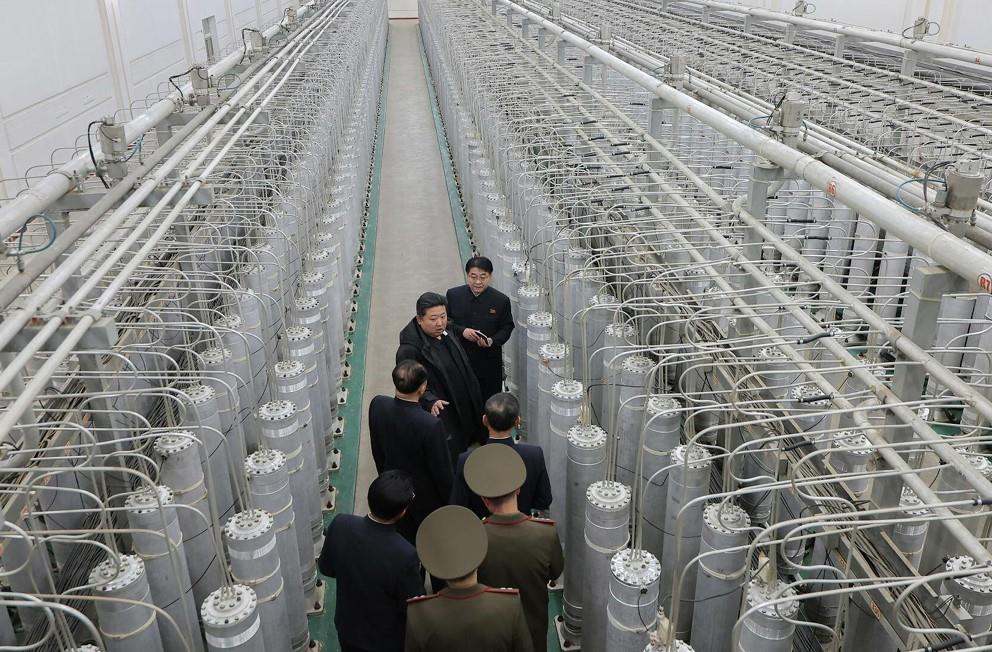
However, major issues remain with the internal and external policies North Korea emphasized last January. The success of its domestic policies depends on its foreign policy achievements. In other words, if its nuclear policy fails, regional development goals are also unlikely to succeed.
The current nuclear provocations are closely linked to its strategy of securing and expanding its “win-set” in the context of North-U.S. negotiations. To engage in talks, the U.S. must offer a level of guarantees in both the economic and military sectors that would ensure the stability of the North Korean regime.
If the "win-set" the U.S. offers falls short of North Korea’s expectations, the provocations are intended to sway U.S. public opinion in their favor. By showcasing missile launches and nuclear facilities, North Korea aims to expand its "win-set" ahead of negotiations, securing a more advantageous position for concrete gains.
North Korea’s nuclear weapons are seen as a symbolic tool to ensure the regime’s survival, with the goal of easing sanctions and recovering the country’s economy. With the start of Donald Trump’s second term, North Korea likely believed it could achieve these goals through a “top-down negotiation strategy.”
This was further reinforced when President Trump, on his first day in office, made remarks suggesting that he might recognize North Korea as a nuclear state, which seemed to align with North Korea’s intentions. Despite Trump’s outreach, Kim Jong un has responded with continued provocations, likely aiming to increase North Korea’s leverage in negotiations.
However, several factors complicate this strategy. One key element is the "win-set." In game theory, a "win-set" refers to the set of all agreements that can secure domestic approval. For North Korea, its "win-set" is all-or-nothing, dependent on Kim Jong Un's decisions. Conversely, the U.S. "win-set" can be influenced by its perception of the North Korean threat. This explains why provocations are inevitable as North Korea prepares for talks.
At the beginning of Trump’s second term, North Korea likely sought to provoke tensions in order to secure a summit with him and achieve either a "big deal" or a "small deal." However, North Korea seems to have miscalculated. While Trump initially made conciliatory gestures, White House spokesperson Brian H. stated on January 28 that, “like in his first term, Trump would pursue North Korea’s complete denuclearization”.
Ultimately, it’s more likely that the negotiations will follow the approach Trump prefers rather than North Korea’s, which could lead to a result similar to the 2019 Hanoi summit's "no deal." In the end, the U.S. win-set regarding North Korea is "complete denuclearization," though this win-set is closer to zero than 100. Therefore, negotiating with the Trump administration, which prioritizes "America First" and profit, makes it very difficult to reach an agreement.
North Korea's 20×10 Regional Development Policy has led to internal issues. From the start, this policy involved the regime abandoning the central planning of the socialist economy and shifting responsibility to the local regions. By delegating power to local party officials and holding them accountable for results, the policy relies solely on punishment without offering any incentives. As a result, it could lead to growing internal discontent and the potential for sporadic collective issues.
An example of this can be seen in the 30th Enlarged Meeting of the Secretariat of the Eighth Central Committee of the WPK held on Jan. 27. The Secretariat explained that the meeting was convened due to serious incidents in Nampo’s Oncheon County and Wonsan County, where party regulations were violated and privileges abused, severely infringing on the people’s dignity and rights.
As a result, this may appear to ordinary citizens as the central party's effort to root out corruption and implement Kim Jong un's people-centered policies. However, for local party officials, it could be seen as an unreasonable policy, placing an overwhelming burden on them with no incentives. This could lead to divisions between mid-level officials and the elite. Given the internal and external factors, the success of the 20×10 Regional Development Policy seems unlikely.
Overall, North Korea prioritized military expansion and closer ties with Russia while also facing economic and ideological challenges in January 2025. Through these efforts, it seeks to strengthen its military capabilities, drive economic growth, and reinforce internal unity while extending its global influence.
-
PREV [NK Focus]
-
NEXT [NK Focus]