


[NK Focus]
North Korean Trends in September 2026
Modernization of Defense Capabilities and Strengthened Ideological Control amid Rising Tensions along the DMZ

Seung-hyun Lee
Ph.D in Public Administration
Research Fellow SAND Research Institute
In September 2026, North Korea accelerated the modernization of its defense capabilities and strengthened its military-industrial production capacity while simultaneously intensifying ideological campaigns aimed at implementing the decisions of the 9th Congress of the Workers’ Party of Korea (WPK). Externally, Pyongyang expanded the material foundations of its strategic cooperation with Russia and reaffirmed its position as a nuclear-armed state. Domestically, it sought to reinforce regime cohesion through celebrations marking the founding of the North Korean state on September 9 and strengthened ideological and propaganda activities, including efforts in the education sector.
Toward the end of the month, military tensions along the inter-Korean border also increased as differences between North and South Korea became more pronounced over a landmine explosion in the Demilitarized Zone (DMZ) and North Korea’s efforts to fortify its border.
Taken together, the major trends observed in North Korea during September can be summarized as follows: ① an increase in the proportion of military-related activities among Kim Jong-un’s public appearances; ② a shift in the modernization of defense capabilities from weapons development toward production, testing, and operational employment; ③ intensified ideological work as an instrument of internal mobilization to implement Party Congress decisions; ④ an expansion of North Korea–Russia cooperation from symbolic political gestures to physical infrastructure; ⑤ greater emphasis on the achievements of the state and patriotism during the September 9 state-founding anniversary; and ⑥ the fortification of the border and heightened tensions in the DMZ and surrounding areas.
① Increase in Kim Jong-un’s Public Activities in the Military Sector
Kim Jong-un made nine public appearances in September, two more than the seven recorded in August. By sector, these activities consisted of three political, three military, zero economic, and three social events.
The composition of his public activities shifted noticeably from August. While social and cultural activities—including appearances involving the National Symphony Orchestra, Liberation Day commemorations, and acrobatic performances—featured prominently in August, September saw a greater emphasis on direct military activities. These included the commissioning ceremony for the destroyer Ganggeon, inspections of production conditions at military-industrial enterprises, and tests of new combat weapon systems.
The increased frequency of military-related activities suggests that the modernization of defense capabilities has become a more visible component of Kim Jong-un’s public agenda, alongside efforts to strengthen the industrial base supporting the armed forces.
② Modernization of Defense Capabilities: From “Weapons Development” to “Production and Operations”
A defining feature of North Korea’s military activities in September was the effort to connect military-industrial production more directly with weapons systems and operational capabilities.
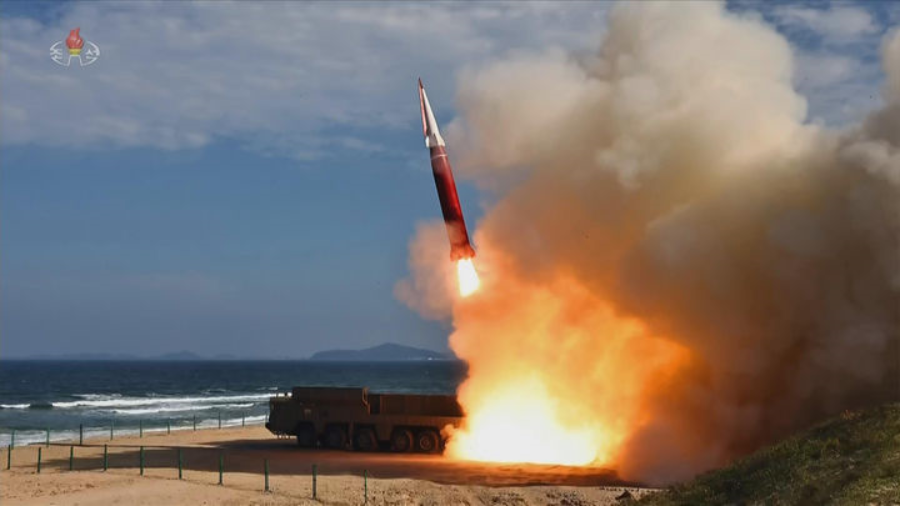
At the commissioning ceremony for the destroyer Ganggeon on September 6, Kim Jong-un emphasized the nuclearization of the navy and the diversification and practical application of nuclear deterrence. On September 12, a joint firepower exercise involving long-range artillery and missile systems demonstrated the integrated employment of multiple weapons systems, including attack drones, strategic cruise missiles, and tactical ballistic missiles.
From September 16 to 18, Kim Jong-un personally inspected production conditions at key defense-industrial enterprises. On September 20, he observed the testing of a new major combat weapon system. On September 24, North Korea also conducted test firings of upgraded 240mm guided multiple-launch rocket system rounds.
Taken together, these developments suggest a sequence extending from the reorganization of military leadership in late August to inspections of military-industrial production in September and subsequent testing of new weapons systems. This pattern indicates that North Korea’s defense modernization is moving beyond organizational restructuring and individual weapons development toward the more practical stages of production, testing, integration, and operational employment.
③ Strengthening Ideological Work: Internal Mobilization to Implement Party Congress Decisions
From September 18 to 21, Pyongyang hosted the Third Training Session for Propaganda Workers of the Workers’ Party of Korea. Kim Jong-un attended both the opening and closing sessions, emphasizing the importance of ideological work and calling for innovation in propaganda and agitation activities, improvements in the qualifications of propaganda personnel, and a stronger role for the Party’s Propaganda and Agitation Department.
This effort appears to go beyond the improvement of propaganda techniques. It points to a broader attempt to strengthen the internal mobilization system required to translate the policy objectives adopted at the 9th Party Congress into concrete implementation.
Viewed together with criticism raised at the August Enlarged Meeting of the Political Bureau concerning the limited policy implementation capacity of economic leadership bodies, the September developments suggest a growing emphasis on execution and implementation rather than simply establishing policy objectives in North Korea’s governance during the second half of the year.
④ North Korea–Russia Cooperation Expands from Symbolism to Infrastructure
On September 7, a new road bridge spanning the Tumen River and connecting North Korea and Russia was opened. While the existing railway bridge has served as the principal land-based connection between the two countries, the new road bridge provides an additional channel for the movement of vehicles, goods, and people.
Both sides have presented the project as a tangible manifestation of progress in their strategic cooperative relationship. Its significance extends beyond symbolism, as the bridge provides physical infrastructure that can support greater logistical and economic interaction between the two countries.
The development is also consistent with Kim Jong-un’s remarks in August during Liberation Day commemorations, when he highlighted the Soviet Army’s contribution to the defeat of Japan and emphasized the historical foundations of North Korea–Russia relations. Whereas August placed greater emphasis on the historical and revolutionary traditions underpinning bilateral relations, September saw those ties acquire a more concrete dimension through the development of transportation and logistics infrastructure.
⑤ September 9: Emphasis on the Achievements of the State and Patriotism
On September 9, marking the 78th anniversary of the founding of the Democratic People’s Republic of Korea (DPRK), North Korea held a flag-raising ceremony and a central oath-taking gathering. Kim Jong-un emphasized national pride, patriotism, and confidence in the country’s development.
The regime’s repeated use of these ceremonies, including similar events in 2025, underscores its effort to reinforce internal cohesion by linking individual responsibility to the state and the people with the defense of the socialist system and patriotic commitment.
It is also noteworthy that several developments in military affairs and external relations were publicized around the state-founding anniversary. The commissioning of the Ganggeon and the opening of the North Korea–Russia road bridge were presented as achievements associated with the country’s national development and state capacity. In this context, the regime appears to have used both military and external cooperation achievements to reinforce the narrative of national strength and institutional performance.
⑥ “Fortification of the Border” in the DMZ and Rising Tensions along the Inter-Korean Border
On September 21, three South Korean soldiers were injured in a landmine explosion in the western sector of the DMZ. During a subsequent joint investigation by South Korea and the United Nations Command (UNC), an anti-personnel landmine believed to be of North Korean origin was identified near the site of the incident. The South Korean military subsequently assessed it as highly likely that a North Korean landmine had caused the explosion.
The South Korean military called on North Korea to immediately halt such activities, issue an apology, and take responsible measures. The UNC determined that the relevant activities constituted a violation of the Korean Armistice Agreement.
North Korea, however, denied responsibility. In a statement issued on September 30, Kim Yo-jong described the installation of barriers and other obstacles along the border as part of North Korea’s effort to “fortify the border” and characterized such measures as an exercise of its sovereignty. She also warned that North Korean forces would respond immediately to any live-fire incident directed against them.
In this context, the most significant aspect of the recent developments in the DMZ may not be the landmine explosion alone, but rather the broader sequence of events: the strengthening of physical barriers along the border, increased activity near the Military Demarcation Line (MDL), the landmine incident, mutual accusations, and warnings of retaliation.
Going forward, sustained monitoring will be necessary to assess whether these developments contribute to a higher risk of unintended military encounters or localized clashes along the inter-Korean border.
Conclusion
An assessment of North Korea’s major activities in September indicates that the country continued to build on the policy priorities established in August, while moving those priorities into more concrete areas of implementation.
Whereas August placed greater emphasis on implementing the decisions of the Party Congress and reorganizing the military leadership as part of broader defense modernization, September saw these efforts extend into military-industrial production, weapons testing, operational integration, ideological mobilization, infrastructure development with Russia, and enhanced control of border areas.
Several developments stand out. First, North Korea’s defense modernization increasingly appears to involve not only the development of individual weapons systems but also the expansion of production capacity and the integration of those systems into operational concepts. Second, the strengthening of ideological and propaganda activities suggests that the regime is placing greater emphasis on mobilizing the population and administrative structures to implement Party decisions. Third, North Korea–Russia cooperation is taking on a more tangible dimension through transportation and logistics infrastructure. Finally, developments along the DMZ have introduced an additional source of military tension, particularly as North and South Korea have adopted conflicting positions over the landmine incident and North Korea’s border fortification measures.
Against this backdrop, monitoring in October should focus in particular on military activity and force posture along the inter-Korean border, the pace of North Korea’s military-industrial production and weapons testing, the implementation of Party Congress decisions, and the further development of North Korea–Russia strategic cooperation.
[NK Inside]
Kim Yo-jong Calls DMZ Landmine Incident a “Self-Staged Farce,” Warns of “Merciless” Retaliation if Live Fire Is Used
Kim Yo-jong, the sister of North Korean State Affairs Commission Chairman Kim Jong-un, has categorically rejected the South Korean military’s assessment that the explosion in the Demilitarized Zone (DMZ) was highly likely to have been caused by a landmine laid by North Korean forces. She also warned of “immediate and merciless retaliation” if South Korean forces were to open fire on North Korean troops.
The Korean Central News Agency reported on September 30 that Kim Yo-jong had issued a statement on September 29 titled “The Perpetrators of the Provocation Must Be Prepared to Pay the Price for Their Self-Inflicted Farce.”
In her statement, Kim claimed that the recent DMZ explosion was “a clear fabrication that closely resembles the ‘wooden box landmine incident’ that caused international concern about a decade ago, both in terms of its timing and the manner in which the alleged provocation was carried out.”
Earlier, on September 21, the South Korean Joint Chiefs of Staff released preliminary findings indicating that the DMZ explosion was highly likely to have been caused by a landmine laid by North Korean forces. The South Korean military stated that, if the investigation ultimately determines that the mine was placed by the North, it would take corresponding measures.
The 2015 landmine incident involved an explosion that South Korean military authorities determined was caused by a wooden-box landmine planted by North Korean forces south of the Military Demarcation Line (MDL). Two South Korean non-commissioned officers were seriously injured in the incident, prompting the South Korean military to resume loudspeaker broadcasts toward North Korea.
Kim Yo-jong repeatedly criticized the South Korean military’s preliminary findings, claiming that “South Korean armed forces are fabricating groundless conclusions and openly discussing the implementation of ‘appropriate and commensurate measures,’ thereby creating a pretext for political and military provocations against us.”
She continued, “How can we simply stand by and watch this absurd spectacle—where they step on a landmine of unknown origin and from an unknown location, detonate it, and then arbitrarily attribute responsibility to someone while claiming that it constitutes a clear violation of the Armistice Agreement?”

Kim specifically characterized the fortification activities currently being undertaken by North Korean forces along the border as “a legitimate exercise of sovereignty unrelated to military purposes.” She, in turn, accused South Korean forces of threatening the safety of North Korean soldiers through warning broadcasts and gunfire while alleging that North Korean troops had crossed the border.
She claimed, “This is a deliberate and premeditated attempt to construct a far-fetched narrative designed to shift responsibility for the escalation of tensions onto us,” adding, “Our soldiers have never crossed the border.”
She also issued a direct warning concerning the use of live ammunition by South Korean forces. Kim Yo-jong stated, “If even a single bullet lands on our territory, they must be prepared to face serious consequences,” and added, “If the South Korean armed forces fire live rounds—not warning shots—at our soldiers, our border units will respond with immediate and merciless retaliation.”
She continued, “Guidelines for responding to such circumstances have already been issued to the border defense units,” and stated that measures had been taken to reinforce tactical counterattack capabilities along the DMZ, particularly in areas facing the South Korean Army’s III Corps and 21st Infantry Division.
The statement appears to attribute responsibility for the DMZ landmine incident to South Korea while strongly objecting to the possibility that the South Korean military could take “corresponding measures” against North Korea.
Of particular concern is Kim Yo-jong’s explicit reference to South Korean live-fire activities as a potential trigger for retaliation, highlighting the risk of inadvertent military escalation or an accidental clash along the inter-Korean border.
Notably, however, her statement was not carried by domestic North Korean media outlets such as the Rodong Sinmun or the Korean Central Broadcasting Station, which are accessible to the North Korean public.
“Are You a Useless Presence or a Stumbling Block?” North Korea Pressures Officials to Deliver Economic Results
Amid persistent domestic and international challenges, North Korea continues to pressure Workers’ Party and government officials to deliver tangible results, urging them to overcome obstacles rather than wait for conditions to improve. In an article titled “Let Us Overcome Objective Factors,” published on September 28, the Rodong Sinmun stressed that officials should confront difficulties directly and take proactive measures rather than passively wait for circumstances to change. In a separate article published the same day, the newspaper called for the elimination of “irresponsibility, self-preservation, and hooliganism” among officials, while underscoring the importance of professional expertise and a stronger sense of responsibility.
The Rodong Sinmun stated that North Korea is “currently engaged in a truly arduous struggle,” acknowledging that “objective factors, including the challenges and obstacles confronting us, remain unfavorable.” Nevertheless, it argued that “we must not be constrained by objective factors or simply accommodate them; rather, we must proactively manage them and turn them to the advantage of the revolution.”
The demands placed on Party and government officials were particularly strong. The newspaper called on officials to “advance the revolution by proactively confronting and overcoming challenges rather than sitting idle and waiting for conditions and circumstances to improve.” It urged not only officials but also Party members and workers to devote their knowledge, capabilities, and commitment to achieving new objectives and overcoming difficulties.
On the same day, North Korea published a separate article titled “Let All Cadres Become Capable and Competent Revolutionary Talents,” effectively calling on officials to engage in systematic self-assessment, self-criticism, and professional development.
The Rodong Sinmun stated, “If officials—who bear responsibility for implementing Party decisions and for the success or failure of national development—fail to fulfill their duties in realizing the vision of the Party Central Committee, they cannot regard themselves as leaders of the revolution.”
The article specifically encouraged officials to ask themselves: “What is the true level of my qualifications and capabilities? Am I indispensable to my region, sector, and organization, and indeed to the revolution—or am I merely an unnecessary presence? Am I instead an obstacle whose absence would be preferable?”
The newspaper also emphasized the importance of professional expertise. Officials were instructed not only to master knowledge in their respective fields but also to acquire knowledge in related areas, as well as in science and technology; understand the broader national situation; and develop the capacity to formulate strategies for economic and social development. The ability to organize and mobilize the population was also identified as an essential quality of Party and government officials.
The newspaper instructed Party organizations to prioritize ideological education aimed at eliminating irresponsibility, self-preservation, and hooliganism among officials. It also called for stronger education and oversight through Party study sessions, organizational meetings, and reviews of Party activities. At the same time, officials were urged not to rely solely on past achievements or educational credentials but to continue studying international development trends, scientific advances, and technological developments.
An official at a state-run research institute assessed that “North Korea appears to be placing greater pressure on officials regarding performance and accountability as it seeks to achieve its national development objectives during the second half of the year.” The official added that “the continued criticism of officials appears intended to attribute shortcomings in policy implementation and economic performance to individual officials’ capabilities and attitudes, thereby increasing organizational pressure and discipline.”
-
PREV [NK Inside]
-
NEXT 다음 글이 없습니다.