

NK Inside
· Kim Jong-un Attends Circus Performance with Ju-ae and Visits Revolutionary Martyrs’ Cemetery on Liberation Day
· North Korea Calls U.S.–South Korea Exercises a “Grave Military Threat” Despite Trump’s Order to Scale Back
· ROK Unification Ministry Seeks to Reduce the “Language of Hostility,” Opens Public Debate on Inter-Korean Terminology and “Main Enemy” Designation

Myongsung Kim
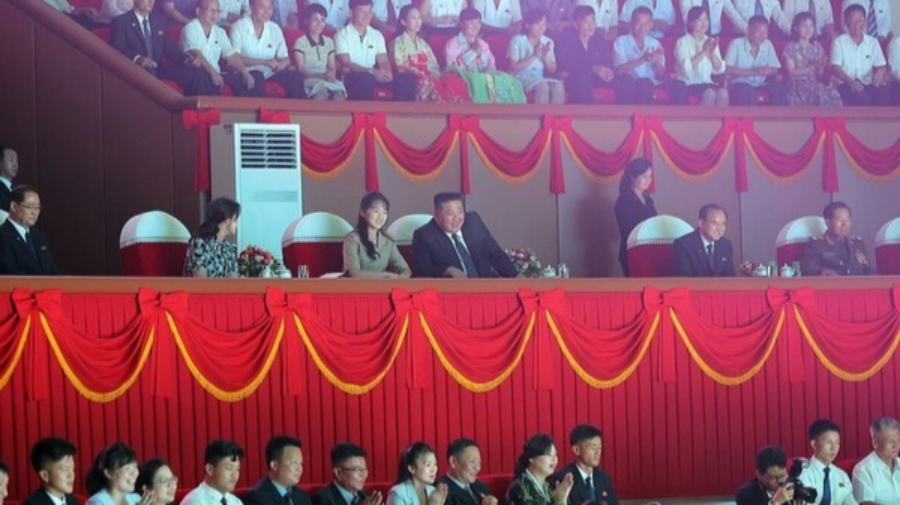
The Korean Central News Agency (KCNA) reported on August 17 that the “Comprehensive Acrobatic Performance Celebrating the 81st Anniversary of the Liberation of the Fatherland,” presented by the National Acrobatic Troupe, was held the previous day at the Pyongyang Acrobatic Theater, with Kim Jong-un in attendance.
The performance featured tightrope walking and aerial acrobatics that had received awards at international circus festivals. KCNA reported that Kim expressed satisfaction with the performers’ achievements and praised their contributions.
According to KCNA, Kim described the National Acrobatic Troupe as “a distinguished artistic ensemble” that has earned the affection of the North Korean people and brought honor and prestige to the country through its world-class acrobatic performances and more than seven decades of artistic activity.
Following the performance, Kim posed for a commemorative photograph with officials and performers from the National Acrobatic Troupe. Later that day, he attended a sports and cultural event featuring swimming and diving competitions and watched the events.
Kim was accompanied by his daughter, Ju-ae, and his wife, Ri Sol-ju. Photographs released by North Korean state media showed Ju-ae seated in the VIP section immediately beside Kim, occupying the central seat next to her father.
The event was also attended by senior North Korean officials, including Workers’ Party of Korea secretaries Jo Yong-won, Ri Il-hwan, Ju Chang-il, and Jong Kyong-thaek; Premier Pak Thae-song; Foreign Minister Choe Son-hui; Defense Minister No Kwang-chol; and Defense Ministry Adviser Pak Jong-chun.
Some analysts view Kim’s decision to bring Ju-ae to a high-profile public cultural and sporting event on Liberation Day as part of an ongoing effort to reinforce her public profile as a potential successor. The prominent placement of Ju-ae in official photographs—seated directly beside Kim in the central position—has also drawn attention as a possible indication that the regime continues to elevate her status within North Korea’s political elite.
On the eve of Liberation Day, Kim also paid tribute to anti-Japanese revolutionary martyrs and Soviet soldiers who died in combat. The sequence of commemorative activities appears intended to reinforce the regime’s historical legitimacy through the legacy of the anti-Japanese revolution while simultaneously portraying North Korea’s increasingly close relationship with Russia—particularly in the military, diplomatic, and economic spheres—as rooted in a shared historical “blood bond.”
According to Rodong Sinmun, the official newspaper of the Workers’ Party of Korea, Kim visited the Taesongsan Revolutionary Martyrs’ Cemetery in Pyongyang on August 14 to commemorate the 81st anniversary of liberation. The ceremony was attended by members of the Standing Committee of the Political Bureau of the Workers’ Party of Korea, as well as senior officials from the Party, government, and military; officials of the Presidium of the Supreme People’s Assembly; members of the Cabinet, committees, ministries, and other central institutions; and senior military commanders.
The same day, Kim visited the Liberation Tower in Pyongyang’s Moranbong District. The monument was erected to commemorate Soviet forces that entered northern Korea following Japan’s defeat in 1945 and has long served as a symbol of North Korea-Russia relations.
During the ceremony at the Liberation Tower, the Russian and North Korean national anthems were played in succession, and a wreath was laid in Kim’s name. The wreath carried the inscription, “We will never forget the exploits of the Soviet martyrs.”
Kim’s decision to pay tribute in succession to anti-Japanese revolutionary martyrs and Soviet soldiers on the occasion of Liberation Day appears to be an effort to link North Korea’s current military cooperation with Russia to its historical relationship with the Soviet Union, thereby reinforcing the regime’s narrative of the legitimacy and durability of the North Korea–Russia partnership.
The messaging is particularly significant given North Korea’s support for Russia’s war in Ukraine and the unprecedented expansion of bilateral military cooperation. By portraying the relationship as a “blood bond” that transcends narrower strategic interests, Kim appears to be framing North Korea–Russia solidarity as a long-term historical partnership rather than a transactional alignment driven solely by current geopolitical considerations.
Some analysts interpret this messaging as an effort to link the Soviet military’s historical role in the defeat of Japan to the contemporary North Korea–Russia relationship, thereby presenting the current partnership as part of a continuing historical legacy.
North Korea has warned about the South Korea–U.S. joint Ulchi Freedom Shield (UFS) exercise, stating that its “exercise of the right to self-defense to thoroughly neutralize the military threats posed by the enemies” will be demonstrated through “even more explicit actions.”
In a commentary released on August 19, KCNA stated that “it is necessary to respond to the increasingly evolving threatening actions of our enemies with evolved new forces.”
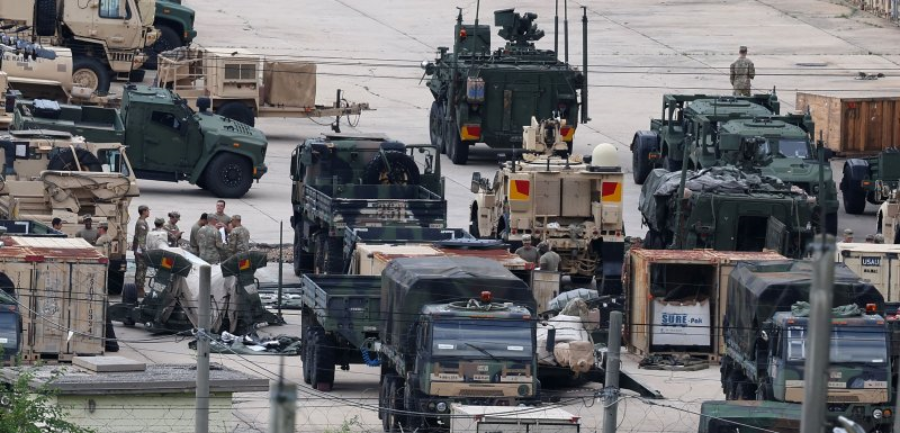
KCNA further warned that “enemies who infringe upon and threaten the sovereignty and security of the Democratic People’s Republic of Korea will remain within the crosshairs of annihilating retaliatory measures.” It added that “all aggressive war exercises conducted by hostile nations will ultimately fail to achieve the objectives pursued by their perpetrators.”
North Korea specifically criticized the content, format, and scale of this year’s UFS. KCNA described the exercise as undergoing an “increasingly dangerous evolution,” arguing that it differs from previous iterations in both scope and character.
Pyongyang also expressed particular concern over the participation of the United Nations Command (UNC), arguing that the UNC’s involvement represents “a full-scale effort to revive its combat capabilities and expand its role” and constitutes a development that “cannot be overlooked.”
North Korea further argued that the prolonged duration of UFS would contribute to a deterioration in security conditions on the Korean Peninsula. KCNA stated that the drills, which had continued for more than ten days, were pushing an already tense situation toward a “tipping point” for renewed conflict.
It warned that the “dangerous expansion and intensification” of the exercises would inevitably contribute to further deterioration of the security environment on the Korean Peninsula and in the broader Asia-Pacific region.
Notably, the commentary did not directly address U.S. President Donald Trump’s recent order to scale back certain South Korea–U.S. joint military exercises or the ongoing consultations between South Korean and U.S. military authorities on how to implement the directive.
Instead, North Korea repeatedly emphasized that it would strengthen its military response, characterizing UFS as an “aggressive war exercise” conducted by the United States and South Korea. Its statement that it would respond to “evolving threats with evolved new forces” appears to leave open the possibility of additional military signaling or demonstrations of force.
North Korea’s response is particularly noteworthy because it comes amid renewed discussion of the possibility of U.S.–North Korea dialogue, while South Korea and the United States continue to maintain their combined defense posture. Rather than immediately responding to signals suggesting a potential opening for diplomacy, Pyongyang appears intent on preserving military pressure by continuing to portray the allied exercises as a direct security threat.
The statement that North Korea will exercise its “right to self-defense” through “even more explicit actions” has prompted some analysts to caution that additional demonstrations of military capability—including missile launches—cannot be ruled out. The commentary, however, did not identify any specific weapons systems or announce a concrete operational plan.
North Korea has previously conducted military activities, including ballistic missile launches, around the time of major South Korea–U.S. military exercises, using the drills as justification for its own demonstrations of force. Whether Pyongyang will again use UFS as a pretext for military escalation remains to be seen.
ROK Unification Ministry Seeks to Reduce the “Language of Hostility,” Opens Public Debate on Inter-Korean Terminology and “Main Enemy” Designation
South Korea’s Ministry of Unification is launching an effort to reduce what it describes as the “language of hostility” embedded in South Korean society, with the stated goal of promoting mutual respect and peaceful coexistence between the two Koreas. The initiative includes public discussions on how the two Koreas refer to one another and whether to reconsider the use of the term “main enemy.” The ministry also plans to pursue the restoration of inter-Korean communication channels, including the Panmunjom liaison channel and military hotlines, as well as the restoration of the September 19 Comprehensive Military Agreement.
On August 15, the Ministry of Unification unveiled follow-up measures related to the three frameworks for peaceful coexistence on the Korean Peninsula—“inclusive peaceful coexistence,” “stable peaceful coexistence,” and “responsible peaceful coexistence”—presented by President Lee Jae-myung in his address commemorating the 81st anniversary of Liberation Day.
Speaking at the Liberation Day ceremony at the Sejong Center for the Performing Arts in Seoul, President Lee stated that South Korea would “embark on a journey to end the war and transform the unstable armistice regime on the Korean Peninsula into a peace regime,” reaffirming his commitment to pursuing peaceful coexistence.

The Ministry of Unification has decided to begin by addressing hostile perceptions, norms, and institutional practices that continue to shape inter-Korean relations, as part of its effort to advance “inclusive peaceful coexistence.”
As its first follow-up measure, the ministry plans to initiate “public discourse aimed at changing the language of hostility within our own society.” Key issues will include the terminology and titles used by the two Koreas when referring to one another, as well as whether the term “main enemy” should be reconsidered. The ministry plans to solicit views from across South Korean society before consulting with relevant government agencies on specific policy measures.
The government also plans to further develop the existing National Community Unification Formula to reflect changes in inter-Korean relations. A new implementation framework will be developed based on expert assessments, public consultations, and changes in the security and political environment surrounding the Korean Peninsula.
In the area of inter-Korean exchanges and cooperation, initiatives in healthcare, the Wonsan-Kalma tourism zone, a Seoul–Beijing high-speed rail connection, and cooperation related to the Greater Tumen Initiative (GTI) are expected to be developed as part of what the government describes as the “Four Major Peace Exchange” projects.
The government also plans to pursue measures designed to reduce military tensions and prevent accidental clashes between the two Koreas. The Ministry of Unification intends to propose dialogue with North Korea when appropriate to restore inter-Korean communication mechanisms, including channels at Panmunjom and military hotlines.
The government has also decided to develop specific plans and timelines for restoring the September 19 Comprehensive Military Agreement in consultation with relevant ministries. Signed by the two Koreas in 2018, the agreement includes measures designed to prevent accidental military clashes in border areas and reduce military tensions. The government views its restoration as a means of reestablishing a basic safety mechanism for managing military tensions between the two Koreas.
The government is also preparing initiatives for the peaceful use of border areas. These include establishing so-called “peace anchors” through projects such as the “Path of Peace” in the Demilitarized Zone (DMZ), the “DMZ Peace Link Train,” the designation of Peace Economy Special Zones, and the resumption of the Seoul–Wonsan rail line restoration project.
The government also plans to accelerate discussions on transitioning from the current armistice regime to a peace regime. Seoul intends to explain its vision for a peace regime on the Korean Peninsula to key countries and seek broader international support, while developing practical measures to halt the continued advancement of North Korea’s nuclear capabilities.
The approach is consistent with President Lee’s proposal in his Liberation Day address that the parties concerned should “set aside mutual threats and begin discussions to end this very long war.” President Lee also stated that inter-Korean dialogue could provide an opportunity to discuss “effective measures to halt the advancement of North Korea’s nuclear capabilities.”
The Ministry of Unification stated that, based on the President’s firm commitment to peaceful coexistence on the Korean Peninsula, it would work closely with relevant ministries, engage in broad public consultation, and move forward without delay with follow-up measures to implement the three major frameworks.
-
PREV [NK Inside]
-
NEXT NK Inside