

North Korea Inside
· North Korea Fires Missile, Warns Against “Wishful Thinking” and Dashes Hopes for Dialogue
· NIS Says Kim Ju-ae Is Kim Jong-un’s Successor, Citing Credible Intelligence
· Wang Yi’s North Korea Visit Signals Accelerating China–North Korea Rapprochement Ahead of U.S.-China Summit

Kim Myong-sung
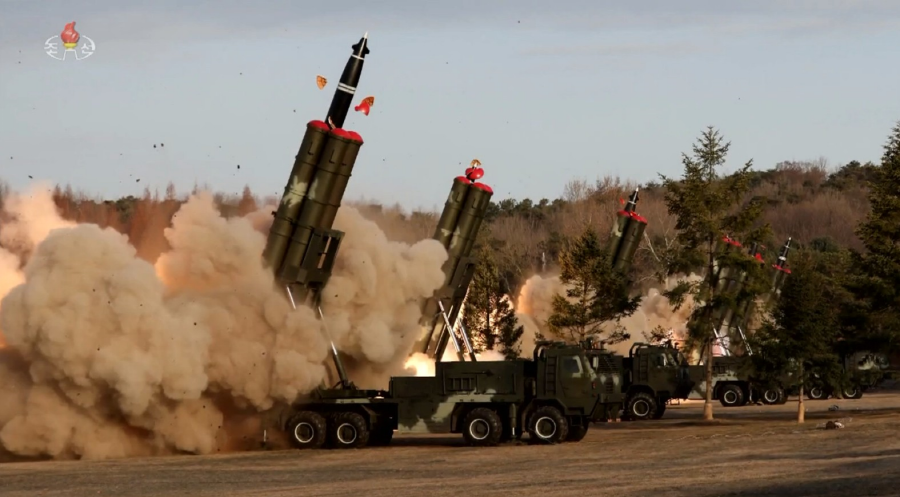
According to the South Korean Joint Chiefs of Staff on April 8, North Korea fired several short-range ballistic missiles from the Wonsan area at approximately 8:50 a.m. that day. The missiles flew roughly 240km before landing in the East Sea. Military authorities stated that South Korean and U.S. intelligence agencies are closely tracking launch patterns and sharing relevant information, and that precise specifications remain under detailed analysis.
This launch marks the second consecutive day of such activity. North Korea fired an unidentified projectile from the Pyongyang area the previous day, but it reportedly disappeared after showing signs of malfunction early in its flight. Military sources assess that there is a high likelihood that the projectile was also a ballistic missile. Consequently, speculation has emerged that North Korea may have carried out consecutive launches to compensate for the failed test.
Some analysts assess that North Korea may have tested the high-thrust solid-fuel engine it recently unveiled, or that this may have been a test of a new projectile incorporating that engine. There is also speculation that the test could be linked to intercontinental ballistic missile (ICBM) technology or involve performance enhancements to multiple rocket launchers intended for use against South Korea.
The South Korean government responded immediately. The National Security Office convened an emergency security review meeting and instructed the military to further strengthen its readiness posture. It also urged North Korea to cease such launches, emphasizing that they constitute violations of United Nations Security Council resolutions.
In parallel with its military actions, North Korea issued a strongly worded message directed at the South. In a speech delivered the previous day, a senior official responsible for inter-Korean affairs described South Korea as “the most hostile state” and sharply criticized Seoul’s interpretation as “wishful thinking.”
This stands in contrast to the relatively restrained assessment previously offered by Kim Yo-jong, Director of the General Affairs Department of the Workers’ Party, regarding President Lee’s expression of regret. At the time, North Korea described it as a “wise move,” signaling a limited but notable degree of receptivity. The South Korean government likewise interpreted this as an indirect indication of mutual intent between the two Koreas and attached significance to it.
However, with a hardline statement and missile launches following within half a day, North Korea is widely seen as having effectively ruled out the possibility of improved relations and clearly demonstrated its intention to maintain the existing posture of “two hostile states.”
Experts assess that, rather than fully foreclosing the possibility of dialogue, North Korea is pursuing a strategy aimed at securing leverage in potential negotiations through calibrated military pressure. The objective appears to be to assert its position through demonstrable actions—namely, military displays—while continuing to advance its nuclear and missile capabilities.
Against this backdrop, it is difficult to rule out the possibility of further provocations by North Korea. In particular, if testing of new weapons systems continue, tensions on the Korean Peninsula are likely to remain elevated in the near term.
Nevertheless, the South Korean government maintains its existing policy stance toward North Korea. The Presidential Office stated the same day, “We will continue our efforts toward peaceful coexistence on the Korean Peninsula based on mutual respect,” adding that it “expects the North to respond accordingly.” It further noted that “criticism and inflammatory rhetoric do not contribute to stability on the Korean Peninsula.”
On April 6, South Korea’s National Intelligence Service (NIS) assessed Kim Ju-ae, the daughter of North Korean State Affairs Commission Chairman Kim Jong-un, as his designated successor. This marks an upgrade from its earlier assessment that she was undergoing succession grooming. Since first appearing publicly in November 2022, Kim Ju-ae is believed to have steadily consolidated her position over the past three years and effectively attained successor status.
Park Seon-won of the Democratic Party of Korea and Lee Seong-kwon of the People Power Party, the respective party coordinators for the National Assembly’s Intelligence Committee, said the NIS delivered a closed-door briefing to the committee on April 6 covering these issues, including developments in the Middle East and matters related to North Korea.
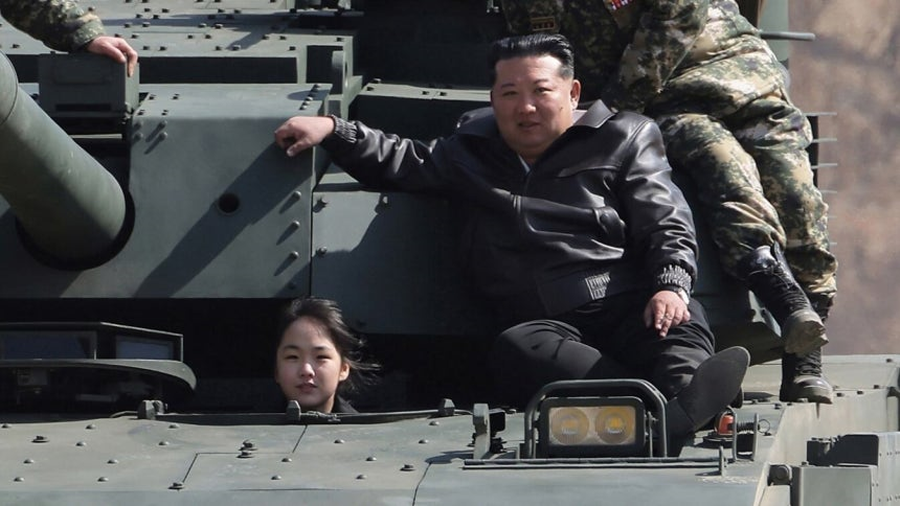
According to Rep. Park, NIS Director Lee Jong-seok stated, in response to a question from committee members about whether Kim Ju-ae should be viewed as the successor, that “it is reasonable to do so.” In response to a follow-up question regarding the credibility of the assessment, Director Lee reportedly added that “this judgment is based not merely on circumstantial indicators but on credible intelligence.”
The NIS further noted that, by staging imagery of Kim Ju-ae driving a tank—evoking Kim Jong-un’s own trajectory as heir apparent—the regime appears intent on highlighting her military credentials. It characterized this as a strategic effort to mitigate skepticism surrounding a female successor and to accelerate the construction of a succession narrative.
The NIS further assessed that North Korea is seeking to widen its diplomatic maneuvering space by deliberately distancing itself from Iran, traditionally aligned with the anti-U.S. camp, in the aftermath of the Middle East conflict. It noted that, following U.S. and Israeli strikes on Iran, Pyongyang has refrained from providing military or material support and has shown symbolic restraint, including by withholding condolence or congratulatory messages in response to leadership changes in Tehran.
In this context, Rep. Park stated that the NIS views these developments as potential preparatory steps designed to secure new diplomatic space in the aftermath of the anticipated U.S.-China summit in May.
The NIS also disclosed that, upon reviewing the revised Workers’ Party charter from June 2024, it confirmed the deletion of phrases such as “northern half of the republic” and “united front.” Rep. Lee noted that this indicates the “two hostile states” policy has already been substantially reflected in legal and institutional frameworks. However, the NIS added that it has not confirmed whether this doctrine has been formally codified into law, leaving open the question of whether it has been incorporated into the North Korean Constitution.
Wang Yi’s North Korea Visit Signals Accelerating China–North Korea Rapprochement Ahead of U.S.-China Summit
Chinese Foreign Minister Wang Yi will visit North Korea for a two-day trip beginning on April 9. Against the backdrop of clear signs of recovering North Korea–China relations—including the recent resumption of rail and air links—the visit is being interpreted by some as a carefully calibrated diplomatic move ahead of the upcoming U.S.-China summit and the possibility of renewed North Korea–U.S. engagement.
North Korea’s Korean Central News Agency reported on the 8th that “at the invitation of the Ministry of Foreign Affairs, Comrade Wang Yi, a member of the Political Bureau of the CPC Central Committee and Minister of Foreign Affairs, will visit our country from April 9 to 10.” Minister Wang’s visit comes as high-level exchanges between North Korea and China continue to regain momentum.
Recently, North Korea and China have accelerated the restoration of bilateral exchanges through the successive resumption of rail and air links. There is a growing view that relations between the two countries, which had remained stagnant for an extended period following the COVID-19 pandemic, have now entered a phase of substantive recovery.
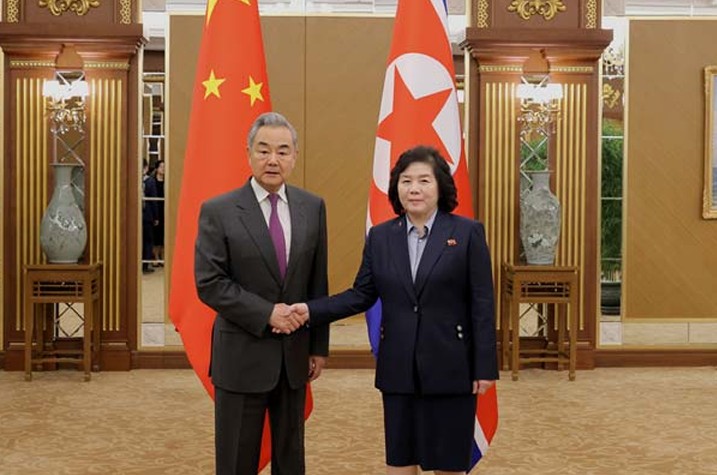
This trend is also evident in political exchanges. Last month, the Chinese leadership sent congratulatory messages to high-ranking officials elected at North Korea’s Supreme People’s Assembly, underscoring the importance of strengthening bilateral ties.
The Chairman of the Standing Committee of the National People’s Congress conveyed a message to his North Korean counterpart expressing a willingness to expand inter-parliamentary exchanges and cooperation, while the Premier of the State Council likewise extended congratulations to his North Korean counterpart, emphasizing the advancement of traditional friendly relations.
Messages at the foreign minister level also followed. In a congratulatory message addressed to North Korea’s foreign minister, Minister Wang expressed his intention to enhance communication and coordination between the two countries’ diplomatic establishments.
President Xi Jinping similarly sent a message congratulating Chairman Kim Jong-un on his re-election, reaffirming the continued development of bilateral relations. This series of “relay congratulatory messages” is widely interpreted as reflecting Beijing’s intention to manage North Korea–China relations in a stable and controlled manner.
Against this backdrop, Minister Wang’s visit to North Korea is attracting heightened attention as it coincides with an evolving international landscape. In particular, U.S. President Donald Trump is expected to visit China in mid-May for a summit with President Xi Jinping, raising the possibility of subsequent engagement between North Korea and the United States.
Accordingly, there is growing speculation that, during his visit, Minister Wang may engage in close coordination with his North Korean counterparts on key issues, including developments on the Korean Peninsula, and may convey messages related to the forthcoming U.S.–China summit and potential U.S.–North Korea diplomatic engagement. In particular, given the uncertainty surrounding the resumption of U.S.–North Korea dialogue, attention is focused on whether China will seek to assume a mediating or coordinating role.
Overall, the visit is widely viewed as a move aimed not only at restoring North Korea–China relations but also at reaffirming Beijing’s influence amid the shifting diplomatic dynamics surrounding the Korean Peninsula.
-
PREV [North Korea Inside]
-
NEXT [NK Focus]