

Trends in North Korea: January 2026
- Regime Preparations for the New Year Period
and the Ninth Party Congress -

Lee Seung-hyun
Ph.D in Public Administration
Research Fellow, SAND Institute
In January 2026, North Korea continued regime management activities across the political, military, social, and economic spheres, maintaining a relatively restrained outward posture to mark the New Year. Political, military, and social developments during the month unfolded within the dual context of preparations for the upcoming Ninth Party Congress and the New Year period.
Chairman Kim Jong Un’s public activities and sectoral reports were organized around the themes of “summarizing” past performance and “implementing decisions” from the outset of the year, emphasizing symbolism and strategic messaging. At the same time, North Korea reiterated its external threat narrative by alleging a South Korean drone incursion—an effort that can be interpreted as part of broader regime management and internal cohesion-building measures ahead of the Workers’ Party Congress.
Kim Jong Un attended a New Year celebration event on January 1, where he took commemorative photographs with Workers’ Party, government, and military officials. North Korean state media repeatedly employed the phrase, “Let us unite as one around the Party Central Committee to achieve new victories,” while emphasizing themes such as “unity of mind,” “conviction,” and “confidence.”
This messaging highlighted the final-stage implementation of decisions adopted at the Eighth Party Congress and reinforced political cohesion in advance of the next party congress. The choice to emphasize this symbolic gesture instead of a New Year’s address can be interpreted as an effort to convey the leader’s message in a deliberately restrained and carefully managed manner ahead of the Ninth Party Congress.
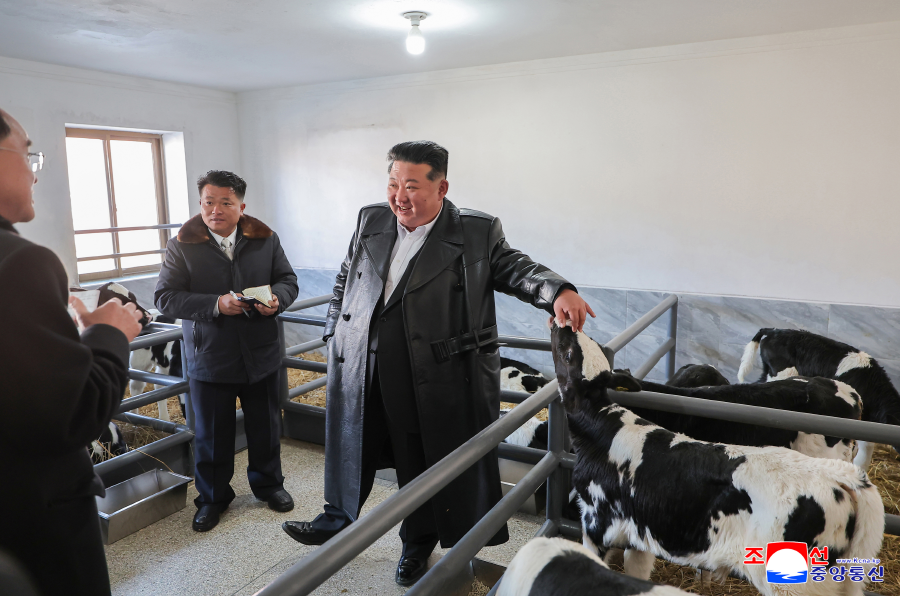
Concurrently, in late January, Kim Jong Un inspected the implementation status of key departments of the Party Central Committee, stressing that “Party decisions must be implemented without the slightest deviation.” This move can be interpreted as an effort to consolidate the collective achievements of the Workers’ Party ahead of its Ninth Congress and to reaffirm responsibility and discipline across the organization.
Rodong Sinmun and the Korean Central News Agency likewise framed sectoral activities from the outset of the year as a “struggle to greet the party congress with glorious achievements,” underscoring the regime’s emphasis on fostering a mobilized political atmosphere.
Meanwhile, in January, North Korea issued strong condemnations, claiming that South Korean drones had infiltrated its airspace. State media, along with statements from the military and the Ministry of Foreign Affairs, characterized the alleged incident as a “violation of sovereignty” and a “military provocation,” thereby underscoring the regime’s asserted legitimacy for countermeasures.
This claim appears aimed not only at establishing a military narrative but also at heightening internal tension by emphasizing external threats. North Korea’s allegations of drone incursions therefore extend beyond immediate security concerns, fitting into the recurring “external hostile forces–internal unity” narrative commonly employed during preparations for the Ninth Party Congresses.
Rodong Sinmun and the Korean Central News Agency used the incident to stress the “severity of the security environment” and the “necessity of defending the revolutionary stronghold,” thereby reinforcing regime messaging designed to unite the Party, the military, and the populace around a single political objective. In essence, the security threat narrative functions as a political instrument to mitigate the effects of economic hardship and social fatigue.
In the military sphere, strategic weapons tests and on-site guidance of the military-industrial sector continued; however, these activities appeared focused more on inspecting existing capabilities and sustaining deterrence than on generating external provocation. Such military activities can also be interpreted as elements of broader regime stability management ahead of the Party Congress, reflecting an intent to incorporate military achievements into its overarching political narrative.
The preparatory tone for the Ninth Party Congress was also evident across the social and economic sectors. Reports on agriculture, local industry, and education repeatedly employed phrases such as “upholding the Party’s decisions” and “responsibly conducting the final settlement.”
Coverage of residential move-in ceremonies and production encouragement campaigns emphasized the stability of livelihoods and the normalcy of the system. This reflects a characteristic reporting strategy that downplays explicit references to economic difficulties while foregrounding achievements and social stability in advance of the Party Congress.
Overall, January 2026 can be assessed as the point at which North Korea fully entered the preparatory phase for the Ninth Party Congress. During the New Year period, the regime prioritized system stability and control over abrupt policy shifts or overt provocations. Kim Jong Un’s public activities combined New Year symbolism with reinforced Party discipline, linking restrained leadership appearances, Party-centered review and implementation efforts, and the security threat narrative exemplified by the alleged South Korean drone incursion.
Politically and diplomatically, North Korea largely reiterated existing positions through working-level engagements, while in the military sphere, activities remained focused on sustaining deterrence and inspecting combat readiness rather than pursuing escalation.
In the socio-economic sphere, North Korea sought to reinforce internal cohesion by emphasizing livelihood stability and highlighting achievements. This approach reflects the regime’s typical pattern of recalibrating its governing foundations at the beginning of the year while simultaneously preparing for forthcoming political schedules and shifts in the external environment.
Across the political, military, and social domains, the unifying theme of “solidarity and unity” was consistently emphasized. Taken together, these patterns suggest that preparatory groundwork is underway to politically consolidate past achievements through the upcoming Party Congress and to frame a new mid- to long-term policy direction.
-
PREV [North Korea Inside]
-
NEXT [North Korea Inside]