

Strengthened North Korea–Russia Military Cooperation
and North Korea’s ICBM Engine Test
- South Korea’s Strategic Response to Accelerated Missile Development
and Satellite Launch Preparations -

Lee Seung-hyun
Ph.D in Public Administration (Research Fellow at the SAND Institute)
Since launching Kwangmyongsong-1 in 1998, North Korea has steadily built its satellite launch capacity. After testing the Hwasong-14 and -15 ICBMs in 2017, proving its reach to the U.S., it adopted a strategy pairing ICBMs with reconnaissance satellites. The Hwasong-17 (liquid-fueled) appeared in 2023, followed by the solid-fueled Hwasong-18 in 2024. In October 2024, it unveiled the Hwasong-19, a solid-fueled ICBM on an 11-axle TEL, boasting record range and payload. Early 2025 saw a test of the Hwasong-16B, a hypersonic IRBM exceeding Mach 10.
The DIA’s 2025 threat report now estimates North Korea may operate “dozens” of ICBMs. Since Malligyong-1’s successful orbit in November 2023, at least three more satellite launch attempts have followed, with Chinese and Russian support likely aiding gradual improvements in resolution and data transmission. Still, the image quality lags behind commercial systems like Google Earth, limiting military use. While ICBM reentry proof remains scarce, agencies like the CIA suggest warhead protection during reentry may now be feasible—indicating technical progress.
Since early 2025, there has been mounting evidence that North Korea has obtained advanced satellite navigation, imaging analysis systems, and missile launch design know-how through deeper military collaboration with Russia. These transfers appear to be boosting the accuracy and real-time monitoring capacity of Pyongyang’s reconnaissance satellite program.
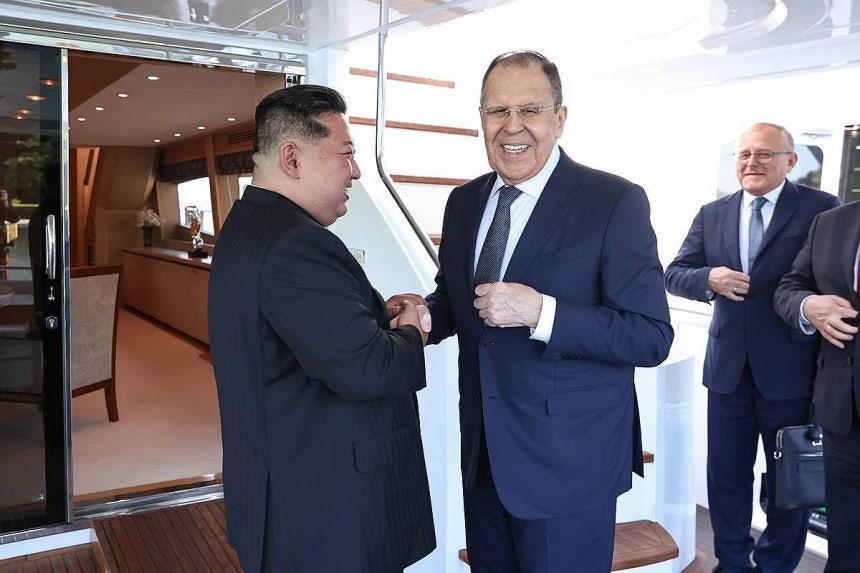
Their bilateral cooperation has moved beyond simple weapons trade to a strategic, symbiotic relationship. From late 2024, North Korea supplied Russia with thousands of artillery rounds, and by 2025, reportedly deployed several thousand troops to the Ukrainian battlefield. In return, Russia has delivered technologies ranging from cutting-edge radar systems and satellite navigation tools to AI-enabled surveillance gear and suicide drones. The sighting of modified Il-76 aircraft equipped with radar domes—typically used in airborne early warning—further points to high-level support from the Russian Air Force.
U.S. and South Korean intelligence agencies have classified these technology transfers not as mere exchanges, but as strategic cooperation, with analyses indicating visible improvements in North Korea’s reconnaissance satellite systems and ICBM guidance accuracy. Russia, using its UN Security Council seat, has shielded Pyongyang from sanctions, granting it political and military breathing room. In response, South Korea, the U.S., and Japan have strengthened security coordination. July 2025 saw a joint aerial drill featuring a U.S. B-52H, along with serious talks on building a unified missile warning and response system.
On July 3, marking Strategic Forces Day, North Korea announced its military goals for the year: completing its ICBM system with miniaturized nuclear warheads, deploying operational satellite tech, and fielding hypersonic ballistic missiles. These declarations reflect the leadership’s clear strategic commitment.
North Korea often schedules ICBM launches around key national dates like the October founding day, April’s Labor Day, or July’s Strategic Forces Day. Since successfully placing a reconnaissance satellite into orbit in November 2023, it has attempted at least one satellite launch annually, making another likely soon—even after setbacks. Combined with its coordination with Russia and the Ukrainian front, there’s growing evidence of planned ICBM and satellite launches in late 2025.
Amid these developments, South Korea must take a pragmatic, forward-looking defense approach. First, it should continue upgrading its Kill Chain, KAMD, and KMPR systems, with particular focus on AI-driven detection and space- and radar-based early warning to counter ICBM reentry. Second, to close surveillance gaps, South Korea needs to rapidly enhance its tactical ISR assets—such as drones and reconnaissance satellites—and formalize real-time intelligence sharing with the U.S. and Japan.
Third, South Korea’s diplomacy should extend beyond traditional allies to include the EU, Australia, and other strategic partners in forming a broader coalition to isolate North Korea and counter Russia’s illicit tech transfers—supported by a “sanctions normalization” plan to bypass Moscow’s UN veto. Fourth, it must strengthen cybersecurity and space defense, while boosting domestic defense tech and international cooperation to respond to cyber and space-related threats. Finally, legal and institutional reforms are needed to unify sanctions and response systems across the rapidly advancing nuclear, missile, and space domains.
In summary, North Korea has bartered military support in Ukraine for access to Russian space and missile technology. Between January and July 2025, it has advanced its ICBM and satellite programs and is preparing further provocations. This shift marks a new phase where its nuclear threat is underpinned by technological alliances—underscoring the need for tighter deterrence through South Korea–U.S.–Japan cooperation and broader global engagement.