

North Korea’s Mid-to-Long-Term Military Buildup Plans
and Weapons Development Trends

Lee Choong-koo
Research Fellow, Korea Institute for Defense Analyses (KIDA)
Since announcing its plan to build a nuclear-powered submarine at the 8th Party Congress in 2021, North Korea has steadily advanced this goal. Though initially met with skepticism, Kim Jong-un’s inspection of a submarine under construction in March 2025 confirmed the shift from rhetoric to implementation.
Early in his rule, Kim Jong-un focused on miniaturizing nuclear warheads and developing mobile ICBMs. By 2016–2017, Pyongyang claimed it had completed its nuclear deterrent. After the collapse of U.S.–North Korea denuclearization talks in 2019, it unveiled SLBMs and multiple-warhead ICBMs, marking a shift toward a more assertive strategy.
In April 2014, North Korea announced its “four pillars of a strong army” policy and restructured the National Defense Commission into the State Affairs Commission. As part of this overhaul, it expanded the number of independent brigades from 74 to 131, focusing on elite training and flexible, decentralized operations.
At the 8th Party Congress in 2021, North Korea formalized these efforts into a “Five-Year Plan for the Development of National Defense Science and Weapons System” prioritizing strategic and tactical nuclear capabilities along with enhanced reconnaissance and intelligence assets.
The plan placed particular emphasis on tactical nuclear weapons for limited conflicts and improving real-time surveillance of U.S.–South Korean joint forces.
North Korea’s weapons development extends across all military branches—strategic forces, army, navy, and air defense.
Within its strategic forces, North Korea has developed eight tactical nuclear systems—including the KN-23, KN-24, KN-25, Hwasong-11D, Hwasal-1 and -2 cruise missiles, the Haeil underwater drone, and a mini SLBM—all of which are either deployed or approaching deployment.
The KN-23 and KN-24, modeled after Russia’s Iskander and the U.S. ATACMS, are optimized for maneuverability and defense evasion. The KN-25’s rapid launch capability enables saturation attacks.
Hwasal-1 and -2 cruise missiles fly at low altitudes to evade detection, while the Haeil drone and mini SLBM bolster asymmetric naval power.
North Korea is also advancing hypersonic weapons. Following the Hwasong-8 test in 2021, it launched the Hwasong-16B in 2024, equipped with a hypersonic glide vehicle.
Equipped with solid-fuel ampoulization and two-stage propulsion, these systems greatly reduce launch times and expand North Korea’s options for both preemptive and retaliatory strikes.
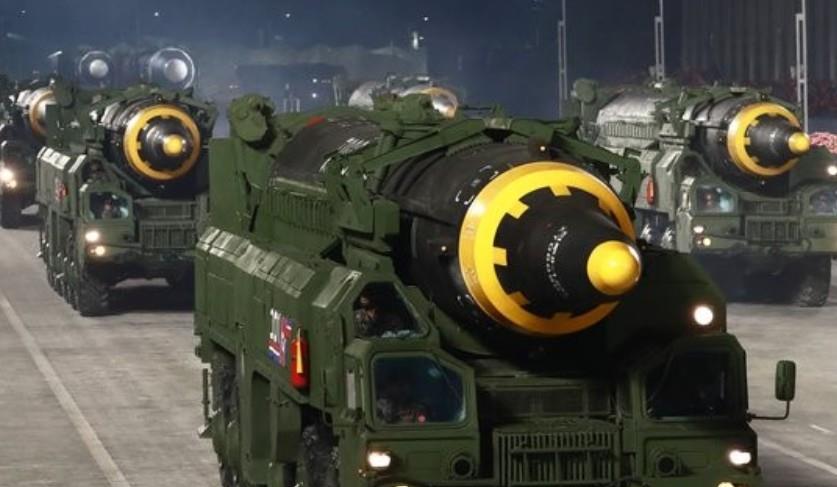
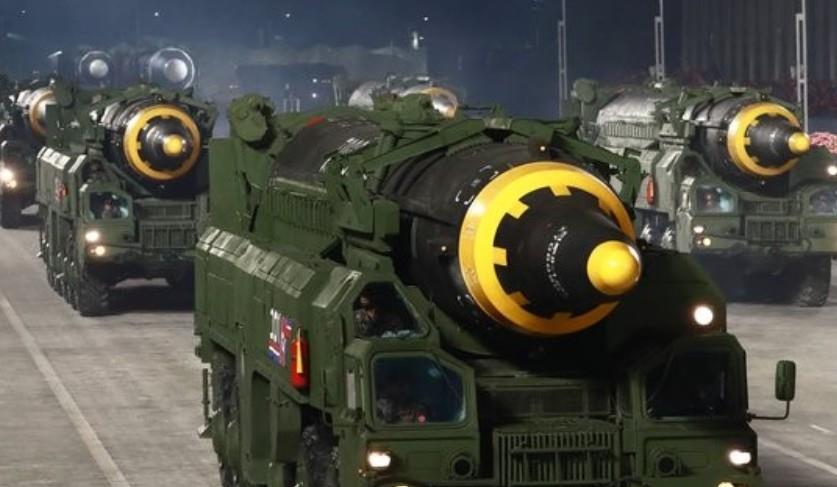
In its strategic arsenal, North Korea is developing ultra-long-range ICBMs beyond the Hwasong-14 and -15, including the Hwasong-17, 18, and 19. The Hwasong-17 runs on liquid fuel with a range over 15,000 km, while the 18 and 19 use three-stage solid fuel to enable faster launches.
These new ICBMs aim to target the entire continental U.S. In tandem, Pyongyang is boosting space surveillance, launching the Malligyong-1 satellite in 2023 and planning more.
The ground forces are adopting systems to improve precision strikes and mobility.
The M-2018 self-propelled gun now uses guided rounds instead of 122mm shells, and 240mm launchers have been upgraded for better accuracy.
North Korea has deployed a new K-11-style hybrid rifle and sniper rifles to elite units. Its armored forces were upgraded with the M-2020 tank and active protection systems on older Chonma-ho models. For anti-tank warfare, it introduced the M-2018 vehicle, modeled on Spike NLOS, and the guided M-2020 and M-2022 tactical rockets.
The navy is advancing tactical nuclear submarine capabilities and new surface ships.
In September 2023, North Korea revealed the Hero Kim Kun Ok, a modified Golf-class submarine, signaling the start of its push to expand nuclear submarine capabilities. Meanwhile, 3,000-ton warships under construction in Nampo and Chongjin suggest possible technology transfers from Russia.
A nuclear-powered submarine estimated at 6,000–7,000 tons is in development. While years from completion, Russian cooperation could speed up construction.
To counter aging aircraft, North Korea is boosting drones and air defense. It has unveiled the Saetbyul-4 (reconnaissance) and Saetbyul-9 (attack) drones, and reportedly ramped up suicide drone production following cooperation with Russia.
In air defense, North Korea tested the Byeoljji-1-2 in 2024—a two-stage surface-to-air missile that surpasses the Pongae-5. It is also reportedly negotiating for MiG-29 and Su-27 jets from Russia.
This military expansion is strongly tied to enhanced cooperation with Russia since 2023, which has provided both financial and technological support for nuclear and conventional modernization.
Modernization of the navy and air force, in particular, highlights how Russia–North Korea ties are raising the overall technological level of Pyongyang’s military.
In conclusion, North Korea is accelerating a dual-track buildup—enhancing nuclear and conventional capabilities simultaneously. This strategy presents a significant challenge to security on the Korean Peninsula and in Northeast Asia.
South Korea and its allies must closely monitor these changes and respond by strengthening layered defense systems and precision strike capabilities.