

State Control Over Food Distribution Could Trigger Market Backlash
Trends and Outlook of Food and Agriculture in North Korea

Kim Young-hoon
Korea Economic Cooperation Institute
Food Supply and Agricultural Policy in 2024
Last year, North Korea's food supply improved, mainly due to increased domestic production. In 2023, food production reached 4.82 million tons, up 6.8% from the previous year (Rural Development Administration, December 15, 2023).
As a result, domestic food supply in 2024 increased. However, it remains unclear whether grain imports also rose that year. Still, North Korea likely imported a substantial amount of Russian grain, leveraging the North-Russia treaty and the Russian war effort.
Despite the overall improvement in grain supply, grain prices surged in North Korean markets. This anomaly appears to be linked to increased government grain purchases and rising import prices due to a sharp currency devaluation.
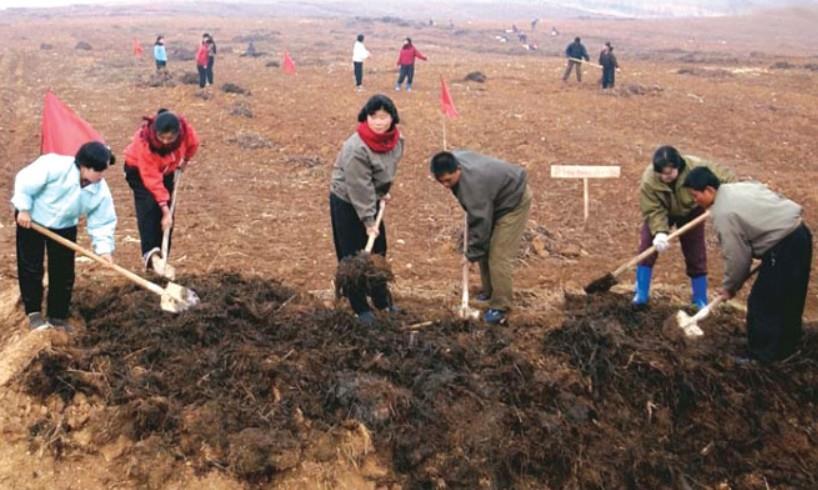
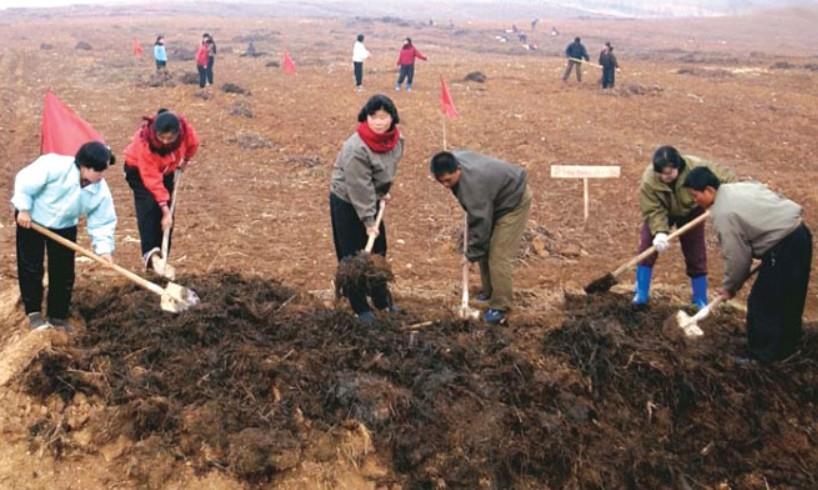
In 2024, North Korea's agricultural policy continued and strengthened the direction set in 2022. To implement the conservative agricultural strategy (New Era Socialist Rural Construction Program, December 2021), it was legalized with the establishment of the Socialist Rural Development Act in 2022.
Meanwhile, North Korea reinforced its agricultural management system, led by the Cabinet and Agricultural Commission, while defining specific goals and tasks for its agricultural policy.
Under this framework, the North Korean government focused on tasks like repairing irrigation systems, supplying farm machinery, promoting agricultural technology, and building rural housing and local factories.
Food Production in 2024
In 2024, North Korea's food crop production totaled 4.78 million tons, slightly down from 2023 by 40,000 tons (0.8%), but still above the average level (see table).
This was largely due to generally favorable agricultural weather. But, localized flooding occurred at the end of July, and slight heatwaves in August and September in certain areas likely caused a small decline in food crop production compared to the previous year.
<Table> 2024 North Korea Food Crop Production (Standardized Conversion)
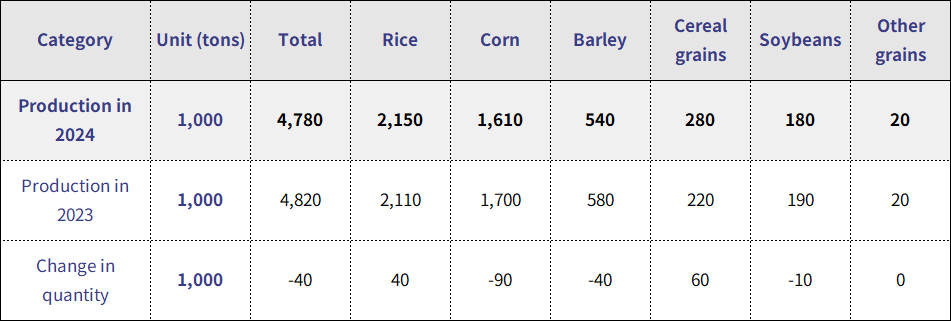
Source: Rural Development Administration, December 19, 2024
A notable event in North Korea's 2024 agriculture was the July flooding in the Sinuiju area along the Amnok River. Reports state that over 4,100 homes and 3,000 ha of farmland were flooded (Rodong Sinmun, July 31, 2024), and around 15,400 displaced people were relocated to Pyongyang (KCNA, August 10, 2024).
The international community has evaluated the impact of heavy rainfall on North Korea's crops in the year's second half. Organizations like FAO and Global Agricultural Monitoring found that while July's heavy rains were limited to a small area, agricultural conditions remained favorable before and after the flood.
The U.S. Department of Agriculture (USDA) estimated the July flood damage to be larger than reported by North Korea but believed it would have minimal impact on food crop production. Despite frequent large-scale natural disasters, the 2024 flood caused relatively limited damage.
Food Supply and Agricultural Production in 2025
North Korea's 2024 food production was forecasted based on agricultural weather, evaluations and projections from international observers, North Korea's own assessments, and crop estimates from South Korea's Rural Development Administration.
According to the forecast, North Korea's 2025 food supply is expected to be slightly lower than the previous year but still above the historical average.
Meanwhile, North Korea's agricultural production in 2025 is expected to remain similar to the previous year, as no significant policy changes have been observed.
According to KCNA (December 29, 2024), North Korea is maintaining its existing agricultural policy direction and has set similar agricultural goals and tasks as last year. Unless there are significant weather-related issues, North Korea's agricultural production in 2025 is expected to remain stable.
Uncertain Mid-to-Long-Term Outlook
Unlike the short-term outlook, the mid-to-long-term prospects for North Korean agriculture appear bleak. This is due to persistent, unresolved issues in the economy and agriculture, along with the emergence of new uncertainties not seen before.
There is a constant shortage of capital goods for agriculture, and the collective farming system hampers productivity. Recently, the government has reinforced its state grain procurement system, which contradicts reforms and suppresses the market.
North Korea's policy to limit food market trade is evident in the revised regulations. The 2021 amendment to the "Agriculture Act" specifically mandates the creation of both "food distribution centers" and "grain sales offices" (North Korean Agriculture Act, March 11, 2021).
The 2022 amendment introduced a new requirement to establish a separate procurement plan for securing the state’s grain sales supply (NK Economy, July 28, 2023).
The formalization of state-run grain sales will significantly impact North Korea’s food distribution, with signs of a shrinking grain market already emerging.
North Korea may shift towards increasing the sales share and reducing distribution in its food supply. If the state controls food distribution without managing capital goods, market resistance is likely to rise.
Close monitoring is needed regarding the potential instability and the likelihood of market resistance to changes in North Korea's food distribution.